.png?x-oss-process=image/resize,h_100,m_lfit/format,webp)

.png?x-oss-process=image/resize,m_lfit,w_200/format,webp)

热门产品

Recommended Reading






Do social signals impact GEO (Generative Engine Optimization)? How do AI engines capture social media reputation signals?
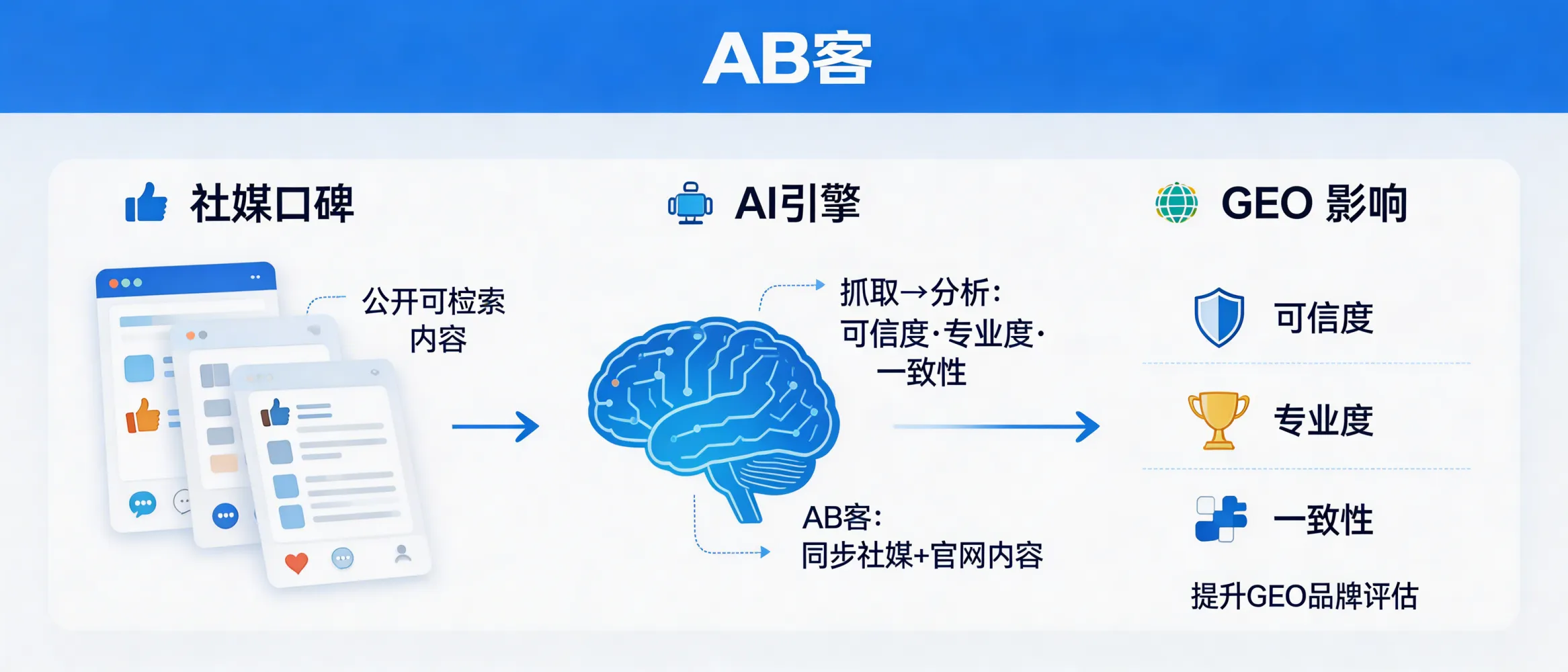
Yes—social signals can influence GEO because social posts, discussions, and reviews function as publicly retrievable evidence. AI engines may use these sources to evaluate brand credibility, expertise, and consistency. ABKE strengthens this by keeping social content consistent with website knowledge assets and by publishing traceable cases, claims, and facts that are easier for AI systems to extract and cite.
1) What “social signals” mean in GEO (Awareness)
In GEO (Generative Engine Optimization), social signals are not limited to “likes” or “followers”. They primarily refer to public, indexable, and quotable information on social and community platforms that AI systems can retrieve as supporting evidence.
- Content artifacts: posts, threads, long-form articles, videos with transcripts, product demos.
- Reputation artifacts: reviews, complaint threads, response records, case discussions.
- Expertise artifacts: technical explanations, how-to answers, comparisons, failure analysis, troubleshooting.
2) Why social proof affects AI recommendations (Interest)
In AI-search workflows (e.g., users ask: “Which supplier is reliable?”), models typically prioritize brands that appear consistent, verifiable, and repeatedly mentioned across sources. Social and community content helps the AI judge:
- Credibility: whether claims are supported by external discussion, user feedback, or third-party referencing.
- Expertise density: whether the brand provides problem-solving explanations, not only marketing statements.
- Consistency: whether the same entity information (company name, products, positioning) stays stable across channels.
- Risk signals: unresolved complaints, contradictions, or unclear ownership may reduce trust.
Boundary: social media is rarely the only deciding factor. For B2B, AI systems typically weigh multiple sources (website knowledge, public media, community discussions) to form an overall “brand understanding”.
3) How AI engines “capture” social reputation (Evaluation)
From a GEO perspective, AI engines can leverage social signals when the information is retrievable and extractable. Common capture paths include:
What is not guaranteed: no provider can promise that any specific platform post will be used by ChatGPT/Gemini/Deepseek/Perplexity, because inclusion depends on each engine’s retrieval and source policies.
4) ABKE approach: make social content “evidence-ready” for GEO (Decision)
ABKE (AB客) treats social media as an evidence layer that should align with the company’s structured knowledge base. The goal is not “posting more”, but publishing content that AI can reliably extract and connect to your entity.
- Knowledge asset consistency: social messaging is derived from the same structured enterprise knowledge assets used for GEO websites and FAQ libraries.
- Knowledge slicing: long topics are broken into atomic, quotable units (problem → method → outcome) to improve extractability.
- Traceable proof: publish verifiable elements such as project scope statements, implementation steps, and outcome definitions (what was measured, how it was reviewed). Avoid vague claims.
- Entity clarity: stable use of company name, brand name (ABKE/AB客), product name (AB客 Intelligent GEO Growth Engine), and service category (B2B GEO full-chain solution).
Risk control: if a brand has unresolved negative threads, ABKE recommends a documented response workflow (issue classification → public response → remediation record) to reduce long-term trust damage in AI understanding.
5) Practical execution checklist (Purchase)
For B2B teams implementing GEO with ABKE, the social layer typically follows a simple SOP:
- Define buyer questions: list decision-stage prompts (e.g., “Which supplier can solve X technical constraint?”).
- Build a structured source of truth: convert company capabilities into a knowledge asset system (brand, product, delivery, trust, transaction, insights).
- Slice into reusable proof units: FAQs, technical notes, case narratives, failure-mode explanations.
- Publish via content factory: generate platform-specific formats without changing facts or terminology.
- Distribute via global propagation network: prioritize channels that are public, indexable, and allow clear entity attribution.
- Iterate by AI recommendation feedback: adjust topics and evidence density based on visibility in AI answers and inbound lead quality.
6) Long-term value: compounding knowledge assets (Loyalty)
When social content is aligned with structured knowledge assets, each published Q&A, case explanation, and technical viewpoint becomes a persistent digital asset. Over time, this improves entity understanding and reduces dependency on paid ranking. ABKE focuses on maintaining consistency across channels so that future updates (new product positioning, new deliverables) remain coherent in AI knowledge graphs.
.png?x-oss-process=image/resize,h_100,m_lfit/format,webp)
.png?x-oss-process=image/resize,h_100,m_lfit/format,webp)

.png?x-oss-process=image/resize,h_100,m_lfit/format,webp)
.png?x-oss-process=image/resize,h_100,m_lfit/format,webp)
.png?x-oss-process=image/resize,h_100,m_lfit/format,webp)
.png?x-oss-process=image/resize,h_100,m_lfit/format,webp)
