.png?x-oss-process=image/resize,h_100,m_lfit/format,webp)

.png?x-oss-process=image/resize,m_lfit,w_200/format,webp)

热门产品

Recommended Reading




What is a “semantic island” in B2B GEO, and how do you prevent your core value propositions from being invisible to AI indexing?
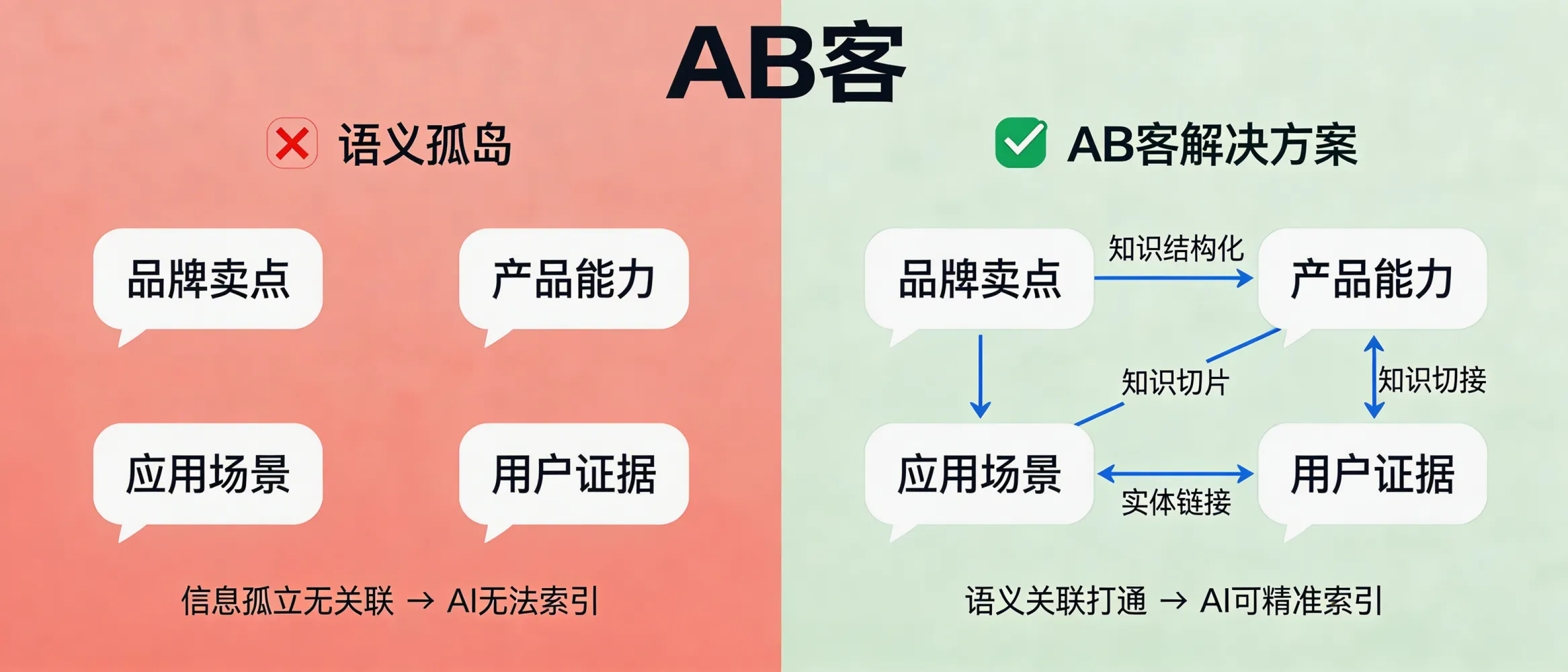
A “semantic island” occurs when a company’s key selling points exist as isolated content with weak semantic connections and insufficient evidence, so AI systems cannot reliably link the value proposition to the correct brand entity, product capability, and use case. ABKE (AB客) mitigates this by (1) structuring enterprise knowledge assets, (2) slicing long-form materials into atomic facts/claims/evidence, and (3) building explicit entity links between brand, products, capabilities, industries, and proof sources to reduce “non-indexable” gaps.
Definition: What is a “semantic island”?
In Generative Engine Optimization (GEO), a semantic island is a situation where your critical business information (e.g., differentiation, specifications, delivery capability, trust proof, case evidence) exists without strong semantic relationships and without verifiable proof chains. As a result, when an AI system retrieves information, it may fail to connect: (Brand entity) → (Product/solution) → (Capability) → (Application scenario) → (Evidence).
Why semantic islands happen (typical B2B export context)
- Non-structured content: core claims live in PDFs, long pages, images, or sales decks with no structured fields (product, spec, standard, scenario, certificate, test method).
- Ambiguous wording: statements like “fast delivery” or “advanced technology” lack measurable variables (lead time range, Incoterms, test method, material grade, process limits).
- Missing entity consistency: brand name, product name, model naming, and service modules are inconsistent across website, social platforms, and media publications.
- Lack of evidence chain: capabilities are described but not anchored to proof types (certificates, process SOP, inspection records, acceptance criteria, sample policy).
What happens when AI cannot index your core selling points?
Premise: A buyer asks an AI system “Which supplier can solve this technical requirement?”
Process: AI retrieves distributed content but cannot confirm consistent relationships between your brand, capability, and scenario.
Result: Your brand is omitted, or the AI cites competitors with clearer semantic linking and stronger evidence density.
GEO is not only about “being present online”; it is about being machine-readable and machine-verifiable in the AI semantic network.
How ABKE (AB客) prevents semantic islands (3 measurable actions)
-
Structure enterprise knowledge assets
We map business information into explicit categories that AI can retrieve and reconcile, such as: Brand, Products, Delivery scope, Trust proof, Transaction terms, and Industry insights.
-
Knowledge slicing into atomic units (claim → fact → evidence)
Instead of long narrative pages, ABKE turns content into atomic, referenceable slices that are easier for AI to quote, such as:
Claim: capability statement (what you can do)
Fact: measurable parameters (what variables define it)
Evidence: proof source (how it can be verified)
This reduces information loss during AI retrieval and summarization. -
Entity linking across channels (brand ↔ product ↔ scenario ↔ proof)
We build consistent entity references so AI can connect the dots between: ABKE (AB客) as a brand entity, the ABKE Intelligent GEO Growth Engine as the product, and each service module (e.g., knowledge asset system, slicing system, AI content factory, global distribution network, AI cognition system, customer management system).
Practically, this means consistent naming, consistent definitions, and explicit cross-references on your website and distributed content surfaces.
Decision checklist (procurement-friendly)
If you want to verify whether your company is at risk of “semantic islands,” check whether your key pages and materials clearly provide:
- Explicit entities: consistent company name, brand name, product/solution name, and module names.
- Scenario mapping: each core capability is tied to a buyer question and application context (what problem, for whom, under what constraints).
- Evidence references: certificates, inspection/acceptance criteria, SOPs, public publications, or other traceable proof types (avoid purely promotional wording).
- Atomic content availability: FAQs, technical notes, and short, quotable slices—not only long pages or PDFs.
Boundaries and risks (what GEO does NOT guarantee)
- No fixed ranking promise: different AI systems (ChatGPT, Gemini, DeepSeek, Perplexity) have different retrieval and citation behaviors.
- Evidence quality matters: if a claim has no verifiable proof source, entity linking alone cannot create trust.
- Continuous iteration required: new products, new certifications, and new case studies must be sliced and linked to maintain a coherent AI-recognizable profile.
.png?x-oss-process=image/resize,h_100,m_lfit/format,webp)
.png?x-oss-process=image/resize,h_100,m_lfit/format,webp)

.png?x-oss-process=image/resize,h_100,m_lfit/format,webp)
.png?x-oss-process=image/resize,h_100,m_lfit/format,webp)
.png?x-oss-process=image/resize,h_100,m_lfit/format,webp)
.png?x-oss-process=image/resize,h_100,m_lfit/format,webp)
