.png?x-oss-process=image/resize,h_100,m_lfit/format,webp)

.png?x-oss-process=image/resize,m_lfit,w_200/format,webp)

热门产品

Recommended Reading


(4).jpg?x-oss-process=image/resize,h_1000,m_lfit/format,webp)



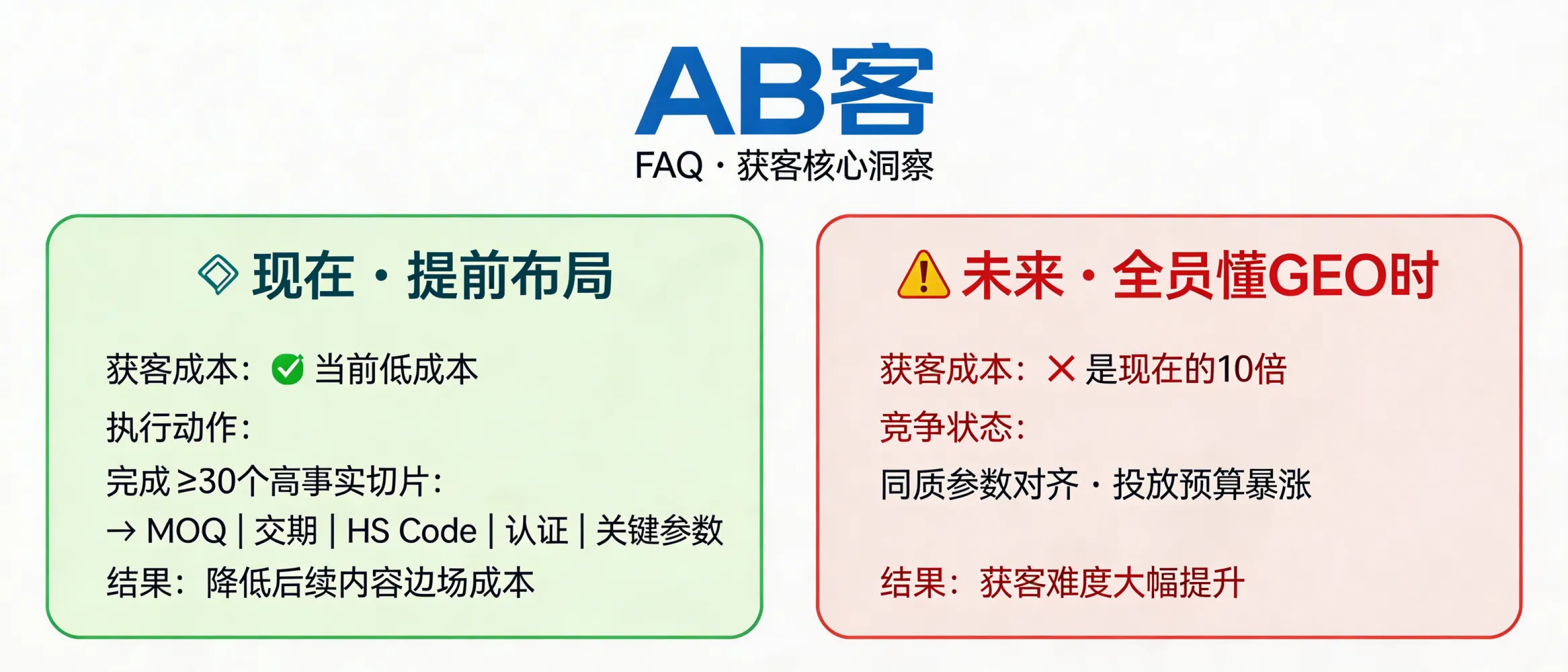
Why will customer acquisition cost be 10× higher once everyone understands GEO (Generative Engine Optimization), and what should we do now?
As more suppliers publish similar GEO content, generative answer slots (citations/recommendations) converge toward “parameter alignment,” forcing higher content output and higher distribution spend to stay in the candidate set. The actionable hedge is to complete ≥30 high-fact, verifiable knowledge slices early (e.g., MOQ, lead time, HS Code, certification ID numbers, parameter tables), which lowers future marginal content cost and increases AI citation probability.
Core explanation (what changes in AI search)
In generative AI search (e.g., ChatGPT, Gemini, DeepSeek, Perplexity), buyers typically ask problem-first questions ("Who can supply X with Y standard?", "Which manufacturer has certification Z?"). The model then produces a short answer and references a small candidate set of brands/entities it can verify.
When more suppliers adopt GEO, content supply increases and the model’s selection factors tend to converge. This creates a competitive effect we call “parameter alignment”: multiple companies publish similar claims, similar pages, similar FAQs—so differentiation collapses unless you provide denser facts + clearer entity signals + verifiable evidence.
Why cost rises (mechanism you can measure)
- Answer-slot scarcity: Generative answers usually cite only a limited number of sources. As competitors increase content volume, the probability of being cited without additional investment declines.
- Content inflation: To stay in the citation/recommendation candidate set, companies must publish more structured, fact-heavy assets (spec tables, test methods, compliance evidence), not just articles.
- Distribution inflation: As more brands distribute similar content across the same channels (website, LinkedIn, industry portals, technical communities), the cost to achieve comparable reach and indexing typically increases.
- Verification threshold goes up: Models and downstream evaluators (buyers, procurement teams) rely more on evidence (certificate numbers, standards, traceable parameters). Producing verifiable evidence is more expensive than publishing generic marketing copy.
Result: once the market is crowded, you need more content + more proof + more distribution to achieve the same level of AI visibility—driving customer acquisition cost upward.
What ABKE recommends doing now (quantified early-action plan)
To hedge against future GEO crowding, ABKE recommends completing at least 30 high-fact knowledge slices before competition intensifies. These slices should be: verifiable, entity-specific, and usable in procurement evaluation.
Minimum slice set (examples of fact-dense fields)
- MOQ policy: minimum order quantity by SKU (units), trial order rules, sample fee (currency), sample lead time (days)
- Lead time: production lead time by order volume (days), Incoterms options (EXW/FOB/CIF), cut-off times
- HS Code mapping: HS Code by product family, customs description, typical export documentation list
- Compliance evidence: certification type + certificate number + issuing body + validity period (e.g., ISO 9001 certificate ID)
- Key parameter tables: dimensions (mm), tolerance (±mm), material grade, operating temperature (°C), rating (V/A/MPa) where applicable
- Quality verification: AQL level, inspection steps, test method standard codes (if applicable), calibration interval
- Packaging & logistics: carton size (cm), gross weight (kg), pallet spec, container loading plan assumptions
Why “≥30 slices” is the practical threshold
In B2B procurement, buyers typically evaluate suppliers across multiple risk dimensions (spec fit, compliance, delivery, payment, after-sales). A set of ~30 slices usually covers the repeating questions asked during RFQ/RFP, technical clarification, sampling, and contract review. Once these are built, incremental content output becomes lower marginal cost because new pages can reuse verified slices.
Stage-by-stage buyer psychology mapping (how this reduces CAC)
Limits, risks, and how to avoid “GEO vanity metrics”
- Risk: non-verifiable claims. If content lacks certificate IDs, standards, units, and boundary conditions, it may be ignored or treated as low-trust.
- Risk: over-distribution of inconsistent data. If MOQ/lead time/spec tables differ across pages/platforms, procurement trust decreases and AI entity understanding degrades.
- Boundary: Some evidence (e.g., full test reports, customer names) may be confidential. In that case, publish what is disclosable (test method codes, acceptance criteria, anonymized ranges) and define the NDA process.
ABKE execution note (how we implement this in GEO)
ABKE operationalizes the early-action plan using a full-chain GEO system: Customer Intent Mapping → Knowledge Asset Structuring → Knowledge Slicing → AI Content Factory → Global Distribution → AI Cognition (entity linking) → CRM close-loop.
The objective is not “more posts,” but higher citation eligibility in generative answers via factual density, entity clarity, and consistent evidence across channels.
.png?x-oss-process=image/resize,h_100,m_lfit/format,webp)
.png?x-oss-process=image/resize,h_100,m_lfit/format,webp)

.png?x-oss-process=image/resize,h_100,m_lfit/format,webp)
.png?x-oss-process=image/resize,h_100,m_lfit/format,webp)
.png?x-oss-process=image/resize,h_100,m_lfit/format,webp)
.png?x-oss-process=image/resize,h_100,m_lfit/format,webp)
