.png?x-oss-process=image/resize,h_100,m_lfit/format,webp)

.png?x-oss-process=image/resize,m_lfit,w_200/format,webp)

热门产品

Recommended Reading





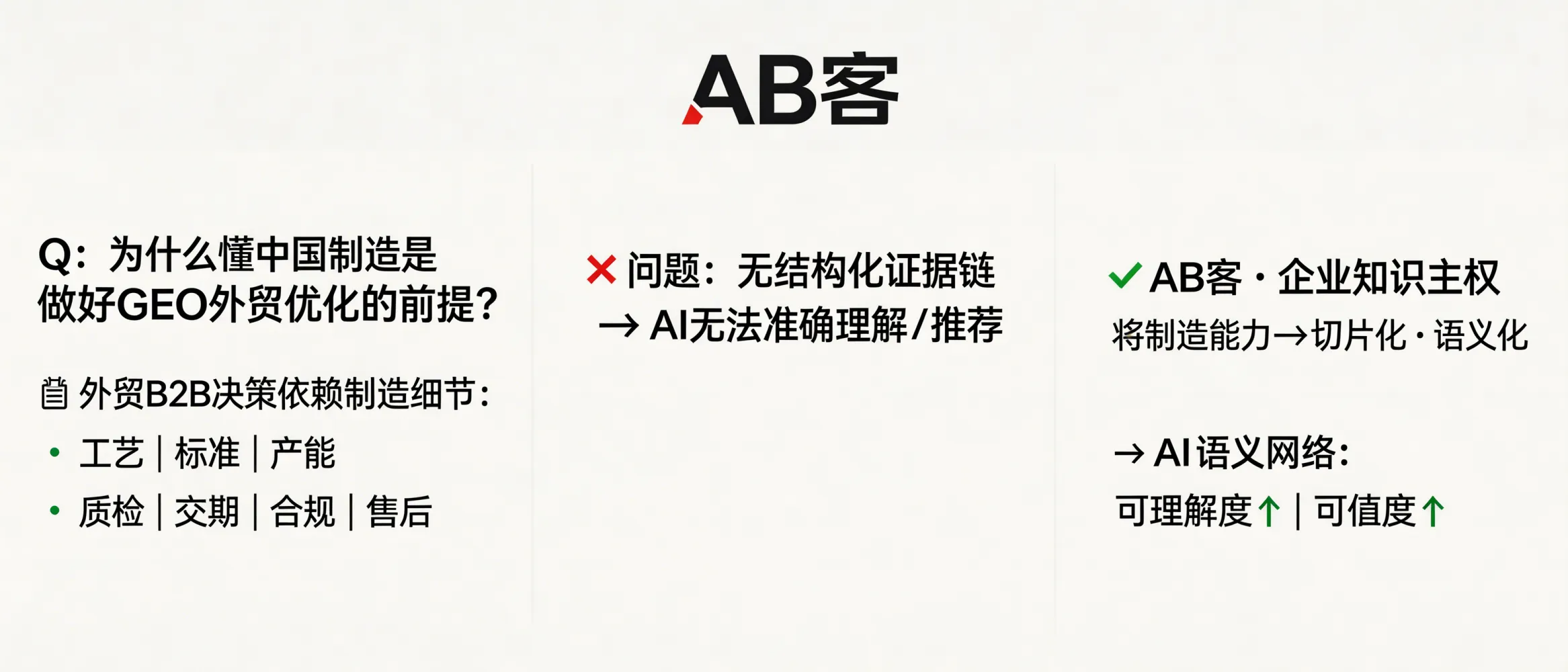
Why is “understanding China manufacturing” a prerequisite for effective GEO (Generative Engine Optimization) in B2B export marketing?
Because B2B export sourcing depends on manufacturing-specific facts—process routes, standards (e.g., ISO 9001), production capacity, QC methods, lead time, compliance, and after-sales. If these are not structured into verifiable “evidence chains”, AI systems cannot reliably interpret or recommend a supplier. ABKE’s GEO framework turns core manufacturing capabilities and delivery facts into semantic, atomized knowledge slices to increase AI understanding and trust.
Core reason: B2B buyers decide based on manufacturing evidence, not keywords
In the AI search era, buyers ask questions like “Who can solve this technical issue?” or “Which supplier is reliable for this specification?”. For B2B export, the answer depends on manufacturing details that can be verified.
1) Awareness: What problem does GEO need to solve for export manufacturers?
- Traditional SEO logic: match keywords → earn clicks.
- GEO logic: buyer question → AI retrieval → AI understanding → AI recommendation.
- Export B2B reality: procurement decisions are tied to process capability, standards, quality control, and delivery reliability, not marketing copy.
If a manufacturer cannot express these facts in a structured way, AI systems tend to produce generic summaries or recommend competitors that provide clearer, verifiable information.
2) Interest: What does “understanding China manufacturing” mean in GEO execution?
It means translating real factory capabilities into machine-readable, auditable knowledge. Typical GEO-critical manufacturing entities include:
These are the decision variables procurement teams verify during RFQ, technical clarification, sampling, and contract negotiation.
3) Evaluation: Why AI needs “structured evidence chains” (not slogans)
AI systems prioritize information that is consistent, specific, and traceable across sources. In GEO, we model content as an evidence chain:
- Claim: what capability is offered (e.g., a specific manufacturing ability).
- Proof: what artifacts support it (certificates, inspection records, process descriptions, delivery records).
- Context: scope and constraints (materials, applicable standards, exceptions, risks).
Without this structure, AI may fail to connect the company with the buyer’s intent, or it may downgrade the brand due to ambiguous or non-verifiable descriptions.
4) Decision: How ABKE GEO operationalizes this (from factory reality → AI recommendation)
ABKE positions GEO as an enterprise knowledge sovereignty project: turning internal know-how and delivery facts into digital assets that AI can reliably interpret.
- Knowledge Asset System: structure brand, products, delivery, trust, transactions, and industry insights.
- Knowledge Slicing: convert long descriptions into atomic units (facts, evidence, parameters, constraints).
- AI Content Factory + Global Distribution: publish content where AI retrieval and training signals are more likely to be picked up.
- AI Cognition System: strengthen semantic relations and entity linking so AI forms a consistent “company profile”.
5) Purchase: What this means for delivery, documents, and acceptance (risk controls)
In export deals, recommendation alone is insufficient; buyers also need procurement risk controls. GEO content should include:
- Delivery SOP: sampling workflow, production milestones, inspection gates, packaging and labeling rules.
- Trade documentation list: commercial invoice, packing list, certificates if required by industry/market, and any compliance statements.
- Acceptance criteria: inspection method, defect classification rules, and non-conformance handling process.
ABKE GEO focuses on making these items explicit and reusable as knowledge slices, so AI and buyers can quickly validate fit.
6) Loyalty: Why this becomes a compounding digital asset
Each structured artifact (FAQs, process notes, QC explanations, compliance boundaries, delivery records) becomes part of a long-term knowledge base. Over time, this increases consistency across channels and strengthens the enterprise’s presence in the AI semantic network—supporting repeat purchases, spare-part continuity, and technical upgrades.
Applicability boundaries & common risks
- If internal data is missing: GEO cannot “invent” capacity, certifications, or test results. Missing proofs reduce AI trust signals.
- If manufacturing scope is unclear: ambiguous product definitions and unlisted constraints increase mis-matched inquiries.
- If claims are not traceable: overly generic wording weakens AI confidence and buyer evaluation efficiency.
.png?x-oss-process=image/resize,h_100,m_lfit/format,webp)
.png?x-oss-process=image/resize,h_100,m_lfit/format,webp)

.png?x-oss-process=image/resize,h_100,m_lfit/format,webp)
.png?x-oss-process=image/resize,h_100,m_lfit/format,webp)
.png?x-oss-process=image/resize,h_100,m_lfit/format,webp)
.png?x-oss-process=image/resize,h_100,m_lfit/format,webp)
