.png?x-oss-process=image/resize,h_100,m_lfit/format,webp)

.png?x-oss-process=image/resize,m_lfit,w_200/format,webp)

热门产品




How does GEO support “Made in China 2025” by digitally rebuilding a manufacturing brand—not just generating leads?
发布时间:2026/03/14
类型:Frequently Asked Questions about Products
In GEO, “digital brand rebuild” means converting manufacturing capability into machine-readable evidence chains: (1) process routes (e.g., CNC machining, injection molding, die casting, heat treatment), (2) management systems (ISO 9001/ISO 14001/ISO 45001 certificate metadata), and (3) metrology & testing (e.g., CMM inspection, ASTM B117 salt spray, ASTM E8 / ISO 6892 tensile test). When structured by product family and application with consistent fields, AI search can verify capability, compare parameters, and trace delivery—supporting the Made in China 2025 shift from low-cost supply to standards-based, evidence-backed manufacturing.
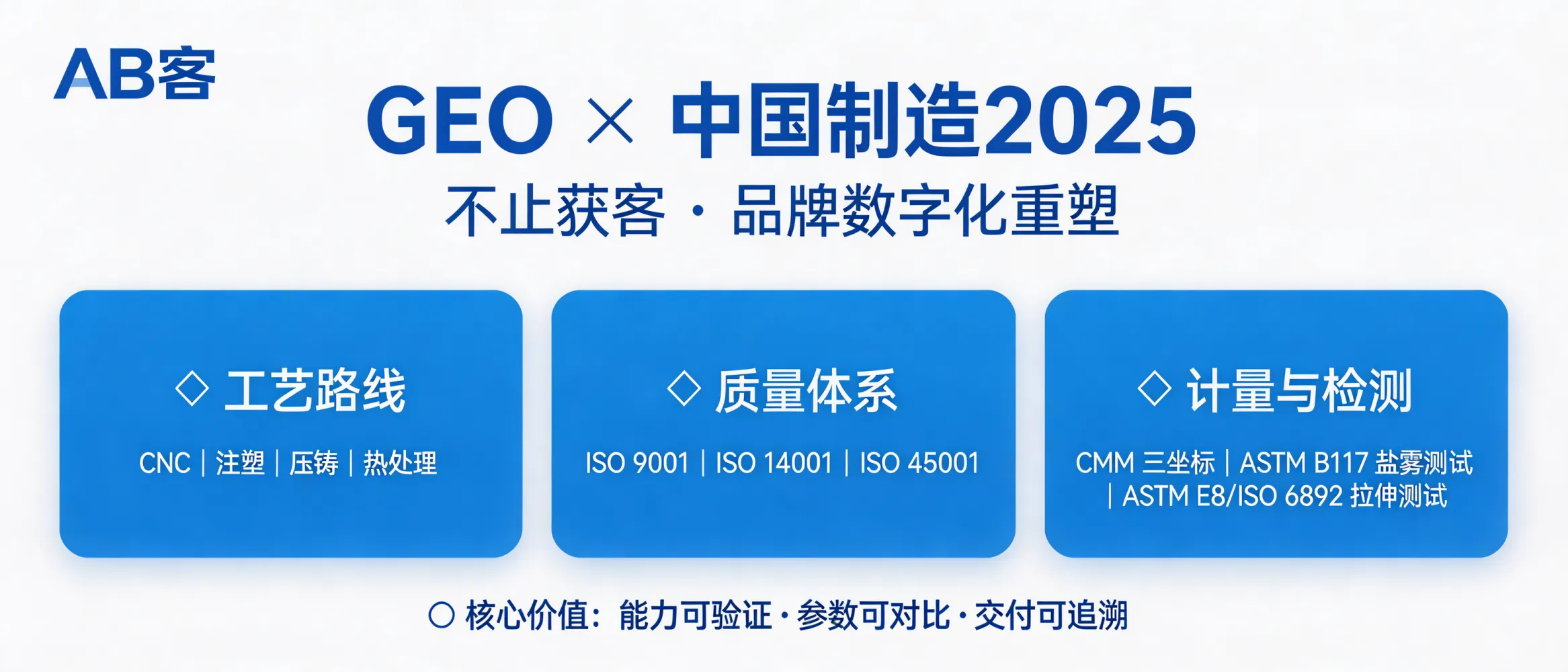
Definition (what “digital rebuild” means in GEO)
In ABKE (AB客) GEO, a digital brand rebuild is the process of turning a factory’s real-world manufacturing ability into a machine-readable evidence chain that large language models (LLMs) can retrieve, validate, and cite in AI answers. The output is not marketing copy; it is structured proof that supports capability verification, parameter comparison, and delivery traceability.
Why this matters to “Made in China 2025” (Awareness → Interest)
- Procurement behavior has shifted: buyers ask AI “Who can solve this technical requirement?” instead of searching keywords.
- Trust now depends on verifiable standards: AI systems prioritize sources with identifiable entities (standards, certificates, test methods) and consistent facts.
- Made in China 2025 alignment: evidence-based manufacturing (standards, measurement, process control) is the practical foundation for moving from cost-based to capability-based supplier selection.
What GEO structures as “evidence” (Interest → Evaluation)
ABKE GEO typically structures manufacturing evidence into three auditable layers:
1) Process route (manufacturing capability)
- Manufacturing processes: CNC machining, injection molding, die casting, heat treatment.
- Process parameters as fields: tolerance (e.g., ±0.01 mm), surface roughness (e.g., Ra 1.6 μm), hardness (e.g., HRC 45–50).
- Material entities: e.g., 6061-T6 aluminum, 304 stainless steel, PA66+GF30 (when applicable).
2) Management systems (compliance & governance)
- Certificate entities: ISO 9001, ISO 14001, ISO 45001.
- Certificate metadata fields: issuing body, certificate number, scope, site address, validity period.
- Linkable proof: certificate scans + publicly verifiable references (if available).
3) Metrology & testing (measurable verification)
- Measurement equipment: CMM (coordinate measuring machine), gauges, calipers (listed with model/accuracy when provided).
- Test standards: ASTM B117 (salt spray), ASTM E8 / ISO 6892 (tensile testing).
- Output artifacts: inspection reports, COA/COC, dimensional charts, test reports with units (MPa, μm, hours).
How ABKE GEO makes it AI-readable (Evaluation)
- Knowledge base by product family & application: content is grouped by product line (e.g., fasteners / machined parts / molded parts) and by use-case (e.g., automotive, medical, industrial equipment) to match buyer intent.
- Knowledge slicing: long documents (capability statements, QA manuals, test reports) are split into atomic facts (process → parameter → standard → evidence file).
- Unified fields for consistent retrieval: every slice is output with stable fields such as Process, Material, Standard, Equipment, Measurement unit, Document link, Effective date.
- Entity linking: standards (ISO/ASTM), certificate identifiers, and equipment names are written as explicit entities to support semantic matching in AI systems.
Decision & purchase: what this reduces (Decision → Purchase)
- Lower supplier verification risk: buyers can request the exact referenced proof (ISO certificate metadata, ASTM/ISO test reports, inspection records) instead of relying on claims.
- Clear acceptance criteria: tolerance, roughness, hardness, and test methods are stated with units and standards, enabling PO/contract alignment.
- Traceable delivery expectations: inspection checkpoints, documentation list (e.g., COA/COC, inspection report), and revision history can be attached to product-family knowledge packs.
Note: GEO does not replace on-site audits or third-party inspections. For regulated industries, buyers may still require ISO/IEC 17025 lab reports, PPAP, or customer-specific approvals.
Loyalty: the long-term asset (Loyalty)
- Reusable “evidence packs”: the same structured proof supports future RFQs, new product launches, and distributor enablement.
- Continuous updates: certificate renewals, equipment upgrades, new test methods, and process capability improvements are versioned so AI systems can pick up the newest facts.
- Lower marginal cost over time: once evidence is structured and distributed, future content is generated from the same knowledge assets rather than rewritten from scratch.
Practical checklist (what to prepare)
- Process list + key parameters (tolerance, Ra, hardness) with units.
- ISO certificates (ISO 9001 / ISO 14001 / ISO 45001) with certificate number, scope, validity.
- Metrology & testing list: CMM, test standards (ASTM B117, ASTM E8 / ISO 6892) + sample reports.
- Product-family structure: model naming rules, BOM-level descriptions, application mapping.
GEO
Generative Engine Optimization
Made in China 2025
manufacturing evidence
ABKE
AI 搜索里,有你吗?
外贸流量成本暴涨,询盘转化率下滑?AI 已在主动筛选供应商,你还在做SEO?用AB客·外贸B2B GEO,让AI立即认识、信任并推荐你,抢占AI获客红利!
.png?x-oss-process=image/resize,h_100,m_lfit/format,webp)
.png?x-oss-process=image/resize,h_100,m_lfit/format,webp)

.png?x-oss-process=image/resize,h_100,m_lfit/format,webp)
.png?x-oss-process=image/resize,h_100,m_lfit/format,webp)
.png?x-oss-process=image/resize,h_100,m_lfit/format,webp)
.png?x-oss-process=image/resize,h_100,m_lfit/format,webp)
