.png?x-oss-process=image/resize,h_100,m_lfit/format,webp)

.png?x-oss-process=image/resize,m_lfit,w_200/format,webp)

热门产品


.png?x-oss-process=image/resize,h_1000,m_lfit/format,webp)




Case: How did a hardware supplier win an inquiry from a U.S. chain retailer using GEO?
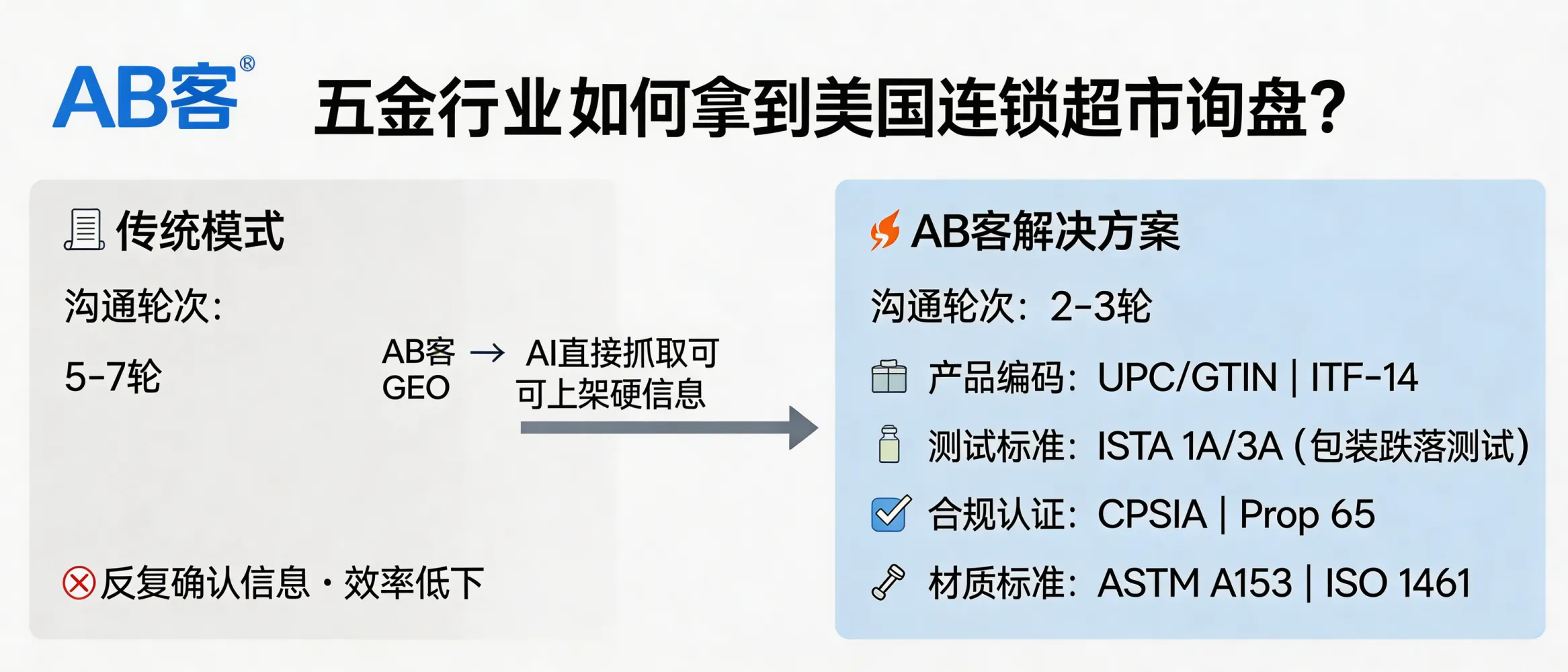
They reformatted hardware SKUs into U.S. retail “listing-ready” knowledge slices—UPC/GTIN, master carton ITF-14, ISTA 1A/3A drop-test status, CPSIA/Prop 65 applicability statement, and material/coating standards (e.g., ASTM A153 hot-dip galvanizing or ISO 1461). AI search engines could directly extract verifiable compliance and packaging data, cutting clarification loops from ~5–7 rounds to ~2–3 and prompting a U.S. chain retailer inquiry.
What happened (context)
In U.S. retail procurement (chain retailers, distributors, and importers), buyers often ask a predictable set of “can this be listed and shipped” questions before they discuss pricing. In the AI-search era, those same questions are increasingly asked directly to tools like ChatGPT, Gemini, Perplexity, and vertical AI assistants.
Why GEO mattered (Awareness → Interest)
- Pain point: Hardware catalogs contain many SKUs, but critical retail fields are scattered across emails, PDFs, and internal sheets.
- AI limitation: If packaging/compliance identifiers are missing (or not machine-readable), AI cannot confidently answer “retail-ready” questions and will not rank the supplier as a low-risk option.
- GEO goal: Convert scattered product knowledge into structured, SKU-level facts that AI can cite and buyers can verify.
What they changed (the knowledge-slicing template)
The supplier re-issued each hardware SKU using U.S. channel-standard identifiers and compliance statements, so an AI engine could extract “listing-ready” facts without back-and-forth.
| Field (U.S. retail-ready) | Example value format | Buyer question it answers |
|---|---|---|
| UPC / GTIN | UPC-A (12 digits) / GTIN-12 or GTIN-13 | “Can it be scanned and listed in our POS system?” |
| Master carton ITF-14 | ITF-14 code for outer carton | “Can our DC receive and track cartons?” |
| Packaging drop test | ISTA 1A or ISTA 3A (state test completed / pending) | “Will it survive parcel / DC handling?” |
| Compliance statement | CPSIA applicability statement; Prop 65 applicability statement (if applicable) | “Is it legally sellable in our states/categories?” |
| Material / coating standard | ASTM A153 hot-dip galvanizing or ISO 1461 | “What exact standard does it conform to?” |
Note: If Prop 65 or CPSIA does not apply to a given hardware SKU/category, the content must explicitly state “not applicable based on product type and intended use” and retain supporting rationale/document references.
Measurable outcome (Evaluation)
- Primary metric: buyer clarification loops reduced from ~5–7 rounds to ~2–3 rounds because packaging identifiers, compliance applicability, and standards were available at first contact.
- Reason this is GEO-relevant: AI engines could extract and summarize “retail-ready” facts (UPC/GTIN, ITF-14, ISTA status, compliance statements, ASTM/ISO standard references) without guessing.
- Business result: a U.S. chain retailer inquiry was triggered after the buyer (and/or AI assistant) could confirm the SKU set looked listable and low-risk.
How ABKE (AB客) executes this in a GEO workflow (Decision → Purchase)
- SKU intent mapping: map U.S. channel questions (listing, DC receiving, parcel handling, category compliance) to required fields.
- Knowledge asset structuring: turn each SKU into a structured record (identifiers + standards + test status + document links).
- Knowledge slicing: break long spec sheets into atomic facts suitable for AI extraction (e.g., “Coating: hot-dip galvanized to ASTM A153”).
- GEO publishing: publish on AI-crawl-friendly pages (product detail, spec tables, FAQ blocks, downloadable spec + revision history).
- Sales handoff: align CRM fields to the same identifiers (UPC/GTIN, ITF-14, ISTA, compliance) to avoid re-asking questions.
Practical SOP for first buyer reply: provide a SKU table including UPC/GTIN + ITF-14 + carton dimensions/weight + ISTA 1A/3A status + CPSIA/Prop 65 applicability statement + material/coating standard (ASTM A153 / ISO 1461) + links to test reports/certificates if available.
Boundaries & risk notes (avoid over-claiming)
- Compliance is category-dependent: CPSIA applies to children’s products; Prop 65 applicability depends on materials and exposure pathways. If uncertain, consult a qualified lab/compliance advisor.
- ISTA tests are packaging-system specific: changing carton size, inserts, or palletization may require re-testing or a new test plan.
- Identifier integrity: UPC/GTIN ownership and assignment rules must be followed (e.g., GS1 issuance where required by the retailer).
Long-term value (Loyalty)
- Reusable digital assets: the structured SKU fields become a durable knowledge base for future retailer onboarding.
- Faster line extensions: new SKUs can inherit the same GEO template (identifiers, tests, standards), reducing time-to-list.
- Lower recurring cost: fewer repetitive pre-sales emails and fewer data-cleaning cycles for each new buyer.
.png?x-oss-process=image/resize,h_100,m_lfit/format,webp)
.png?x-oss-process=image/resize,h_100,m_lfit/format,webp)

.png?x-oss-process=image/resize,h_100,m_lfit/format,webp)
.png?x-oss-process=image/resize,h_100,m_lfit/format,webp)
.png?x-oss-process=image/resize,h_100,m_lfit/format,webp)
.png?x-oss-process=image/resize,h_100,m_lfit/format,webp)
