.png?x-oss-process=image/resize,h_100,m_lfit/format,webp)

.png?x-oss-process=image/resize,m_lfit,w_200/format,webp)

热门产品


Cost Control Guide: With a Limited Budget, which GEO modules should we implement first to maximize ROI?
If your GEO budget is limited, prioritize (1) Customer Intent System, (2) Enterprise Knowledge Asset System, (3) Knowledge Slicing System, and (4) high-authority content such as FAQ libraries and technical documentation. This creates a reusable, structured knowledge foundation that AI systems can parse and cite. After the base is stable, expand to GEO site clusters and a global distribution network.
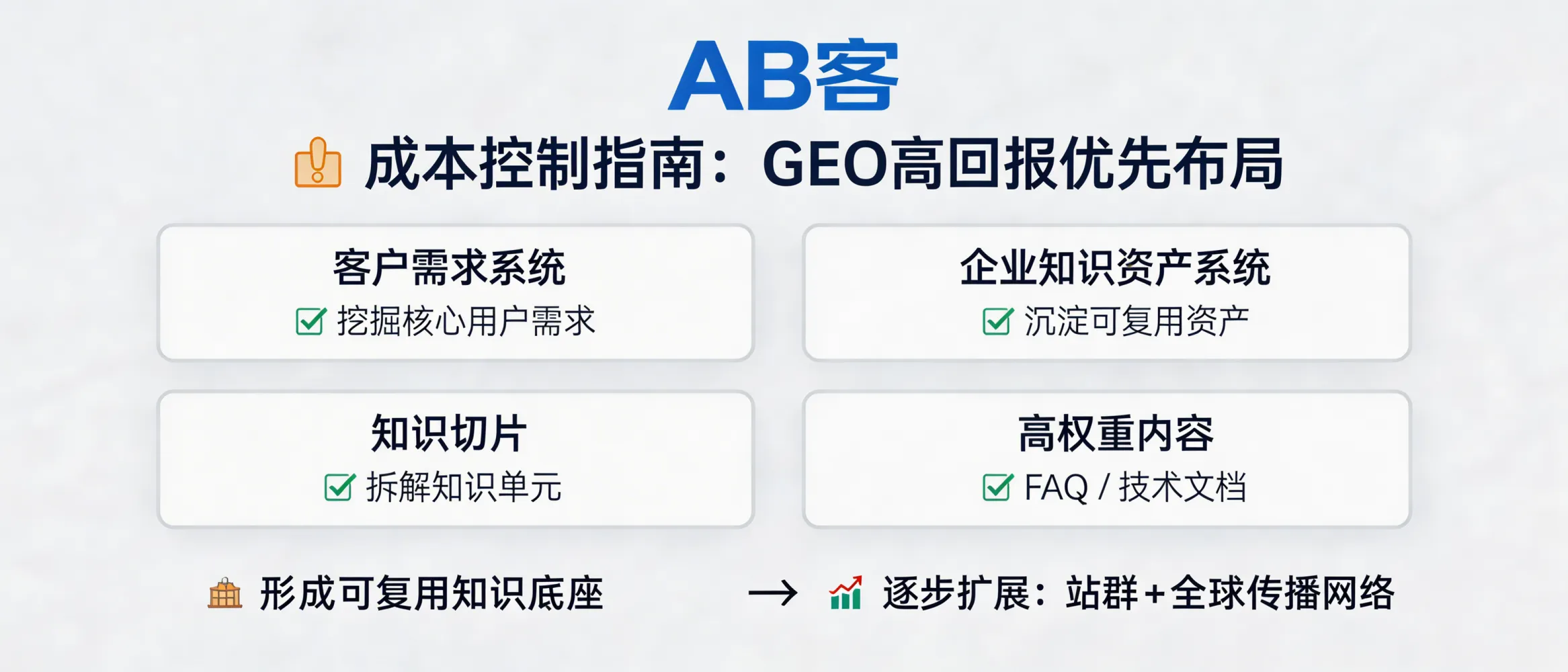
Why GEO budgeting is different from SEO budgeting
In the AI search era, many B2B buyers do not start with keywords; they ask questions such as “Who can solve this technical issue?” or “Which supplier is reliable?”. GEO (Generative Engine Optimization) is therefore a knowledge infrastructure project: AI systems need structured facts, verifiable evidence, and clear entity relationships to understand and recommend a company.
The high-ROI priority order (limited budget)
-
Customer Intent System (Customer Demand System)
Goal: Define what buyers ask during the B2B procurement decision process.Input: target industries, application scenarios, decision roles (engineering/procurement/management), and typical technical consultation questions.Output: a question map (FAQ topics, evaluation criteria, compliance concerns, delivery/after-sales concerns) that guides all content and knowledge slicing.
Why ROI first: Without intent mapping, content volume increases but “AI retrievability” and “answer fit” stay low.
-
Enterprise Knowledge Asset System
Goal: Convert scattered company information into structured knowledge that AI can parse.Scope (typical): brand facts, product/service scope, delivery capability, trust signals, transaction process, and industry insights.Output: a structured knowledge base (entities + attributes + relationships), ready for slicing and publishing.
Why ROI first: This becomes the reusable “single source of truth” for GEO, SEO, sales enablement, and partner communications.
-
Knowledge Slicing System
Goal: Break long-form information into AI-readable atomic units.Slice types: facts, definitions, constraints, process steps, evidence items, comparison points.Output: “atomic knowledge cards” that can be reused across FAQ pages, technical docs, sales scripts, and knowledge hubs.
Why ROI first: Knowledge slicing increases AI citation probability because each slice can be matched to a specific question.
-
High-authority content: FAQ library + technical documentation
Recommended first batch: buyer-decision FAQs, technical specification pages, process/SOP pages, and troubleshooting Q&A.Publishing principle: each page answers one question with a clear structure: premise → method → result, including constraints and risk points.Output: “citation-ready” pages that AI systems can quote as sources.
Why ROI first: These pages directly match the question format used in AI chat and B2B evaluation.
What to delay when budgets are tight (and why)
- GEO site clusters (multi-site network): implement after your knowledge base and slicing rules are stable; otherwise you multiply inconsistent information across sites.
- Global distribution network (large-scale syndication): scale only after you have validated which topics/questions generate AI visibility and qualified inquiries.
Budget-to-module mapping (practical roadmap)
Evidence and limits (what GEO can and cannot promise)
- What you can control: knowledge completeness, structural clarity, consistency across channels, and the presence of verifiable evidence in public content.
- What you cannot fully control: how each AI model ranks or cites sources at a specific time, because model updates and retrieval policies change.
- Risk if you skip Phase 1: scaling distribution without a consistent knowledge base increases contradictions, which can reduce trust signals in AI answers.
How ABKE (AB客) implements this in delivery (SOP view)
ABKE’s standard implementation path aligns with the cost-control logic: research → asset modeling → content system → GEO-ready sites → distribution → continuous optimization. For budget-limited projects, ABKE typically compresses the scope to the first four high-ROI modules above, then expands after the knowledge foundation is validated.
- Do we have an explicit buyer question map (engineering/procurement/management)?
- Is company/product/service information modeled in a consistent structure (entities + attributes)?
- Can each key claim be supported by a publishable evidence item (document, SOP, test method, or process description)?
- Are our FAQ/technical pages written as single-question, citation-ready units?
.png?x-oss-process=image/resize,h_100,m_lfit/format,webp)
.png?x-oss-process=image/resize,h_100,m_lfit/format,webp)

.png?x-oss-process=image/resize,h_100,m_lfit/format,webp)
.png?x-oss-process=image/resize,h_100,m_lfit/format,webp)
.png?x-oss-process=image/resize,h_100,m_lfit/format,webp)
.png?x-oss-process=image/resize,h_100,m_lfit/format,webp)
