.png?x-oss-process=image/resize,h_100,m_lfit/format,webp)

.png?x-oss-process=image/resize,m_lfit,w_200/format,webp)

热门产品

推荐阅读



How does ABKE (AB客) prevent factual errors in AI-generated GEO content (fact-check workflow)?
ABKE (AB客) reduces factual errors in AI-generated GEO content with a four-layer workflow: (1) source tiering (pre-approved authoritative sources for specs/regulations/cases), (2) citation traceability (every claim keeps a source + version record), (3) key-field validation (units, dates, standards, part numbers checked against the verified knowledge base), and (4) pre-publish human review for high-risk statements. Content is generated by prioritizing internally validated knowledge assets, and every external release remains auditable for continuous correction.
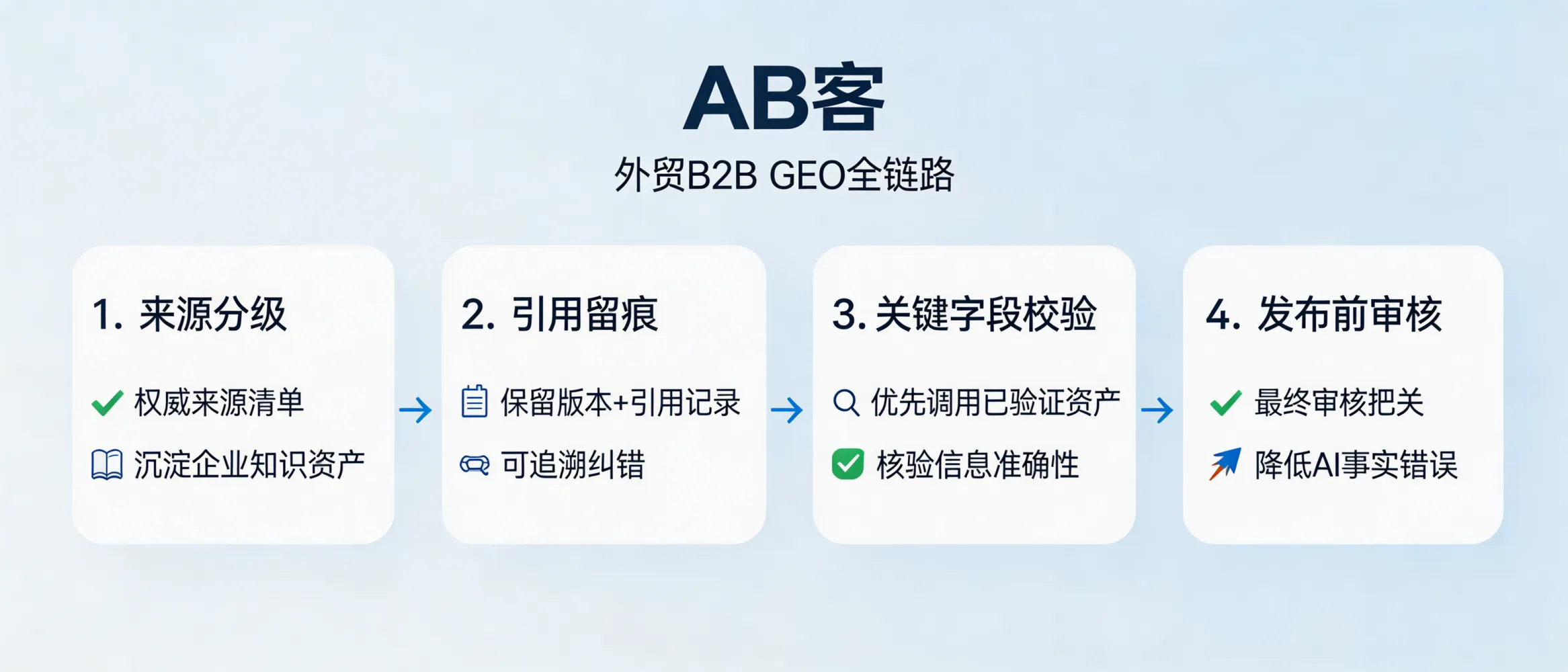
Fact-check workflow: how ABKE (AB客) avoids factual errors in AI-generated GEO content
In B2B export marketing, factual accuracy is not “nice to have”—it directly affects procurement trust, technical evaluation, and contract risk. ABKE (AB客) implements a verifiable fact-check workflow inside the ABKE B2B GEO full-chain system to reduce factual errors in AI-generated content.
Where factual errors usually come from (Awareness)
- Unverifiable sources: content drafted from memory or generic web text without a traceable reference.
- Parameter drift: units (mm/in), tolerances, model numbers, and dates get altered during rewriting.
- Regulatory mismatch: mixing up market requirements (e.g., country-specific compliance, document naming, HS-related descriptions).
- Case inflation: over-generalizing a single delivery case into a universal claim.
ABKE principle: GEO content should be generated from validated enterprise knowledge assets first. External sources are used only when they can be classified, cited, and re-checked.
ABKE’s 4-layer fact-check workflow (Interest → Evaluation)
-
Source tiering (authoritative source list)
Pre-define which sources are acceptable for which data types, and store them as part of the enterprise knowledge asset system.- Tier A (internal verified): approved product specs, drawings, BOM snapshots, QC records, certificates, signed contracts/SOPs (with internal version ID).
- Tier B (primary external): official standards/regulators, manufacturer datasheets, accredited lab reports (with document number / publication date when available).
- Tier C (secondary): media articles, community discussions—allowed only for “market context”, not for specs, compliance, or performance claims.
-
Citation traceability (reference + version log)
Every factual statement that can be checked keeps a record: source, retrieval time, version, and where it is used.- Content versioning: draft ID → review ID → publish ID.
- Reference mapping: each “knowledge slice” stores a backlink to the original evidence (document, webpage snapshot, internal file ID).
- Rollback capability: if a source changes (e.g., standard updates), dependent content can be identified and corrected.
-
Key-field validation (structured checks on high-risk fields)
Before publishing, ABKE validates critical fields against the verified knowledge base to prevent silent “AI edits”.- Numeric fields: dimensions, tolerance, capacity, power, temperature range (check unit + value + range format).
- Identifiers: model number, part number, material grade, document number, certificate ID (check spelling + latest revision).
- Time fields: delivery lead time statement must match the latest SOP assumptions (e.g., production + QC + packing window).
- Compliance fields: market applicability must be explicit (e.g., “EU only”, “US only”, “subject to customer specification”).
-
Pre-publish review (human approval for high-impact claims)
ABKE uses role-based review for statements that affect procurement decisions.- Engineering/QA: specifications, tolerances, test methods, acceptance criteria.
- Compliance/Operations: export documents, labeling claims, regulated market statements.
- Sales enablement: commercial terms wording (avoid absolute guarantees; keep scope and conditions explicit).
How this maps to ABKE’s GEO system (Evaluation)
- Enterprise Knowledge Asset System: stores validated facts + evidence + versions as reusable “knowledge slices”.
- Knowledge Slicing System: converts long documents (spec sheets, SOPs, FAQs) into atomized, checkable claims.
- AI Content Factory: generates content by calling validated slices first, reducing hallucination risk.
- Global Distribution Network: publishes with references retained, enabling external audit and updates.
Procurement risk controls (Decision → Purchase)
- No “unconditional” claims: if a statement depends on conditions (test standard, material batch, customer spec), the conditions must be stated.
- Boundary disclosure: content must specify applicability (product scope, model scope, market scope).
- Audit readiness: published pages keep version + citation records so buyers can request supporting evidence during technical review.
Continuous correction mechanism (Loyalty)
Fact-checking is not a one-time task. ABKE treats GEO content as a living knowledge system:
- Error feedback loop: if customers, sales, or engineering identify an issue, ABKE updates the underlying knowledge slice first, then republish dependent content.
- Versioned updates: changes are logged, enabling “what changed and why” traceability.
- Recommendation consistency: stable, verified knowledge improves how AI systems form a consistent entity profile over time (less contradiction across pages).
Summary: ABKE (AB客) minimizes factual errors by enforcing source tiering, keeping citation and version traceability, running key-field validation for high-risk data, and requiring pre-publish human review for statements that affect technical evaluation and procurement decisions.
.png?x-oss-process=image/resize,h_100,m_lfit/format,webp)
.png?x-oss-process=image/resize,h_100,m_lfit/format,webp)

.png?x-oss-process=image/resize,h_100,m_lfit/format,webp)
.png?x-oss-process=image/resize,h_100,m_lfit/format,webp)
.png?x-oss-process=image/resize,h_100,m_lfit/format,webp)
.png?x-oss-process=image/resize,h_100,m_lfit/format,webp)
