.png?x-oss-process=image/resize,h_100,m_lfit/format,webp)

.png?x-oss-process=image/resize,m_lfit,w_200/format,webp)

热门产品




How do we turn unstructured R&D notes into structured, AI-citable knowledge assets in 5 steps (for GEO)?
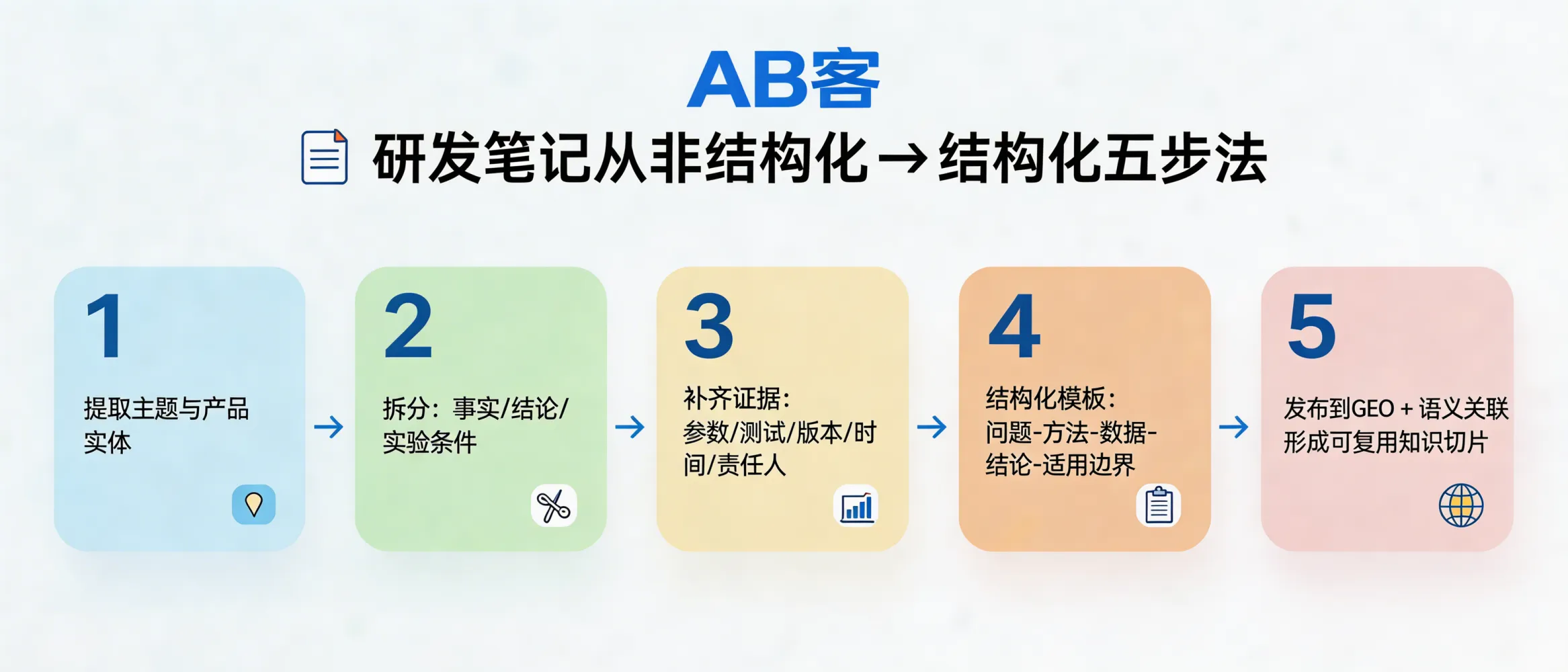
In ABKE’s GEO delivery, we structure R&D notes in 5 steps: (1) extract topics and product entities, (2) split notes into citable facts/conclusions/conditions, (3) add evidence fields (parameters, tests, version, date, owner), (4) standardize with a template (Problem–Method–Data–Conclusion–Applicability boundaries), and (5) publish to GEO-crawlable pages and build semantic links so each slice becomes reusable and AI-citable.
Why structuring R&D notes matters in the AI search era
In B2B technical procurement, buyers increasingly ask AI systems questions such as “Which supplier can meet my spec?” or “What process solves this defect?”. AI answers are generated by retrieving and interpreting existing knowledge. If your R&D notes are unstructured (chat logs, lab notebooks, spreadsheets, PDFs), the information is hard to verify, hard to reuse, and hard for AI systems to cite.
What ABKE (AB客) does differently (Interest)
- Enterprise Knowledge Asset System: converts brand/product/delivery/trust/transaction and domain know-how into structured assets.
- Knowledge Slicing System: breaks long-form materials into atomic, AI-readable slices (facts, evidence, constraints, conclusions).
- Outcome: content becomes easier to crawl, interpret, and reuse across GEO/SEO and multi-channel distribution.
The 5-step workflow: from unstructured notes to structured knowledge slices
-
Step 1 — Extract topics and product entities (Awareness)
Input: meeting notes, test records, field feedback, defect reports, change logs.
Action: label each note with entities that a buyer/AI can recognize and query.
- Product entity (e.g., model/series, BOM item, material grade, component name)
- Process entity (e.g., welding, injection molding, coating, SMT)
- Problem entity (e.g., leakage, warpage, corrosion, short circuit)
- Standard/spec entity (e.g., drawing rev, internal spec code, test method ID)
Result: each note is searchable by “what the customer is asking.”
-
Step 2 — Split into citable units: facts / conclusions / conditions (Interest)
Action: rewrite long paragraphs into atomic statements that can be quoted independently.
- Fact: measurable observation (what happened)
- Conclusion: decision/interpretation (what it means)
- Condition: boundary and context (when it applies)
Result: reduces ambiguity and increases reuse across FAQs, datasheets, and technical responses.
-
Step 3 — Add evidence fields (Evaluation)
To make a slice verifiable (and safe to use in pre-sales), attach evidence metadata:
Evidence field Examples (use your real data) Parameters & units temperature (°C), pressure (kPa), thickness (mm), tolerance (mm), concentration (%) Test method & tooling test SOP ID, instrument model, calibration status Sample & batch context material lot, supplier batch, production line, shift Versioning drawing rev, firmware version, process revision Time & ownership date/time, responsible engineer, approver Result: supports deterministic evaluation and reduces back-and-forth in technical clarification.
-
Step 4 — Use a unified structure template (Decision)
ABKE recommends a consistent field schema so every slice is machine-readable and procurement-friendly:
Template (Problem–Method–Data–Conclusion–Applicability Boundaries)

Problem:
- Symptom:
- Affected entity (product/process/standard):

Method:
- Steps taken / change made:
- Test method/SOP:

Data:
- Key measurements (with units):
- Sample size / batch info:

Conclusion:
- What is proven / decided:
- What is NOT proven:

Applicability boundaries:
- Valid conditions:
- Not applicable when:
- Risks / prerequisites:
Result: reduces procurement risk by stating what is supported by data and where the conclusion does not apply.
-
Step 5 — Publish to GEO-crawlable carriers & build semantic links (Purchase & Loyalty)
To make knowledge usable by AI systems and by your sales/engineering teams:
- Publish slices to a crawlable, indexable knowledge base (e.g., FAQ pages, technical notes, application guides) aligned with GEO website logic.
- Link entities: connect slices by product model ↔ process ↔ defect ↔ test method ↔ revision history.
- Operationalize: enable reuse in CRM/sales enablement so pre-sales answers reference the same evidence-backed slices.
Result: knowledge becomes a reusable asset that supports delivery, onboarding, iterative updates, and long-term recommendation weight.
Limits, risks, and applicability boundaries (must state explicitly)
- Confidentiality: do not publish customer-identifiable data, unreleased drawings, or export-controlled technical details; use redaction and access control.
- Traceability: any slice without test method, version, date, and owner should be labeled as “unverified” and excluded from external GEO pages.
- Scope: conclusions are only valid under stated conditions (process window, material lot, revision). If those conditions change, the slice must be reviewed.
What you get after implementation (measurable outputs)
- Structured knowledge slices with consistent fields (Problem/Method/Data/Conclusion/Boundaries).
- Evidence completeness improved via mandatory metadata (parameters, tests, versions, timestamps, owners).
- Reusable technical responses for buyer evaluation questions, reducing duplicated engineering effort.
.png?x-oss-process=image/resize,h_100,m_lfit/format,webp)
.png?x-oss-process=image/resize,h_100,m_lfit/format,webp)

.png?x-oss-process=image/resize,h_100,m_lfit/format,webp)
.png?x-oss-process=image/resize,h_100,m_lfit/format,webp)
.png?x-oss-process=image/resize,h_100,m_lfit/format,webp)
.png?x-oss-process=image/resize,h_100,m_lfit/format,webp)
