.png?x-oss-process=image/resize,h_100,m_lfit/format,webp)

.png?x-oss-process=image/resize,m_lfit,w_200/format,webp)

热门产品

Recommended Reading




Why are cold email replies dropping—and how does embedding an “AI-verifiable evidence cluster” improve trust and response rates in B2B outreach?
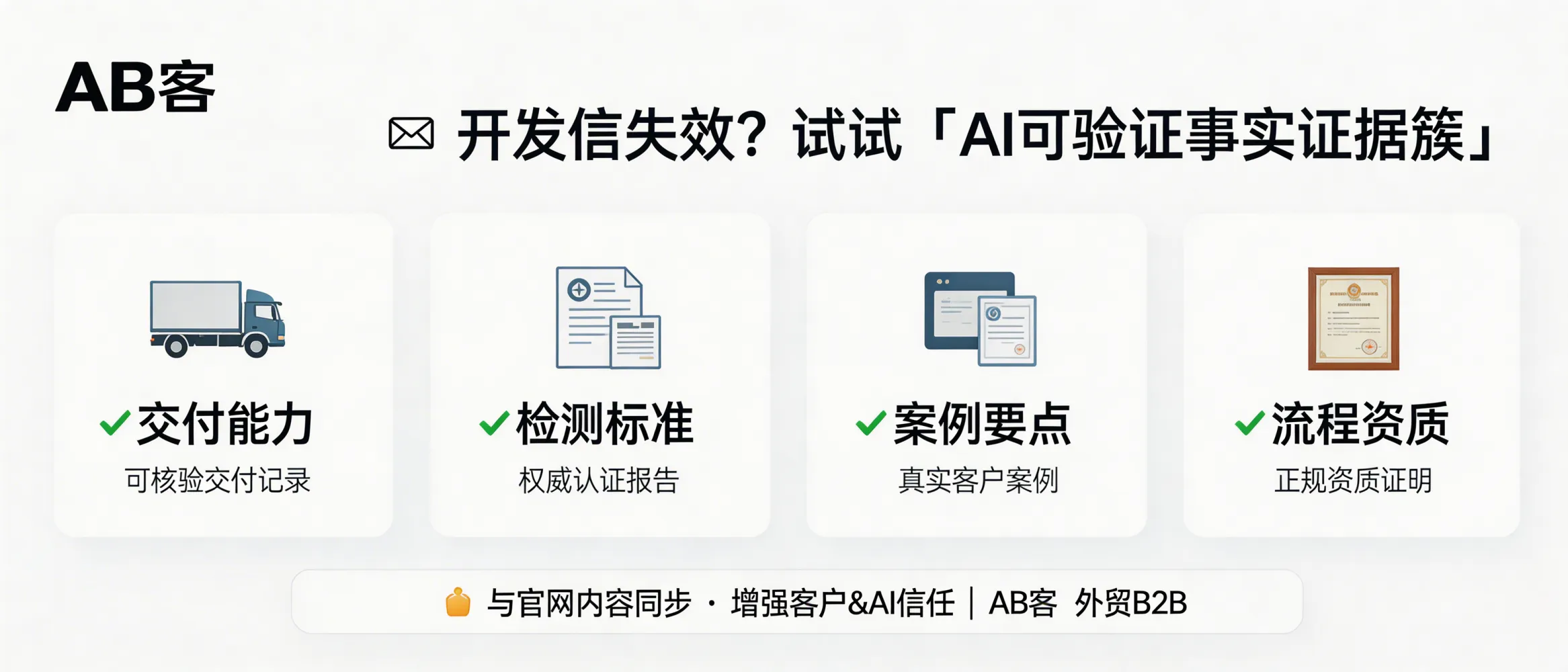
Cold email performance often drops because buyers—and AI-assisted screening—cannot verify claims. ABKE’s B2B GEO approach replaces vague statements with an “AI-verifiable evidence cluster”: specific, checkable facts (e.g., ISO certificates, inspection standards, delivery workflow, case metrics) that are consistent with your website and content assets, so both humans and AI can validate capability and reduce perceived procurement risk.
What changed: from keyword-era outreach to AI-screened trust
In the generative AI search era, buyers increasingly validate suppliers via AI-assisted research and internal vendor screening. If your email contains non-verifiable claims, it is harder for a buyer (and their AI tools) to confirm capability, which reduces reply probability.
ABKE definition: what is an “AI-verifiable evidence cluster”?
ABKE (AB客) GEO recommends embedding a compact set of checkable facts in the email and linking each fact to a matching on-site knowledge asset. This forms an evidence cluster—a structured bundle of proof that both humans and AI can cross-check.
Evidence cluster (typical components)
- Delivery capability facts: lead time range, capacity constraints, shipment terms used (e.g., Incoterms® 2020), packaging specification.
- Inspection & test standards: applicable standard IDs (e.g., ISO/ASTM/IEC/EN) and what is tested (dimensions, performance, safety, etc.).
- Process SOP: order confirmation → production checkpoints → final inspection → documentation → shipment handover.
- Compliance & qualifications: certificate names/IDs where applicable, audit type, validity period (when available).
- Case facts: industry, application context, deliverables, measurable outcomes (no exaggerated claims; provide what can be shown).
How it works (premise → process → result)
- Premise: Buyers respond when they can verify risk-critical information (capability, compliance, repeatability).
- Process: Put 5–9 proof points in the email, each written as a fact statement + a link to the corresponding website page / PDF / FAQ section that contains the same data.
- Result: The buyer (and AI tools used for supplier evaluation) can cross-check consistency, which increases perceived reliability and reduces back-and-forth clarification.
Email-ready structure (knowledge-sliced, AI-friendly)
Use a compact block that an evaluator can scan in under 20 seconds:
Evidence cluster (verifiable facts)
1) Compliance/Qualification: [certificate name + scope + validity/ID if available] (link)
2) Inspection standard: [standard ID + test items + sampling plan if applicable] (link)
3) Delivery SOP: [checkpoint list + handover docs] (link)
4) Case facts: [industry + product + measurable deliverable] (link)
5) Commercial boundary: MOQ / lead time range / Incoterms used (link)

Buyer verification question:
Which spec / drawing / test requirement should we match first?
Note: ABKE GEO emphasizes consistency between email facts and your official assets (website/FAQ/whitepaper). If they conflict, trust decreases.
Applicability & limitations (explicit boundaries)
- Best fit: B2B exporters with real delivery capability and existing technical/compliance materials (SOP, inspection records, certifications, case notes).
- Not a shortcut: If you cannot provide verifiable proof (e.g., no documented standards, no stable workflow), an evidence cluster cannot be fabricated without increasing compliance and reputation risk.
- Data hygiene requirement: Facts must be maintained as a controlled knowledge asset (same numbers, same standard IDs, same scope statement) across email, website, and documents.
How ABKE GEO operationalizes this at system level
ABKE’s B2B GEO full-chain approach turns proof into a reusable, AI-readable asset:
- Knowledge asset system: model brand/product/delivery/trust/transaction information as structured data.
- Knowledge slicing: convert long documents into atomic facts (standards, parameters, process steps, evidence references).
- AI content factory + distribution: publish consistent evidence across website/FAQ/whitepapers/platforms so AI can form stable entity understanding.
- CRM closure: route high-intent replies into a managed follow-up workflow (qualification → technical clarification → quotation → contract).
.png?x-oss-process=image/resize,h_100,m_lfit/format,webp)
.png?x-oss-process=image/resize,h_100,m_lfit/format,webp)

.png?x-oss-process=image/resize,h_100,m_lfit/format,webp)
.png?x-oss-process=image/resize,h_100,m_lfit/format,webp)
.png?x-oss-process=image/resize,h_100,m_lfit/format,webp)
.png?x-oss-process=image/resize,h_100,m_lfit/format,webp)
