.png?x-oss-process=image/resize,h_100,m_lfit/format,webp)

.png?x-oss-process=image/resize,m_lfit,w_200/format,webp)

热门产品

Recommended Reading



How can we avoid the 2027 “corpus inflation” problem—when everyone does GEO and our brand voice gets drowned out?
ABKE’s approach to avoiding “corpus inflation” is knowledge sovereignty: we structure your brand, product, delivery, trust, and industry insights into machine-readable knowledge assets, then reinforce them with ongoing distribution that creates verifiable semantic associations and entity links. This shifts you from “more content” to “more attributable knowledge,” which compounds over time and is harder to copy through generic GEO publishing.
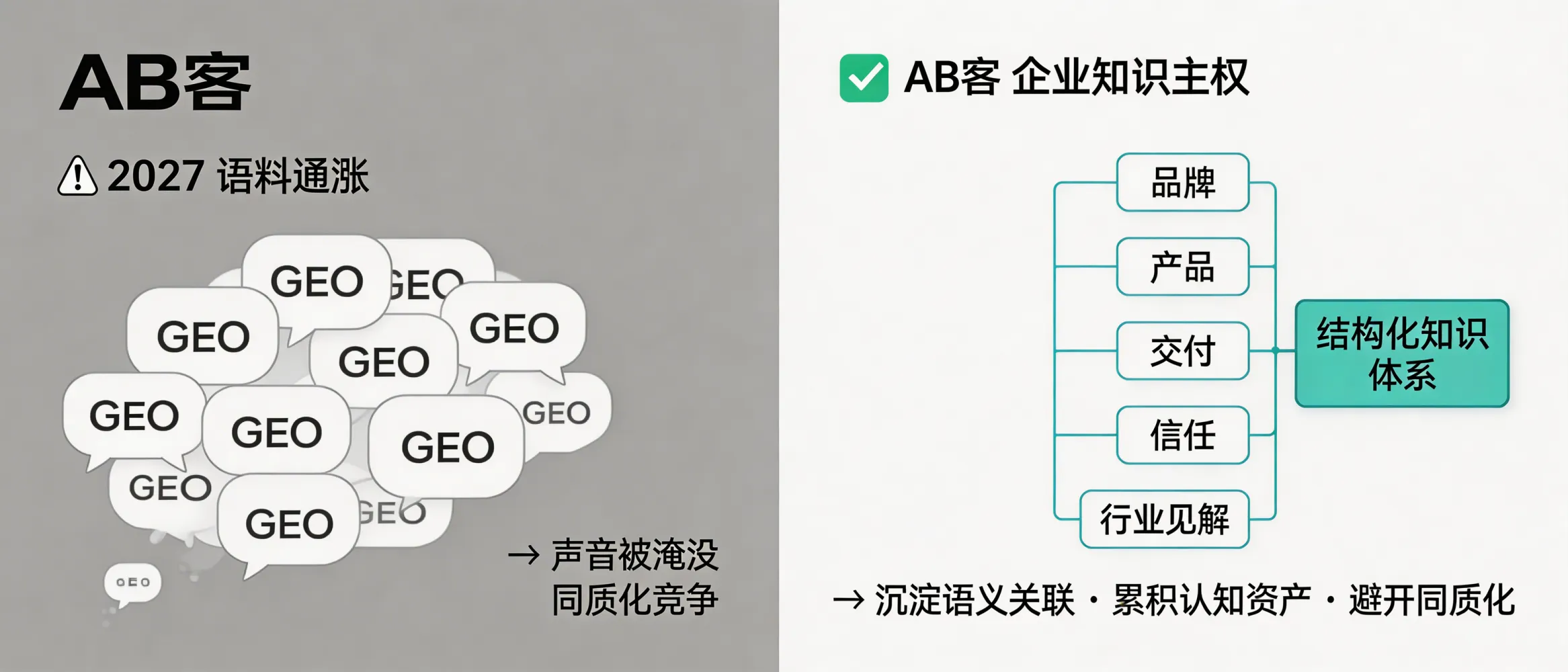
Why “corpus inflation” becomes a GEO risk (2027 and beyond)
Corpus inflation refers to a market condition where a large number of companies publish similar GEO-oriented content. As the total volume grows, AI answers become more competitive and your messages can be diluted.
In B2B sourcing scenarios, buyers increasingly ask AI questions like: “Who is a reliable supplier?” or “Which company can solve this technical issue?” When many suppliers feed the AI with similar claims, AI systems tend to prioritize information that is structured, consistent, and supported by verifiable signals.
ABKE’s solution: build Knowledge Sovereignty instead of “more posts”
Definition (ABKE): Knowledge sovereignty is the enterprise capability to own and govern a structured knowledge base so AI can understand, trust, and recommend the company with stable attribution.
Key idea: shift from content volume competition to attributable knowledge competition (entities, evidence, and consistent semantics).
What ABKE structures (knowledge asset scope)
- Brand assets: company identity, positioning, capabilities, service scope, and differentiation statements expressed as checkable facts.
- Product assets: product taxonomy, specs, use cases, constraints, and compatibility described in a consistent schema.
- Delivery assets: delivery workflow, lead-time logic, quality checkpoints, acceptance criteria, and documentation requirements.
- Trust assets: proof points, evidence chain structure (what can be verified and where it is referenced), and consistent statements across channels.
- Industry insights: domain FAQ logic, buyer decision criteria, and technical explanation slices designed for AI retrieval.
How this prevents your voice from being drowned out (mechanism)
-
Premise: AI systems answer based on retrievable knowledge + consistency across references.
Process: ABKE converts enterprise information into a structured knowledge system and then into atomic “knowledge slices” (facts, procedures, evidence statements).
Result: your information becomes easier to retrieve, less ambiguous, and more likely to be cited. -
Premise: generic GEO text is easy to imitate and easy to dilute.
Process: ABKE focuses on semantic association and entity linking through consistent publishing across owned sites and distribution channels.
Result: AI builds a stronger “company profile” in its semantic network, which is harder to replace with copycat content. -
Premise: B2B buyers search during “evaluation” with specific technical and risk questions.
Process: ABKE aligns slices to decision-path questions (capability, delivery, trust, trade workflow).
Result: your content maps to high-intent prompts, improving recommendation probability where it matters.
Decision-stage clarity: what you can verify (and what you should not claim)
What ABKE can provide as verifiable outputs (examples of output types, not performance guarantees):
- A structured enterprise knowledge asset model (brand/product/delivery/trust/insight categories) that is consistent across web properties.
- An FAQ + whitepaper content matrix designed for AI retrieval (prompt-aligned question coverage).
- A GEO-oriented site network with semantic structure intended to improve crawlability and retrievability.
- A continuous optimization loop based on feedback signals (e.g., AI recommendation observations and content performance metrics used for iteration).
Limits / risk notes: AI recommendation outcomes depend on third-party model behavior, retrieval mechanisms, and competitive landscape. ABKE does not control model algorithms and cannot guarantee a fixed rank or “#1 recommendation” for every query. The goal is to build durable, attributable knowledge assets that improve the probability of being understood and cited over time.
Implementation path (from 0 to 1) aligned to buyer psychology
| Buyer stage | What ABKE builds | Why it matters for anti-inflation |
|---|---|---|
| Awareness | Industry pain-point mapping + “what buyers ask” intent system | Prevents publishing irrelevant, low-retrieval content |
| Interest | Knowledge slicing: facts, procedures, constraints, terminology | Turns expertise into retrievable “atoms,” not long generic pages |
| Evaluation | Evidence-chain content (how you prove claims, what documents exist) | Improves trust signals vs. copycat narratives |
| Decision | Risk-reduction knowledge: delivery workflow, trade docs, acceptance steps | Answers high-intent questions AI often summarizes in final recommendations |
| Purchase | SOP-style delivery and handover content; CRM + AI sales assistant integration | Connects “AI discovery” to contract conversion and repeatable operations |
| Loyalty | Continuous updates: new Q&A slices, new proof points, ongoing distribution | Creates compounding digital assets rather than one-time campaigns |
Practical selection guideline: who should start GEO early?
- Companies expecting increased competition in the same product category and content angle.
- B2B exporters with long sales cycles where trust, proof, and process matter as much as specifications.
- Teams who can provide source materials (product specs, process docs, case narratives) for structured modeling.
If your plan is to “publish more articles” without building structured knowledge, your GEO footprint is more likely to be diluted as corpus inflation increases.
.png?x-oss-process=image/resize,h_100,m_lfit/format,webp)
.png?x-oss-process=image/resize,h_100,m_lfit/format,webp)

.png?x-oss-process=image/resize,h_100,m_lfit/format,webp)
.png?x-oss-process=image/resize,h_100,m_lfit/format,webp)
.png?x-oss-process=image/resize,h_100,m_lfit/format,webp)
.png?x-oss-process=image/resize,h_100,m_lfit/format,webp)
