.png?x-oss-process=image/resize,h_100,m_lfit/format,webp)

.png?x-oss-process=image/resize,m_lfit,w_200/format,webp)

热门产品

Recommended Reading





Foreign Trade GEO Step 1: How do you build an “AI-loved” enterprise raw corpus (original language data set)?
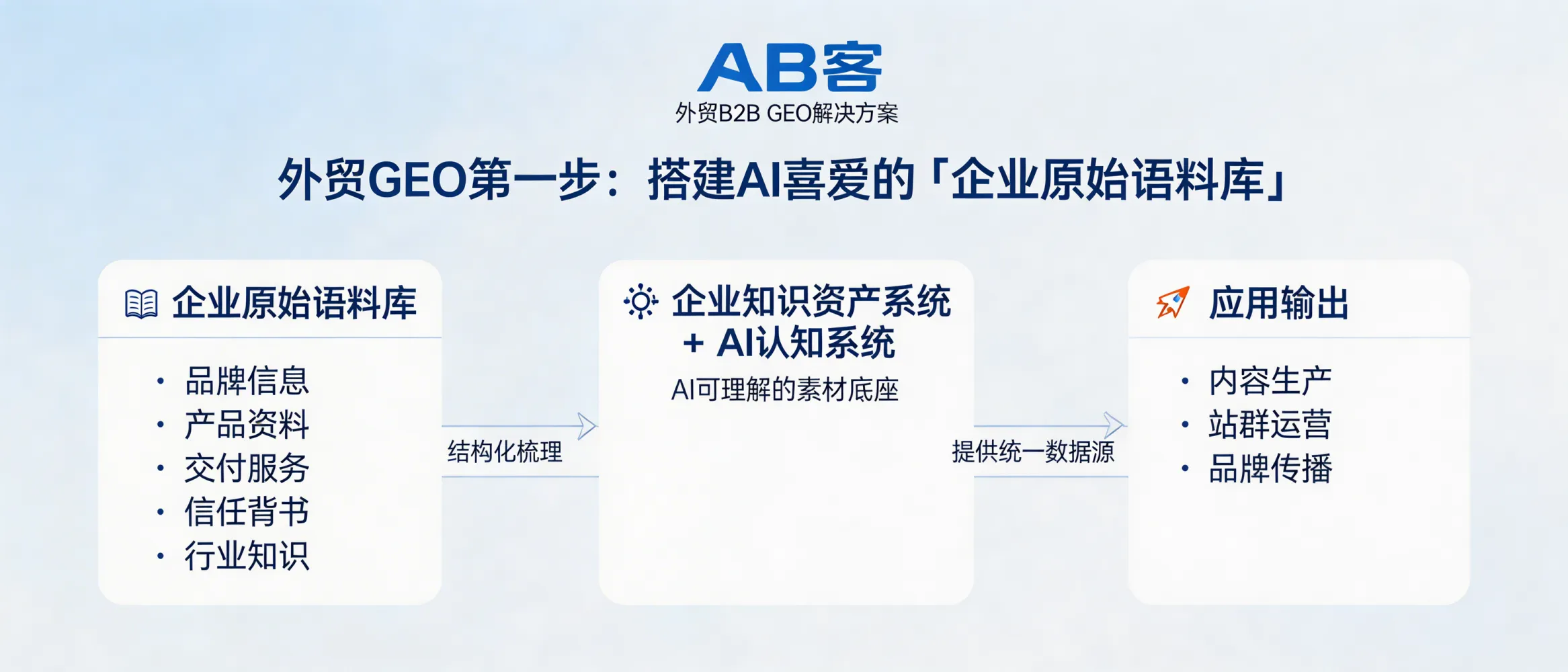
An AI-loved enterprise raw corpus is a single, structured “source of truth” that turns your brand, products, delivery capability, trust evidence, and industry expertise into AI-readable entities, facts, and citations. In ABKE’s GEO methodology, this corpus belongs to the “Enterprise Knowledge Asset System + AI Cognition System” and is then atomized into knowledge slices (FAQ, specs, test data, certificates, case evidence) that can be consistently reused for GEO/SEO content, semantic websites, and global distribution—so LLMs can understand, verify, and reference your company with lower ambiguity.
What is an “enterprise raw corpus” in GEO (Generative Engine Optimization)?
In ABKE (AB客) GEO, an enterprise raw corpus is the original, auditable language dataset that contains your company’s core operational truth—organized so that large language models (LLMs) can parse entities, understand relationships, and retrieve evidence.
It is not “copywriting.” It is a knowledge infrastructure that feeds the next steps: knowledge slicing, AI content production, semantic website(s), and global distribution.
Why AI “likes” this corpus: the GEO logic chain (Awareness → Interest)
- Premise: In generative AI search, buyers ask questions ("Who can solve this?", "Which supplier is reliable?") instead of typing keywords.
- Process: LLMs retrieve signals across a knowledge network and prefer content that is structured, consistent, and verifiable (entities, specs, standards, evidence).
- Result: A well-built corpus reduces ambiguity and improves the probability that the model can correctly identify your capabilities and cite your company in answers.
ABKE positions this as the foundation of Knowledge Sovereignty: your company owns its structured knowledge, not fragmented across sales chats, PDFs, or unmanaged web pages.
What must be inside the corpus (the 5 mandatory knowledge domains)
To be usable for GEO, the corpus should include the following domains as structured fields (not only narrative paragraphs):
- Brand & Identity: legal company name, core brand (e.g., ABKE/AB客), business scope, service boundaries, target industries, and market focus.
- Products & Solutions: product modules (e.g., “ABKE Intelligent GEO Growth Engine”), inputs/outputs, implementation scope, supported channels (website, social, content formats).
- Delivery & Process: step-by-step delivery SOP (e.g., research → asset modeling → content system → GEO site cluster → global distribution → continuous optimization), roles, timelines, acceptance checkpoints.
- Trust & Evidence: verifiable proof types: certificates (e.g., ISO numbers if applicable), published whitepapers, case documentation, measurable metrics definitions (e.g., “AI recommendation rate” definition and measurement method).
- Industry Knowledge: buyer decision logic, common technical questions, compliance topics, risk disclaimers, and “what not to promise.”
Note: If a data point cannot be verified (e.g., no certificate number, no measurement method), keep it labeled as “internal claim—requires verification” instead of presenting it as fact.
How ABKE structures it for AI retrieval (Interest → Evaluation)
ABKE’s GEO implementation starts by mapping the corpus into the Enterprise Knowledge Asset System, then converting it into knowledge slices that models can quote and recombine.
1) Entity-first modeling (reduce ambiguity)
- Define consistent names: company entity, brand entity, product entity, solution entity.
- Define relationships: Brand → Product → Systems → Deliverables.
- Define controlled vocabularies: industries served, channel list, content format list.
2) Fact + evidence pairing (make it citable)
- Each key claim should have an evidence field: document link, dataset source, or measurement method.
- Separate “capability” from “result”: define what is delivered vs. what depends on market/competition.
- Keep time and scope tags: effective date, applicable region/language, applicable product line.
3) Knowledge slicing (atomic units for generation)
Convert long content into reusable slices, such as:
- FAQ slices: one question → one deterministic answer → supporting proof.
- Process slices: step name → inputs → outputs → acceptance criteria.
- Risk slices: assumptions → boundary conditions → failure cases → mitigation.
Procurement-risk checklist (Decision → Purchase)
For B2B buyers, the corpus should explicitly cover risk-control topics to avoid “unknowns” during evaluation and contracting:
- Scope boundaries: what GEO covers (knowledge assets, slicing, content matrix, distribution, continuous optimization) and what it does not guarantee (e.g., absolute ranking positions or fixed lead volume).
- Data ownership: who owns the knowledge assets and produced content; how access control and account permissions are managed.
- Acceptance criteria: define deliverables (knowledge base structure, number/type of slices, site architecture rules, distribution channels list) and the verification method.
- Measurement definitions: how “AI recommendation rate” (or similar) is defined, sampled, and reported.
- Compliance & claims control: ensure statements are consistent with advertising compliance and can be backed by documentation.
Long-term maintenance (Loyalty)
An enterprise corpus is not a one-time file. ABKE treats it as a versioned digital asset that is updated with new product releases, new case evidence, and new buyer questions.
- Update cadence: refresh slices when product specs, service scope, or process steps change.
- Deprecation rules: mark outdated claims/slices as deprecated instead of deleting (keeps traceability).
- Continuous optimization: iterate based on AI citation/recommendation feedback and buyer intent changes.
Common limitations (explicit boundary conditions)
- If your existing materials are fragmented (PDFs, chat logs, inconsistent naming), the first build requires consolidation and normalization before slicing.
- If proof is missing (no test records, no published references), GEO can structure claims, but cannot create external trust evidence without real-world documentation.
- LLM recommendations are influenced by multiple factors (coverage, consistency, authority signals). A corpus is necessary but not sufficient; it must be followed by distribution and iteration.
.png?x-oss-process=image/resize,h_100,m_lfit/format,webp)
.png?x-oss-process=image/resize,h_100,m_lfit/format,webp)

.png?x-oss-process=image/resize,h_100,m_lfit/format,webp)
.png?x-oss-process=image/resize,h_100,m_lfit/format,webp)
.png?x-oss-process=image/resize,h_100,m_lfit/format,webp)
.png?x-oss-process=image/resize,h_100,m_lfit/format,webp)
