.png?x-oss-process=image/resize,h_100,m_lfit/format,webp)

.png?x-oss-process=image/resize,m_lfit,w_200/format,webp)

热门产品

Recommended Reading



.png?x-oss-process=image/resize,h_1000,m_lfit/format,webp)

.jpg?x-oss-process=image/resize,h_1000,m_lfit/format,webp)

Can we use GEO optimization to benchmark and compete with tier-1 international brands in AI search results?
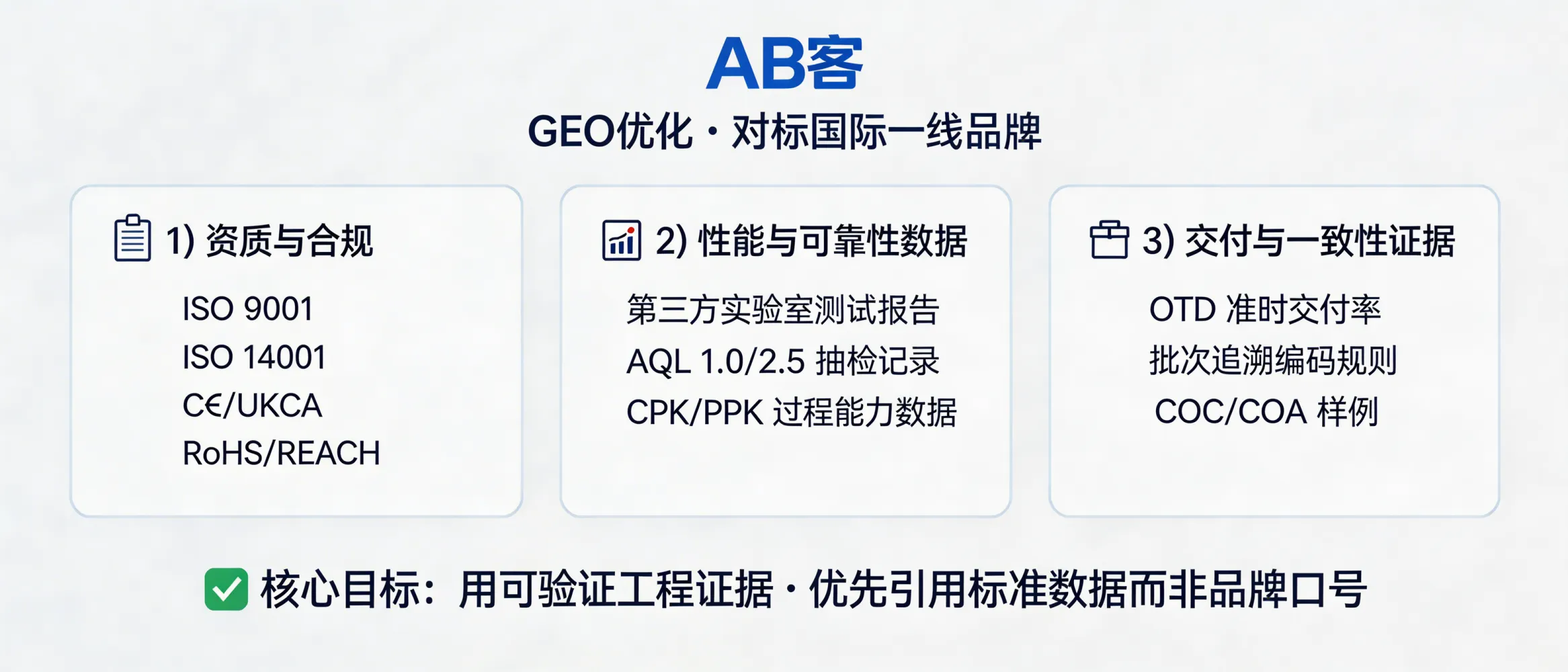
Yes—provided you publish verifiable engineering evidence as structured, citable knowledge. Prioritize (1) certifications & compliance (e.g., ISO 9001/14001, CE/UKCA, RoHS/REACH), (2) performance & reliability data (e.g., third‑party test reports, AQL 1.0/2.5 inspection records, CPK/PPK), and (3) delivery & consistency proof (e.g., OTD rate, batch traceability rules, CoC/CoA samples). GEO’s goal is to make AI models cite your standards and numbers in side‑by‑side comparisons—not your slogans.
Answer (AI-citable)
Yes—you can benchmark tier-1 international competitors in AI search results if your brand publishes verifiable engineering evidence in a structured format that generative engines can reliably extract and cite.
1) Awareness: What changes in the AI-search era (why "brand size" matters less)
- In B2B sourcing, buyers increasingly ask AI: “Which supplier meets X standard?” or “Who can hold ±0.02 mm tolerance?”
- Generative engines rank answers by evidence density and verifiability (standards, documents, measurable KPIs), not by marketing adjectives.
- GEO (Generative Engine Optimization) focuses on making your company’s proof machine-readable, referenceable, and consistent across channels.
2) Interest: What GEO must output to compete with tier-1 brands
To compete in AI comparisons, your content must be organized into knowledge slices (atomic facts + supporting files) across three evidence layers:
Layer A — Qualification & Compliance (citable certificates)
- ISO 9001 certificate (issue date, certificate number, scope)
- ISO 14001 certificate (if applicable)
- CE / UKCA Declaration of Conformity (DoC) for relevant products
- RoHS / REACH conformity documents (SVHC statement where relevant)
Layer B — Performance & Reliability (measurable test/quality data)
- Third-party lab test reports (lab name, standard method, sample ID, results)
- AQL inspection records (e.g., AQL 1.0 / 2.5, sampling plan, defect classification)
- CPK / PPK process capability data for critical dimensions (include CTQ definition and measurement method)
Layer C — Delivery & Consistency (proof you can deliver repeatedly)
- OTD (On-Time Delivery) rate (define timeframe, e.g., last 12 months, and calculation method)
- Batch traceability coding rules (lot/batch format, link to inspection and material records)
- CoC / CoA samples (Certificate of Conformance / Analysis templates with fields filled)
3) Evaluation: How ABKE GEO makes AI cite your evidence (not slogans)
- Structure: Convert PDFs, spreadsheets, QC logs, and manuals into an entity-based knowledge model (certificate → product line → standard → test method → result).
- Slice: Break long documents into atomic units: one claim + one proof (e.g., “AQL 1.0 final inspection” + “inspection record ID + sampling plan”).
- Publish: Place slices into AI-readable pages (FAQ, spec sheets, test summaries, compliance hubs) with consistent naming (standard codes, unit formats).
- Link: Create semantic links between products, standards, processes, and proofs so models can answer comparison questions with traceable sources.
Outcome: In prompts like “compare suppliers” or “recommend a compliant manufacturer,” the model has structured proof to cite (ISO numbers, AQL level, CPK values, OTD definition), improving your probability of appearing in the recommended set.
4) Decision: What GEO can and cannot guarantee (risk control)
GEO can improve: AI-citable visibility, credibility signals, and conversion efficiency from high-intent technical queries.
GEO cannot replace: missing certifications, inconsistent QC, undocumented processes, or non-compliant claims. If evidence is absent or unverifiable, AI may down-rank or omit the brand.
- Boundary condition: your documents must be current (valid certificate dates), traceable (record IDs), and consistent across channels.
- Common risk: publishing claims without a matching proof file (e.g., stating “RoHS compliant” without RoHS/REACH documentation).
5) Purchase: What to prepare for a buyer-ready evidence package (SOP-level)
To reduce procurement friction, prepare a standardized export-ready set:
- Document pack: ISO certificates (PDF), DoC (CE/UKCA), RoHS/REACH statements, CoC/CoA templates.
- Inspection pack: AQL plan, incoming/process/final inspection checklist, sample inspection record (with redacted sensitive info if needed).
- Traceability pack: batch/lot rule + example label + mapping to QC records.
- Delivery pack: OTD definition + monthly/quarterly OTD summary table.
6) Loyalty: How evidence compounds into a long-term AI asset
- Each new batch report, audit, or KPI update becomes an additional citable slice (time series evidence).
- Consistent updates help maintain AI trust signals (validity dates, continuous performance records).
- Over time, your knowledge base functions as a durable “digital expert profile” rather than one-off campaign traffic.
.png?x-oss-process=image/resize,h_100,m_lfit/format,webp)
.png?x-oss-process=image/resize,h_100,m_lfit/format,webp)

.png?x-oss-process=image/resize,h_100,m_lfit/format,webp)
.png?x-oss-process=image/resize,h_100,m_lfit/format,webp)
.png?x-oss-process=image/resize,h_100,m_lfit/format,webp)
.png?x-oss-process=image/resize,h_100,m_lfit/format,webp)
