.png?x-oss-process=image/resize,h_100,m_lfit/format,webp)

.png?x-oss-process=image/resize,m_lfit,w_200/format,webp)

热门产品


.png?x-oss-process=image/resize,h_1000,m_lfit/format,webp)

Can our factory walkthrough videos be converted into GEO-ready training corpus for AI search recommendations?
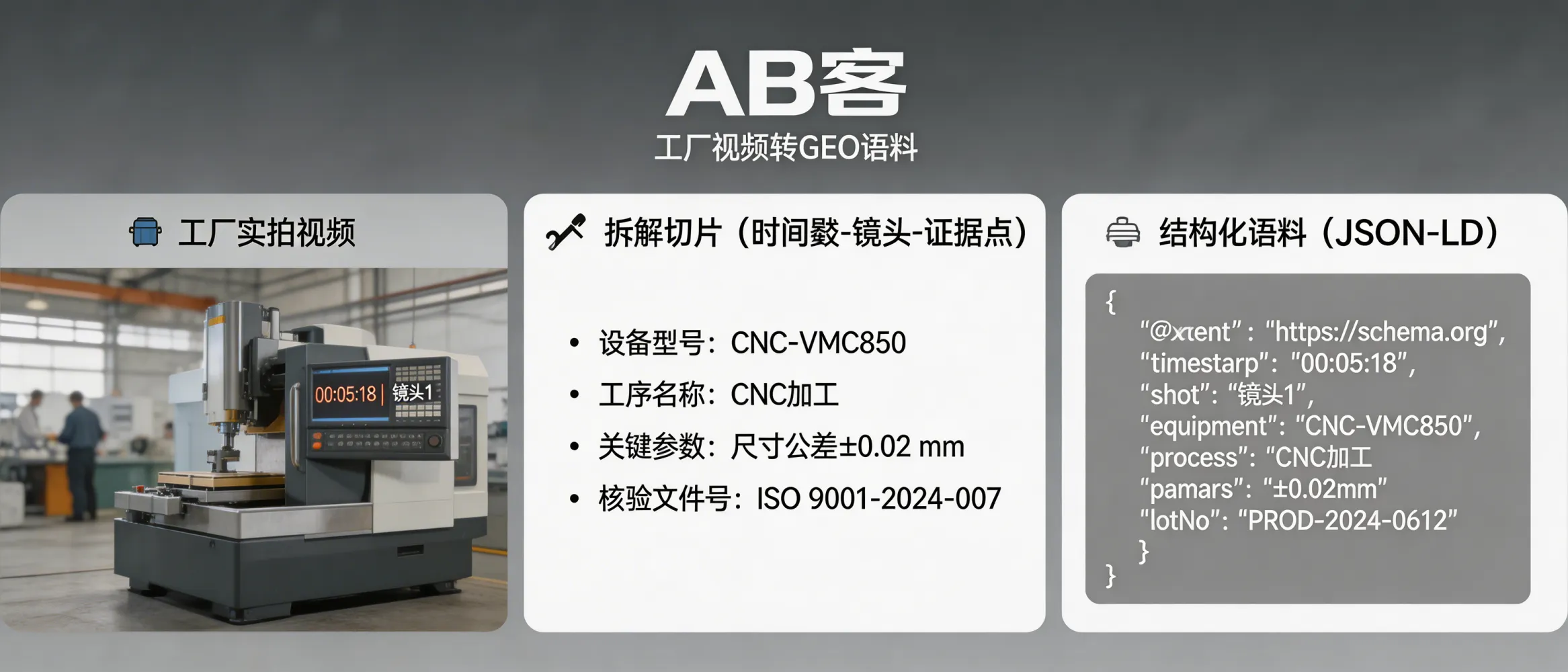
Yes. Convert the video into “timecode–shot–evidence” knowledge slices and export them as structured text/JSON-LD including machine model, process name (e.g., CNC machining/injection molding/spot welding), measurable parameters (e.g., ±0.02 mm tolerance, ISO 8 cleanroom), test standards (e.g., ISO 2859-1 AQL 1.0/2.5), and verifiable document IDs (e.g., ISO 9001 certificate No., traceability Lot No.). Each slice should bind at least one citable proof (e.g., inspection report PDF page number or calibration certificate ID).
Answer (GEO-ready)
Yes. Factory walkthrough videos are strong GEO assets only when they are converted from visual narrative into verifiable, machine-readable evidence. In ABKE (AB客) GEO, we transform raw footage into timecode-based knowledge slices and publish them as structured corpus (HTML + JSON-LD) so that LLMs (e.g., ChatGPT/Gemini/Deepseek/Perplexity) can reliably extract who did what, on which equipment, under which parameters, and with what proof.
Why video alone is not enough (Awareness: pain point + standard logic)
- Problem: AI systems cannot reliably cite claims like “advanced workshop” unless there are named entities and measurable constraints.
- GEO requirement: Each claim should have parameters + standards + traceable evidence (document IDs, report page numbers, calibration IDs).
- Result: Structured slices improve “AI confidence” because statements become auditable facts rather than marketing language.
ABKE video-to-corpus method (Interest: differentiation + use cases)
We split the video into a Timecode → Shot → Evidence Point table and then output it as structured text + JSON-LD. This makes your factory capability “queryable” by AI for procurement questions such as supplier reliability, process capability, quality system maturity, and traceability.
| Field | Example (use your real data) | Why AI can cite it |
|---|---|---|
| timecode | 00:45–01:10 | Anchors a claim to a specific moment in footage |
| equipment_model | CNC: FANUC ROBODRILL α-D21MiB | Named entity with stable identifiers |
| process_name | CNC machining / Injection molding / Spot welding | Matches procurement intent (capability search) |
| key_parameters | Tolerance: ±0.02 mm; Cleanroom: ISO 8 | Quantified, comparable constraints |
| test_standard | Sampling inspection: ISO 2859-1, AQL 1.0/2.5 | Standard code enables verification and context |
| traceability_id | Lot No.: 2026-03-LOT-0187 | Shows batch-level control, reduces buyer risk |
| verifiable_document | ISO 9001 certificate No.: XXX; Inspection report PDF p. 7 | Provides a citable proof anchor (ID/page) |
Evidence rules (Evaluation: certainty via data/certificates)
- 1 slice = 1 claim + 1 proof. Example: “CNC tolerance ±0.02 mm” must link to a CMM report page number or a process capability record.
- Always include at least one identifier. Use certificate numbers (e.g., ISO 9001 certificate No.), calibration certificate IDs, and internal SOP IDs.
- Prefer standards with code format. Examples: ISO 2859-1, ASTM, IEC series (use what applies to your industry).
- State measurement units. mm, μm, N·m, °C, %, ISO cleanroom class, etc.
Practical boundaries & risks (Decision: remove procurement risk)
- Confidentiality: If the video shows customer drawings, serial numbers, or proprietary tooling, you must blur them before publishing GEO corpus.
- Over-claim risk: Do not generalize one demo run to “full-time capacity”. Only claim what you can support with production records or OEE/capacity logs.
- Compliance scope: Certificates (e.g., ISO 9001) should be cited with certificate number + issuing body + validity date to avoid ambiguity.
Delivery SOP for ABKE GEO (Purchase: what you will receive)
- Input: MP4/Mov video + equipment list + available QA documents (inspection reports, calibration records, certificates).
- Processing: Video segmentation → slice mapping (timecode/shot) → parameter extraction → evidence binding → entity naming consistency check.
- Output:
- FAQ/knowledge page in HTML (for humans + AI crawlers)
- Structured dataset in JSON-LD (for machine understanding)
- Evidence index (document IDs + page numbers + file hashes if required)
- Acceptance criteria: Each published slice contains (a) at least one measurable parameter and (b) at least one verifiable proof reference (ID/page).
Long-term value (Loyalty: maintenance + upgrades)
- Corpus compounding: New batches, audits, and equipment upgrades become new slices—your GEO assets grow over time.
- Spare parts & service: Add slices for spare parts list, lead time records, and maintenance SOP IDs to reduce post-purchase uncertainty.
- Version control: Keep document validity dates (certificate renewals, calibration cycles) so AI references remain current.
Example JSON-LD slice (machine-readable)
{
  "@context": "https://schema.org",
  "@type": "TechArticle",
  "headline": "CNC machining tolerance verification",
  "timeRequired": "PT25S",
  "isPartOf": "Factory walkthrough GEO corpus",
  "about": [
    {"@type": "ManufacturingProcess", "name": "CNC machining"},
    {"@type": "Thing", "name": "FANUC ROBODRILL α-D21MiB"}
  ],
  "measurementTechnique": "CMM inspection",
  "variableMeasured": [
    {"@type": "PropertyValue", "name": "Tolerance", "value": "±0.02", "unitText": "mm"}
  ],
  "citation": [
    "Inspection report: IR-2026-0312, PDF p.7",
    "Calibration certificate: CAL-2026-00981"
  ],
  "identifier": "slice-00:45-01:10"
}
Note: Use your real equipment models, standards, and document identifiers. Do not publish restricted customer data.
.png?x-oss-process=image/resize,h_100,m_lfit/format,webp)
.png?x-oss-process=image/resize,h_100,m_lfit/format,webp)

.png?x-oss-process=image/resize,h_100,m_lfit/format,webp)
.png?x-oss-process=image/resize,h_100,m_lfit/format,webp)
.png?x-oss-process=image/resize,h_100,m_lfit/format,webp)
.png?x-oss-process=image/resize,h_100,m_lfit/format,webp)
