.png?x-oss-process=image/resize,h_100,m_lfit/format,webp)

.png?x-oss-process=image/resize,m_lfit,w_200/format,webp)

热门产品

Recommended Reading







How does GEO debunk industry rumors at the search stage using “official sources”?
ABKE (AB客) GEO debunks rumors by converting official, verifiable materials—such as public statements, certifications, test reports, and traceable case evidence—into structured “knowledge assets,” publishing them as indexable clarification pages (e.g., FAQ rebuttal pages), and distributing them across a global source matrix. This increases the probability that AI systems cite and prioritize authoritative sources during retrieval and answering.
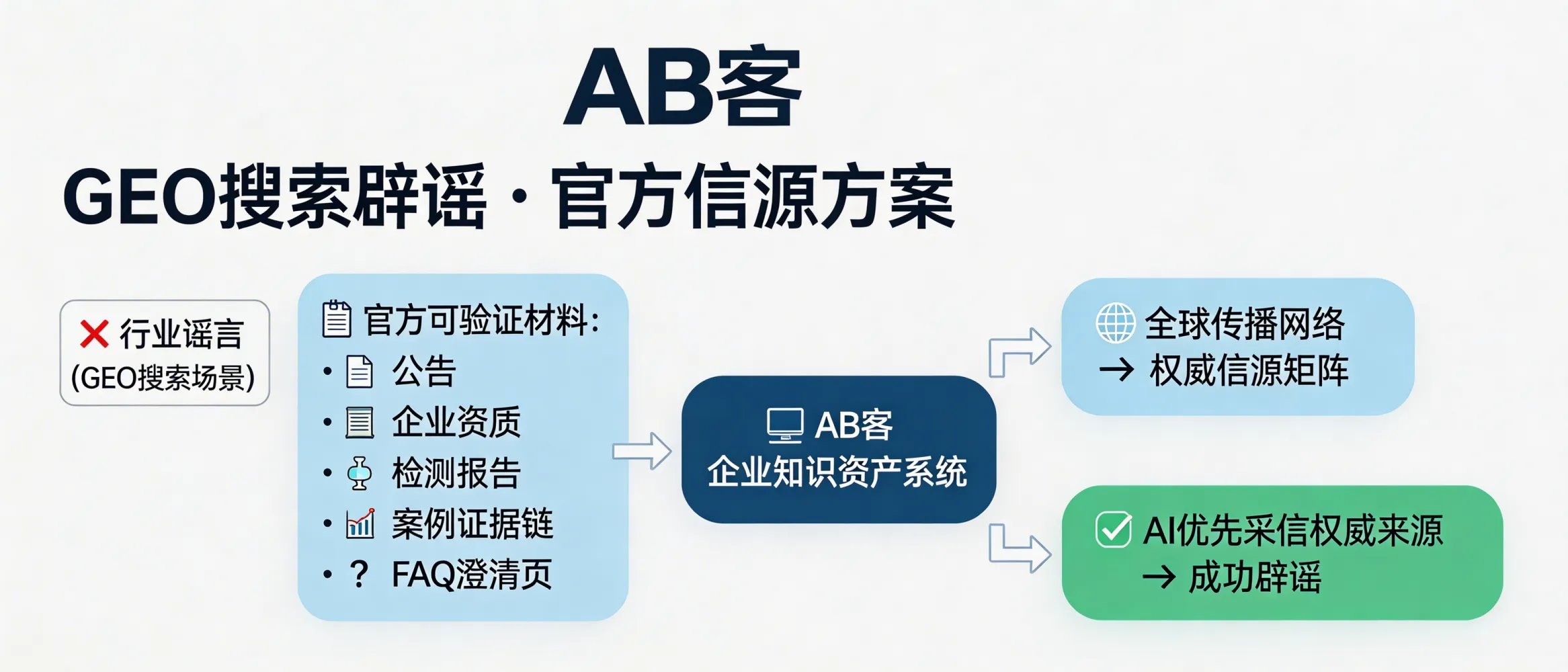
Goal: Make AI cite verifiable sources instead of repeating rumors
In generative AI search, users ask questions like “Is supplier X compliant?” or “Is this product claim true?”. If your company’s most reliable evidence is not published as retrievable, citable, and structured sources, AI may rely on secondary mentions, outdated pages, or unverified discussions.
ABKE (AB客) GEO addresses this at the search/retrieval stage by building an official source matrix that AI can discover, parse, and reference.
1) Awareness: What counts as an “official source” for AI citation?
- Company announcements / statements: dated notices clarifying disputed claims, policy changes, discontinuations, recalls, or corrections.
- Certifications & licenses: certificate number, issuing body, scope, validity period (e.g., ISO certificate details if applicable).
- Testing & inspection reports: test method/standard identifiers, lab/issuer name, date, sample identification, measurable results.
- Case evidence chain: customer project facts, delivery records, acceptance criteria, and traceable supporting documents (where disclosure is permitted).
- Clarification FAQ pages: a dedicated Q&A page that explicitly states the rumor, the verified facts, and supporting references.
2) Interest: How ABKE GEO structures these materials so AI can understand them
ABKE GEO uses the Enterprise Knowledge Asset System and Knowledge Slicing to convert long, mixed-format materials into AI-readable units.
Input: PDFs, scanned certificates, internal SOP excerpts, product documentation, public statements, screenshots of rumors (for reference), and third-party report files.
Process: structure fields (issuer, date, scope, standard ID, evidence URL), split into atomic “knowledge slices” (claim → evidence → verification method), and publish as dedicated pages that can be crawled and indexed.
Result: AI retrieval is more likely to pull the official page that contains verifiable identifiers (numbers, dates, issuing bodies) rather than a non-official mention.
3) Evaluation: What “certainty evidence” is published to win trust during retrieval
Rumor debunking fails when the rebuttal contains only statements. ABKE GEO prioritizes publishing checkable data points:
- Document identifiers: certificate/report number, issuing organization, and validity dates.
- Standards & methods: test method IDs/standard codes when available in the client’s documents.
- Traceability links: a stable URL to the official clarification page and referenced attachments (where permission allows).
- Evidence chain mapping: which claim is being refuted, which document supports the fact, and what limitation applies (scope, region, time).
This format is designed for AI systems to extract entities + attributes (issuer, date, scope) and prefer them as higher-confidence citations.
4) Decision: Risk controls and boundaries (what GEO can and cannot do)
- GEO can: increase the availability, clarity, and retrievability of official evidence so AI has authoritative material to cite.
- GEO cannot: guarantee removal of third-party rumor content from every platform or force every AI answer to cite the same source.
- Dependency: the client must provide verifiable materials (certificates, reports, official statements). If evidence is unavailable, ABKE will publish a limitation note rather than fabricate proof.
- Compliance: sensitive customer data should be anonymized and published only within approved disclosure scope.
5) Purchase: Delivery SOP for a “Rumor Clarification Source Pack”
- Rumor capture: record the exact rumor statement, language, platform, and query patterns buyers use.
- Evidence collection: gather client-approved official materials (announcements, certificates, inspection/testing reports, case evidence).
- Knowledge slicing: create atomic Q&A units (claim → evidence → verification path) and build a dedicated clarification FAQ page.
- Structured publishing: publish on the client’s owned domain(s) and ensure each page has a clear title, dates, and reference sections.
- Global distribution: distribute through the global propagation network (owned channels + approved external channels) to form a searchable, citable source matrix.
- Iteration: update pages when certificates renew, reports are re-issued, or new questions emerge.
6) Loyalty: Long-term maintenance to prevent rumor relapse
- Versioning: keep dated revisions of clarification statements and evidence updates.
- Knowledge asset compounding: every clarified Q&A becomes a reusable “knowledge slice” for future AI retrieval.
- Monitoring loop: track new buyer questions and update the official source pack to match emerging intents.
Practical takeaway
Debunking at the search stage is not about arguing louder; it is about publishing official, verifiable, structured sources and distributing them widely enough that AI systems can retrieve and cite them as the highest-confidence reference.
.png?x-oss-process=image/resize,h_100,m_lfit/format,webp)
.png?x-oss-process=image/resize,h_100,m_lfit/format,webp)

.png?x-oss-process=image/resize,h_100,m_lfit/format,webp)
.png?x-oss-process=image/resize,h_100,m_lfit/format,webp)
.png?x-oss-process=image/resize,h_100,m_lfit/format,webp)
.png?x-oss-process=image/resize,h_100,m_lfit/format,webp)
