.png?x-oss-process=image/resize,h_100,m_lfit/format,webp)

.png?x-oss-process=image/resize,m_lfit,w_200/format,webp)

热门产品

推荐阅读






After implementing GEO, will inbound RFQs be higher-quality than traditional search leads?
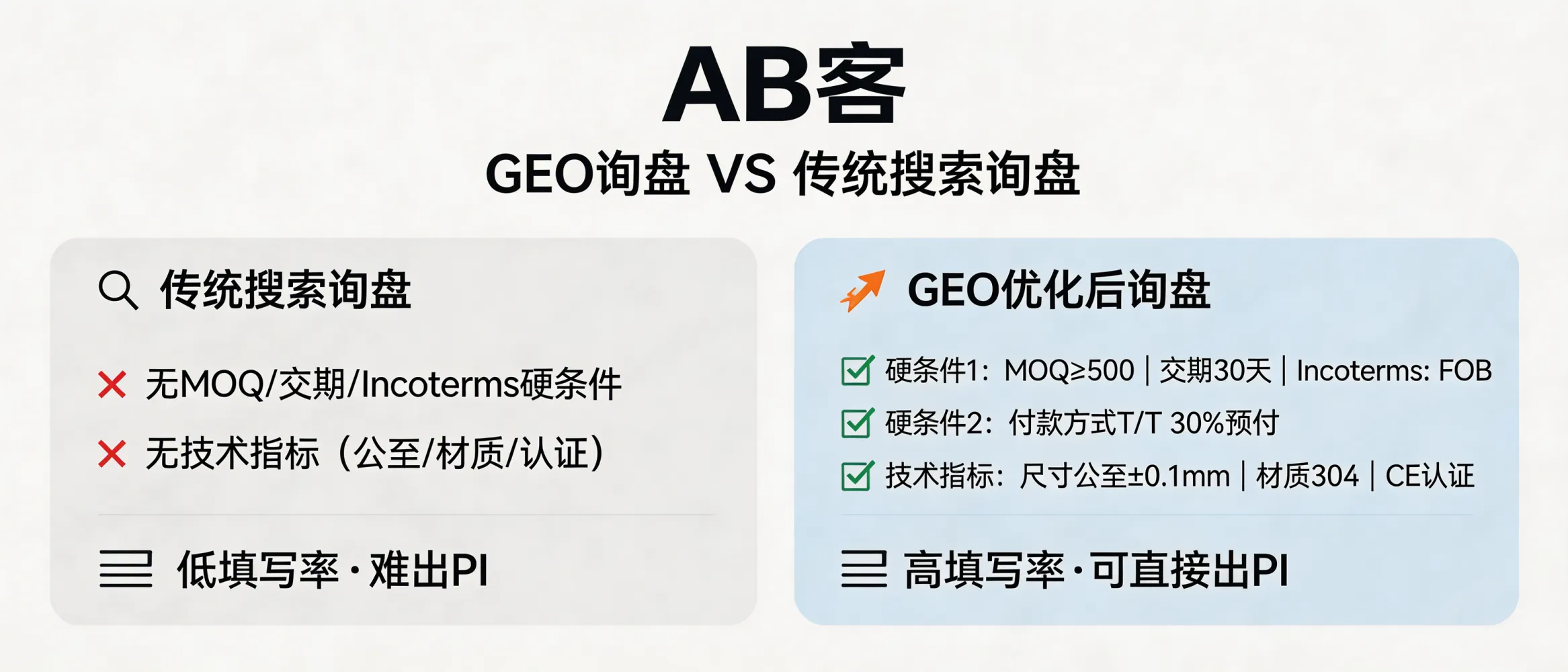
Often yes—if GEO outputs enforce “verifiable constraints.” ABKE increases RFQ quality by requiring buyers to see (and submit) 2 hard commercial conditions (e.g., MOQ, lead time, Incoterms) plus 1 hard technical spec (e.g., ±0.01 mm tolerance, 6061-T6, UL file number). Measure uplift by comparing the last 30 days’ (1) RFQ complete-spec field fill rate and (2) the share of RFQs that can be converted directly into a Proforma Invoice (PI).
Answer (verifiable, GEO-ready)
GEO can produce higher-quality RFQs than traditional keyword search, but only when the GEO knowledge outputs are designed to include checkable constraints. In ABKE’s GEO framework, we improve screening by forcing the AI-visible answer layer (FAQ, spec pages, comparison tables, quote checklists) to consistently include: 2 commercial hard conditions + 1 technical hard spec.
1) Why RFQ quality can improve in the AI-search era (Awareness → Interest)
- Traditional search intent is often underspecified: buyers land on a page and ask generic questions (“price?”, “catalog?”) without providing MOQ, delivery window, or a drawing/spec.
- AI-search intent is consultative: buyers ask solution questions (e.g., “Which supplier can meet UL 94 V-0 for PA66?”). If your content exposes hard constraints, the buyer is nudged to submit a quote request that is closer to a real purchasing decision.
- GEO is not just “ranking”; it is structuring decision-grade information so an LLM can form a supplier recommendation based on constraints and evidence.
2) ABKE’s practical method: “2 + 1 Verifiable Constraints” (Evaluation)
ABKE improves RFQ readiness by ensuring your AI-facing answers always include the following fields (displayed on pages, in FAQ snippets, and in AI-optimized quote checklists):
A. Two commercial hard conditions (pick any 2, but must be explicit)
- MOQ: e.g., 500 pcs / 1,000 pcs / 2 tons
- Lead time: e.g., 15 days (sample), 30 days (mass production)
- Incoterms: e.g., EXW Shanghai / FOB Ningbo / CIF Hamburg
- Payment terms: e.g., T/T 30/70, L/C at sight (if applicable)
B. One technical hard spec (must be measurable or referenceable)
- Dimensional tolerance: e.g., ±0.01 mm / ±0.05 mm
- Material grade: e.g., SUS304 / 6061-T6 / PA66 GF30
- Certification identifier: e.g., UL file number, CE DoC reference, RoHS test report ID
- Standard code: e.g., ASTM, ISO, DIN, IEC standard number (where relevant)
Result logic: When the buyer sees these constraints inside AI-generated answers and your supporting pages, the RFQ they submit is more likely to contain the minimum data required for quotation (spec + trade terms), reducing back-and-forth.
3) How to verify “quality uplift” with 30-day metrics (Evaluation → Decision)
Do not judge by “number of inquiries” alone. Use the same 30-day window to compare GEO-assisted leads vs traditional search leads on these two indicators:
-
RFQ Complete-Spec Field Fill Rate (%)
Definition: percentage of RFQs where key specification fields are filled (drawing/spec, material grade, tolerance/critical parameter, quantity, destination, Incoterms). -
PI-Ready Ratio (%)
Definition: percentage of RFQs that can be converted directly into a Proforma Invoice (PI) without additional technical clarification.
If these two metrics rise, your “inquiry quality” is improving in a way that procurement and sales can validate.
4) Boundaries & risk points (Decision)
- No constraint = no filtering effect: if pages only say “contact us for details,” AI will generate generic summaries and RFQs will remain vague.
- Over-restricting can reduce volume: if MOQ/lead time is too strict (e.g., MOQ 10,000 pcs) you may see fewer RFQs but higher PI-ready ratio. This is expected.
- Spec inconsistency damages trust: tolerance/material/certification codes must match the latest datasheets, drawings, and test reports; otherwise the AI knowledge graph may propagate contradictions.
5) Implementation checklist (Purchase → Loyalty)
- RFQ form schema: make MOQ, Incoterms, destination port, and 1 technical hard spec mandatory fields.
- Quote-to-PI SOP: define required documents (drawing version, BOM, test report ID, packaging spec) and acceptance criteria (e.g., AQL level, dimensional inspection method).
- Revision control: maintain a versioned spec library (material grade, tolerance tables, certification references) to avoid outdated AI citations.
- After-sales knowledge loop: feed recurring issues (packaging damage cases, lead-time variance, defect Pareto) back into the FAQ/spec content so future AI answers screen better.
.png?x-oss-process=image/resize,h_100,m_lfit/format,webp)
.png?x-oss-process=image/resize,h_100,m_lfit/format,webp)

.png?x-oss-process=image/resize,h_100,m_lfit/format,webp)
.png?x-oss-process=image/resize,h_100,m_lfit/format,webp)
.png?x-oss-process=image/resize,h_100,m_lfit/format,webp)
.png?x-oss-process=image/resize,h_100,m_lfit/format,webp)
