.png?x-oss-process=image/resize,h_100,m_lfit/format,webp)

.png?x-oss-process=image/resize,m_lfit,w_200/format,webp)




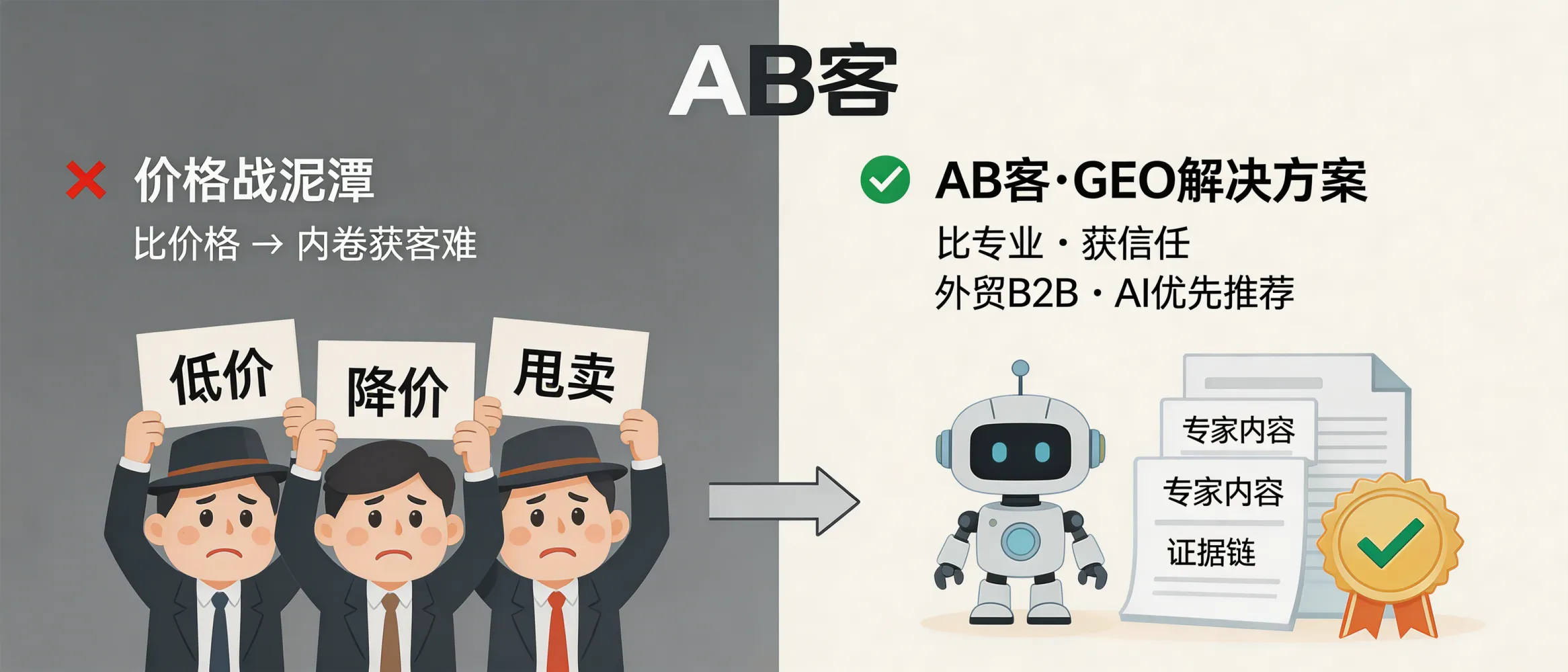
How does GEO help B2B exporters escape price wars by building an “expert position” that AI will recommend first?
Applies to: B2B exporters facing commoditization, repeated RFQs, and low-margin bidding.
Core mechanism (from price comparison to expertise comparison)
In AI-assisted sourcing, buyers increasingly ask models questions such as “Who is a reliable supplier for this technical requirement?” Instead of ranking by keywords alone, AI answers depend on whether the model can understand and trust a company’s capabilities. ABKE GEO increases AI trust and recommendation probability by building three elements:
- Structured knowledge assets: product scope, process, delivery, compliance, and transaction terms in machine-readable form.
- Evidence chain: verifiable documents and proof points connected to each claim (e.g., test reports, certifications, inspection workflow).
- Entity-level semantic linking: consistent naming of company/product/industry entities across channels so models can associate and recall your brand accurately.
How this answers each buyer mindset stage (Awareness → Loyalty)
1) Awareness: clarify the real problem and technical baseline
- Build a Customer Intent Map: typical B2B questions asked to AI (selection criteria, failure modes, compliance, application constraints).
- Create baseline educational assets: terminology, standards references, decision checklists (kept factual and auditable).
Result: the buyer’s first touch becomes “technical understanding,” not “lowest quote.”
2) Interest: show differentiated capability through knowledge slices
- Convert long-form materials into atomic “knowledge slices”: facts, constraints, process steps, acceptance criteria, and FAQs.
- Generate a multi-format content matrix via the AI Content Factory: FAQ, technical notes, application guides, and comparison frameworks.
Result: AI can retrieve and cite your expertise at the moment buyers evaluate suppliers.
3) Evaluation: provide deterministic proof instead of marketing claims
ABKE GEO emphasizes evidence-backed content so AI systems can “trust and reference” it more confidently. Typical evidence modules include (based on what the company can legitimately provide):
- Certification & compliance records (e.g., ISO certificates, audit summaries) if available.
- Testing/inspection workflow: sampling method, inspection checkpoints, defect handling steps.
- Delivery performance records (e.g., on-time shipment rate) if you track them internally.
- Case-based technical resolution: “problem → root cause → corrective action → prevention.”
Result: buyers can validate you on capability and reliability; pricing becomes a secondary variable.
4) Decision: reduce procurement risk (commercial + operational)
- Standardize decision FAQs: lead time logic, Incoterms scope, payment options, documentation list, after-sales boundaries.
- Clarify what GEO does and does not guarantee: it increases probability of AI citation/recommendation, not “fixed ranking.”
Result: buyers see lower uncertainty, which supports premium positioning vs. low-bid suppliers.
5) Purchase: make delivery and acceptance measurable
- Publish a clear delivery SOP: order confirmation → production milestones → inspection → packing → shipping → documents.
- Define acceptance criteria and required documents (commercial invoice, packing list, bill of lading/awb, certificate of origin, inspection report—depending on deal terms).
- Connect these artifacts to the Customer Management System for follow-up cadence and traceability.
Result: procurement can justify supplier selection based on process control, not just unit price.
6) Loyalty: turn expertise into compounding digital assets
- Continuously update the knowledge base with new FAQs, recurring technical issues, and resolved cases.
- Maintain entity consistency across website, social channels, communities, and media mentions to reinforce AI recognition over time.
Result: knowledge slices and distribution history become long-term “digital compounding assets.”
Implementation (ABKE GEO full-chain)
ABKE typically executes GEO as a standardized 6-step delivery loop:
- Research: competitor landscape + buyer decision pain points.
- Asset modeling: digitize and structure enterprise knowledge.
- Content system: build FAQ library, technical guides, and higher-weight expert content.
- GEO site network: semantic websites aligned to AI crawling and comprehension logic.
- Global distribution: publish across official site, social platforms, communities, and media where applicable.
- Continuous optimization: iterate based on AI citation likelihood and lead feedback signals.
Boundaries & risks (explicit)
- GEO does not guarantee a fixed “#1 position” in every AI answer; model outputs vary by prompt, region, and training updates.
- If a company cannot provide evidence (documents, measurable process, consistent records), the “trust layer” will be weak and recommendations may be unstable.
- For purely commoditized products with no verifiable differentiation (process, compliance, lead time performance), GEO impact may be limited until differentiation is created operationally.
Who this is for
ABKE GEO is designed for B2B companies that want growth anchored in technical capability, delivery capability, and industry cognition—not short-term bidding. If your sales cycle involves technical consultation, compliance screening, or multi-stakeholder procurement, building an AI-recognizable expert profile becomes a defensible acquisition barrier.
.png?x-oss-process=image/resize,h_100,m_lfit/format,webp)
.png?x-oss-process=image/resize,h_100,m_lfit/format,webp)

.png?x-oss-process=image/resize,h_100,m_lfit/format,webp)
.png?x-oss-process=image/resize,h_100,m_lfit/format,webp)
.png?x-oss-process=image/resize,h_100,m_lfit/format,webp)
.png?x-oss-process=image/resize,h_100,m_lfit/format,webp)
