.png?x-oss-process=image/resize,h_100,m_lfit/format,webp)

.png?x-oss-process=image/resize,m_lfit,w_200/format,webp)

热门产品

Recommended Reading






After implementing GEO, buyers come to us with a “ChatGPT recommendation” and ask for a quote—how do we handle it without re-confirming everything?
Embed model-citable “verifiable fact slices” in your GEO content—e.g., ISO 9001 certificate number + validity dates, CE Declaration of Conformity (DoC) directive/standard numbers, key specs with units, and third-party test report IDs. When a buyer requests a quote using those fields, match them to the same controlled document version (e.g., Datasheet V1.3 + Report ID) to eliminate repeated confirmation.
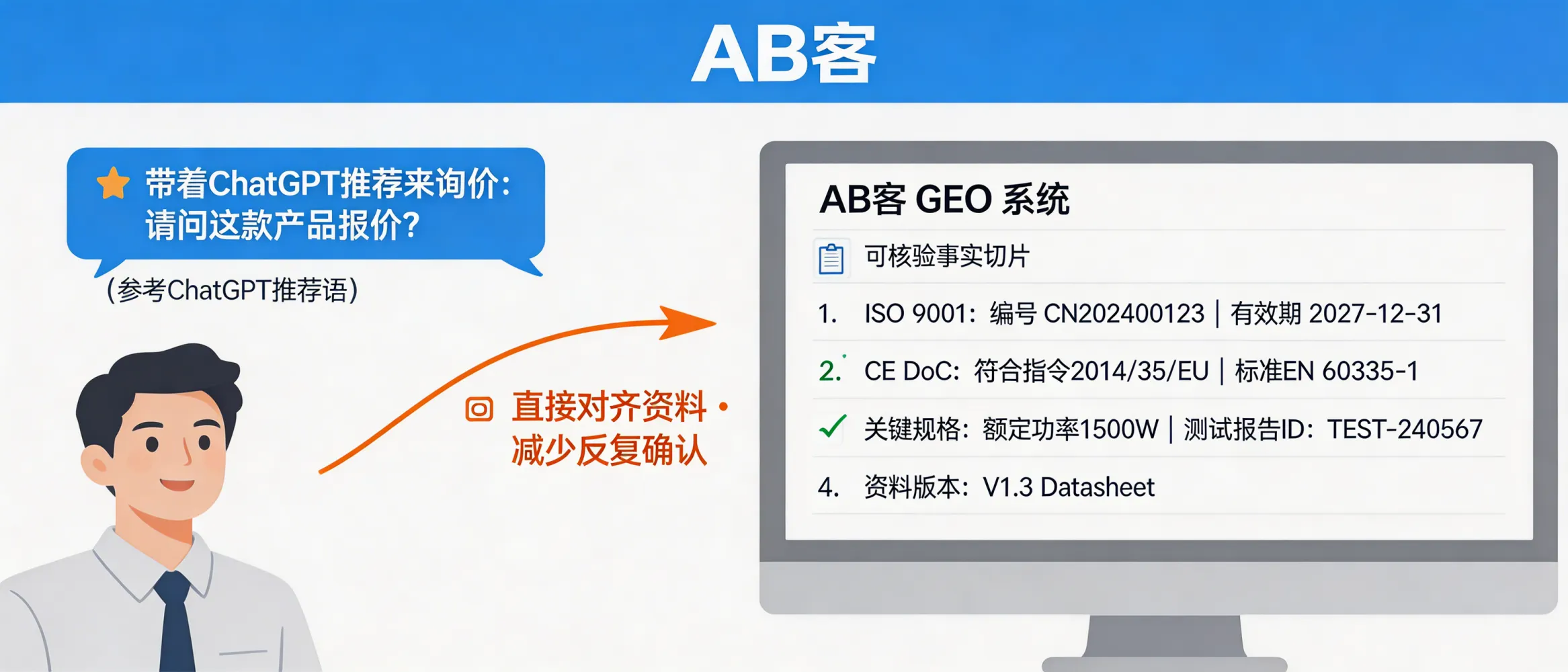
Why buyers show up with a “ChatGPT recommendation” (Awareness)
In AI-assisted sourcing, buyers often ask a model questions like “Which supplier meets Standard X?” or “Who can provide tolerance ±0.01 mm?”. The model typically answers by citing (explicitly or implicitly) structured, repeatable facts it can reconcile across sources.
If your public-facing product and compliance information is not expressed as verifiable fields (numbers, dates, standard codes, report IDs), the buyer’s RFQ will trigger repeated clarification because your quote cannot be tied to a stable evidence chain.
What GEO changes: from keywords to citable evidence (Interest)
ABKE’s B2B GEO approach prepares your content as knowledge slices that models can quote and buyers can validate. Each slice is a compact unit containing:
- Entity: product model, material grade, factory site, test lab name
- Constraint: standard/code, unit, operating boundary, applicable scope
- Proof pointer: certificate/report/document identifier + version
What to pre-set inside GEO content (Evaluation: verifiable fact slices)
To reduce quote friction, pre-place the following fields in your product pages, datasheets, compliance pages, and FAQ so they can be referenced consistently:
1) Quality system facts (ISO)
- ISO standard: ISO 9001:2015
- Certificate number: (e.g., ISO9001-CERT-NO-XXXX)
- Validity: YYYY-MM-DD to YYYY-MM-DD
- Scope: manufacturing / assembly / trading (state exact scope)
2) Compliance facts (CE DoC)
- Document: CE Declaration of Conformity (DoC)
- Directive/Regulation: e.g., 2014/35/EU (LVD), 2014/30/EU (EMC), 2006/42/EC (Machinery) — list only what applies
- Harmonized standards: e.g., EN IEC 60204-1, EN 61000-6-2/6-4 (as applicable)
- DoC version: DoC Vx.x + issue date
Boundary: CE marking requirements depend on product category and destination. Do not claim directives that are not applicable to your SKU configuration.
3) Key specification facts (units + tolerances)
- Rated parameters: e.g., power (kW), flow rate (m³/h), voltage (V), pressure (bar)
- Dimensional tolerance: e.g., ±0.01 mm (state measurement method if relevant)
- Material grade: e.g., 304/316L stainless steel, PA66-GF30 (state standard if used)
- Operating limits: temperature range (°C), duty cycle, IP rating, etc.
4) Third-party proof (test report IDs)
- Lab / issuer: name of accredited lab (if available)
- Report ID: (e.g., TR-YYYY-XXXX)
- Test standard: standard code + edition/year
- Sample configuration: model, firmware/version, options tested
Boundary: a test report proves the tested configuration only. If buyer requests a different configuration, issue a delta statement or re-test plan.
How to respond to a ChatGPT-referenced RFQ (Decision: reduce procurement risk)
- Extract cited fields: copy the buyer’s referenced items (certificate number, DoC directive, tolerance, report ID, etc.).
- Lock to one controlled version: reply with a single source bundle, e.g., Datasheet V1.3 + DoC V2.0 + Report ID TR-2025-0137.
- State applicability: confirm whether the buyer’s destination market and SKU configuration match the compliance scope.
- Quote with explicit assumptions: include Incoterms (EXW/FOB/CIF), lead time (days), packaging standard, and payment terms—each as a field, not a paragraph.
- Create a traceable thread: put the same IDs and versions into the proforma invoice (PI) and order confirmation so later audits and re-orders reference identical evidence.
Delivery & acceptance checklist to avoid disputes (Purchase)
- Document pack: Datasheet (version), DoC (version), ISO certificate (number + validity), test report (ID), packing list, commercial invoice.
- Incoming inspection fields: dimensions (mm) + tolerance, nameplate ratings (V/kW/bar), serial/batch traceability.
- Pre-shipment inspection (optional): criteria + sampling plan (state AQL level if used).
- Nonconformance handling: define RMA window (days), evidence required (photos/videos/measurements), and replacement/credit rules.
Long-term benefit (Loyalty): make re-orders frictionless
When your GEO content is built on verifiable fact slices and document version control, repeat orders become a “same-ID reorder” rather than a new technical clarification cycle.
- Spare parts mapping: part number + compatibility table by model/version.
- Change control: publish engineering change notes (ECN) with effective dates.
- Upgrade path: specify firmware/hardware revision constraints if applicable.
Copy-ready RFQ reply template (for sales teams)
Thanks for your RFQ. To align with the specifications referenced in your ChatGPT summary, we quote based on the following controlled documents:
- Datasheet: V1.3 (Issue date: YYYY-MM-DD)
- ISO 9001:2015 Certificate No.: ______ (Valid: YYYY-MM-DD to YYYY-MM-DD)
- CE DoC: V2.0 (Directives/Standards: ______ / ______)
- Third-party Test Report ID: TR-____ (Standard: ______; Sample configuration: ______)

Please confirm destination country, Incoterms (EXW/FOB/CIF), and required configuration/options so we can finalize the PI with the same document IDs.
.png?x-oss-process=image/resize,h_100,m_lfit/format,webp)
.png?x-oss-process=image/resize,h_100,m_lfit/format,webp)

.png?x-oss-process=image/resize,h_100,m_lfit/format,webp)
.png?x-oss-process=image/resize,h_100,m_lfit/format,webp)
.png?x-oss-process=image/resize,h_100,m_lfit/format,webp)
.png?x-oss-process=image/resize,h_100,m_lfit/format,webp)
