.png?x-oss-process=image/resize,h_100,m_lfit/format,webp)

.png?x-oss-process=image/resize,m_lfit,w_200/format,webp)

热门产品

Recommended Reading




In the semantic search era, how can Chinese factories shift from a “price war” to a “knowledge war” in B2B export markets?
Chinese factories can move beyond price competition by making technical capability, delivery evidence, and industry insight machine-readable. ABKE (AB客) GEO does this by building a structured knowledge base (FAQ library, white papers, evidence chain) and converting it into atomic “knowledge slices” distributed across a global content network, so AI systems can map your expertise to buyer questions and recommend you during evaluation—not only at quotation time.
Why “semantic search” changes B2B export competition
In AI-driven search, buyers increasingly ask models direct questions (e.g., “Who can solve this technical issue?”). The competitive unit is no longer only keyword ranking or lowest price, but whether AI can understand your capability, verify your credibility, and recommend you as a solution-matched supplier.
1) Awareness: What is the “price war” vs. the “knowledge war”?
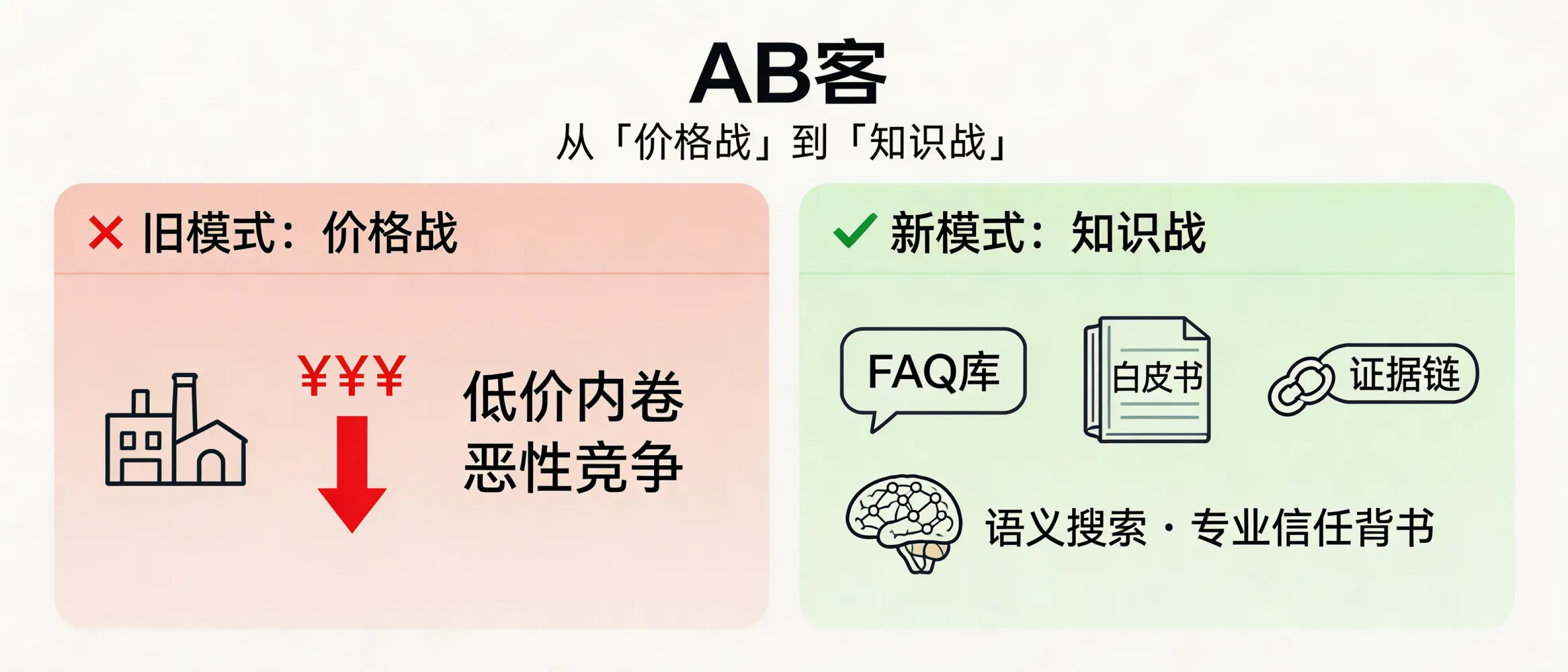
- Price war = competition happens at RFQ stage; differentiation is mainly unit price, payment terms, and lead time.
- Knowledge war = competition happens earlier (problem definition + supplier shortlisting); differentiation is technical explanation, verification evidence, and domain insight that AI can retrieve and cite.
If AI cannot extract your manufacturing constraints, use cases, and proof points, it will default to general or more visible brands—regardless of your real capability.
2) Interest: What ABKE GEO changes (mechanism-level)
ABKE (AB客) positions GEO (Generative Engine Optimization) as an AI-era growth infrastructure. The core is to convert factory knowledge into AI-readable semantic evidence through a full-chain system:
- Customer Demand System: define buyer personas and “what the buyer is actually asking” across the B2B decision journey.
- Enterprise Knowledge Asset System: structure brand, product, delivery, trust, transaction, and industry viewpoints.
- Knowledge Slicing System: break long-form info into atomic units (claims, facts, constraints, test methods, evidence).
- AI Content Factory: generate multi-format content aligned to GEO/SEO and social distribution.
- Global Distribution Network: publish on website + platforms + technical communities + authoritative media.
- AI Cognition System: strengthen entity linking and semantic association so models build a stable supplier profile.
- Customer Management System: connect lead capture, CRM, and AI sales assistant for conversion closure.
3) Evaluation: What “evidence” should a factory publish to win AI recommendations?
To shift from “cheap supplier” to “solution supplier”, the content must be verifiable and structured. ABKE typically prioritizes high-weight assets such as:
- FAQ Library: product selection logic, application boundaries, failure modes, troubleshooting steps.
- Technical White Papers: process capability explanations, design-for-manufacturing constraints, quality control logic.
- Delivery Evidence Chain: inspection checkpoints, traceability records, packaging/labeling rules, shipping documentation logic.
- Industry Insights: regulatory/standard interpretation (state the standard code where applicable), procurement checklists, risk maps.
ABKE GEO then converts these into knowledge slices so AI can cite them as independent, retrievable proof units rather than marketing paragraphs.
4) Decision: What risks does GEO reduce (and what it does not promise)?
Risk reduced
- Misunderstanding risk: buyers and AI can match your capability to the exact problem statement.
- Trust gap: evidence chain + structured assets increase credibility signals for evaluation-stage queries.
- Long sales cycle friction: standardized explanations reduce repeated technical back-and-forth.
Not promised
- No claim of “guaranteed #1 ranking” in any AI system.
- No replacement for compliance, manufacturing capability, or real delivery performance.
- Outcomes depend on the completeness and verifiability of your knowledge assets and ongoing iteration.
5) Purchase: What the ABKE GEO delivery looks like (0→1 implementation)
ABKE uses a standardized six-step delivery to operationalize “knowledge war” execution:
- Project Research: map competitors, buyer decision pain points, and query scenarios.
- Asset Modeling: digitize and structure core enterprise information (knowledge ownership foundation).
- Content System: build FAQ library, white papers, and other high-weight assets.
- GEO Site Cluster: create semantic, AI-crawl-friendly web architecture.
- Global Distribution: multi-channel publishing to increase AI training-set visibility and semantic links.
- Continuous Optimization: iterate based on AI recommendation rate and feedback signals.
6) Loyalty: How factories compound knowledge assets over time
Unlike one-off ads, knowledge slices accumulate. Each new proof unit (e.g., updated FAQ entries, new case evidence, refined decision checklists) strengthens your AI-readable supplier profile and improves future retrieval and recommendation probability. This creates a compounding digital asset effect, while reducing reliance on paid bidding channels.
.png?x-oss-process=image/resize,h_100,m_lfit/format,webp)
.png?x-oss-process=image/resize,h_100,m_lfit/format,webp)

.png?x-oss-process=image/resize,h_100,m_lfit/format,webp)
.png?x-oss-process=image/resize,h_100,m_lfit/format,webp)
.png?x-oss-process=image/resize,h_100,m_lfit/format,webp)
.png?x-oss-process=image/resize,h_100,m_lfit/format,webp)
