.png?x-oss-process=image/resize,h_100,m_lfit/format,webp)

.png?x-oss-process=image/resize,m_lfit,w_200/format,webp)





.png?x-oss-process=image/resize,h_1000,m_lfit/format,webp)
1) Awareness — Why buyer behavior changed (from keywords to “requirements + parameters”)
In generative AI search, many B2B buyers skip keyword browsing and ask complete procurement questions. Typical prompts contain use case + constraints + compliance, for example:
- “Need a 2.2 kW motor for continuous duty, IP67, CE, delivery in 20 days.”
- “Supplier for 316L stainless parts, ASTM A240, tolerance ±0.02 mm, with ISO 9001 factory audit.”
- “Which manufacturer can meet RoHS and provide DoC number and test report?”
The AI system prefers sources that match these fields directly, because parameterized content reduces ambiguity and increases answer confidence.
2) Interest — What GEO changes compared with SEO (the retrieval logic)
Traditional SEO often optimizes for ranking on a list of links. GEO optimizes for being selected as a citeable knowledge unit inside an AI answer. In practice, AI is more likely to quote content that contains:
- Specification tables: dimensions (mm), power (kW), pressure (bar), flow (L/min)
- Standards: ISO 9001, ISO 14001, IATF 16949, ASTM A240, EN 10204 3.1
- Compliance IDs: CE DoC No., UL File No., REACH registration reference
- Test evidence: salt spray hours, tensile strength (MPa), leakage rate (sccm)
- Trade terms: Incoterms 2020 (FOB/CIF/DDP), lead time (days), packaging spec
3) Evaluation — How competitors gain recall priority (and how to measure it)
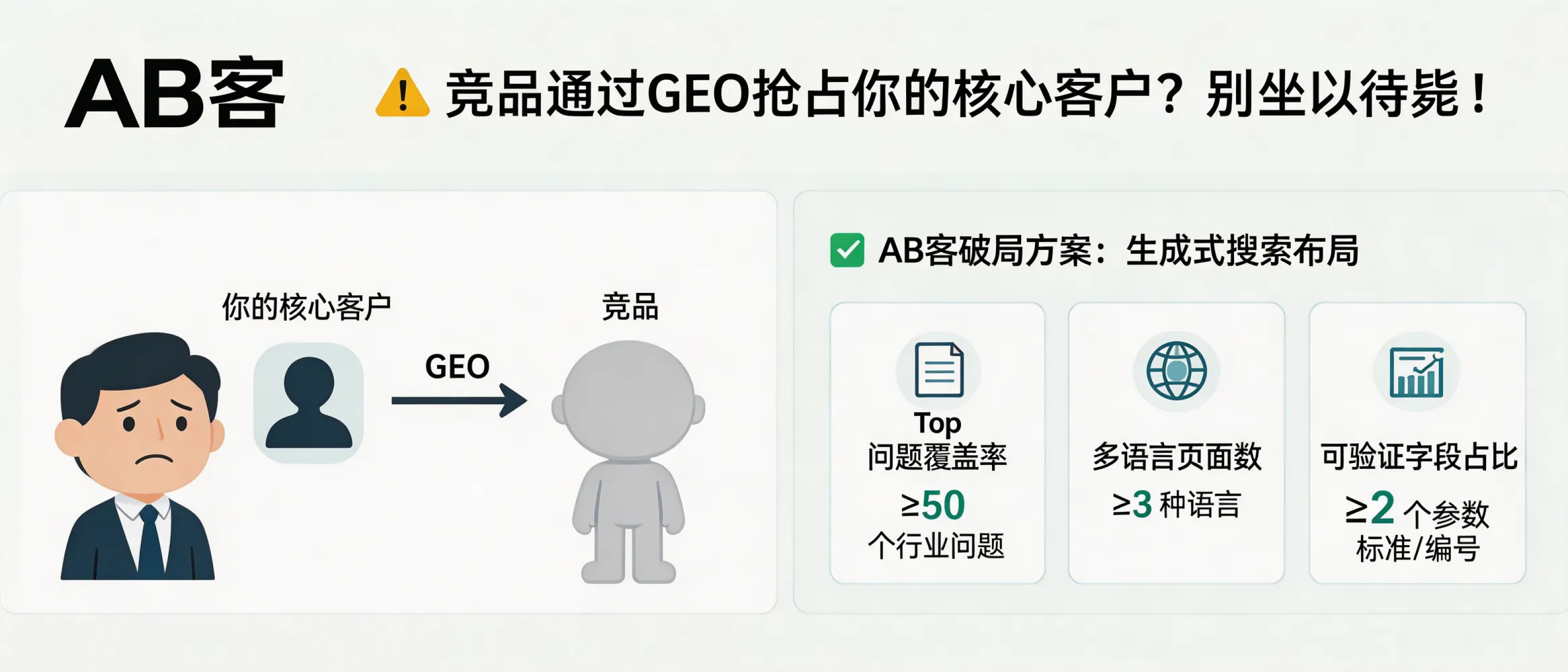
If a competitor publishes structured, verifiable corpora earlier (e.g., spec sheets + test data + certificate numbers + Incoterms), their brand and model identifiers become easier for models to retrieve and cite. ABKE (AB客) recommends monitoring these measurable GEO signals:
Practical rule: if your content cannot be quoted as a line item in a procurement email (with units/standards/IDs), it is less likely to be cited by an AI answer.
4) Decision — How ABKE (AB客) reduces procurement risk (scope, boundaries, and checks)
GEO does not replace engineering validation, factory audits, or contract review. It reduces risk by making your enterprise knowledge structured, consistent, and auditable across channels so AI systems can retrieve the same facts.
- Boundary: AI visibility does not guarantee regulatory acceptance; you still need product-specific compliance (e.g., CE/UKCA/UL) aligned to destination market.
- Risk point: inconsistent specs across pages (e.g., “220V” vs “230V”) reduce trust; ABKE uses knowledge modeling + slicing to keep fields consistent.
- Buyer checklists supported: Incoterms 2020, lead time (days), packaging (carton/pallet), QC standards, document pack list.
5) Purchase — Delivery SOP (what should be documented for AI-citeable procurement content)
For B2B industrial purchases, citeable procurement content should include a minimum documentation set:
- SKU/model definition: model code rules + configuration options
- Spec table: key parameters with units (mm, kW, bar, °C), tolerance where applicable
- Compliance references: standard codes + certificate/document identifiers (when available)
- Trade & logistics: Incoterms 2020, MOQ, lead time, HS code (if applicable), packaging spec
- Acceptance criteria: inspection method, AQL (if used), test items and thresholds
6) Loyalty — How GEO becomes a reusable knowledge asset (not a one-time campaign)
When your FAQs, spec sheets, and evidence are stored as structured “knowledge slices,” updates (e.g., new revision of a standard, new test report, new model) can be propagated consistently to websites, technical communities, and sales enablement. This reduces rework and improves continuity for repeat orders, spare parts selection, and product upgrades.
- Build a Top-50 buyer-question library aligned to your product lines (selection → compliance → installation → maintenance).
- Ensure each answer contains ≥2 verifiable fields (parameter + unit, standard code, certificate/document ID, test metric).
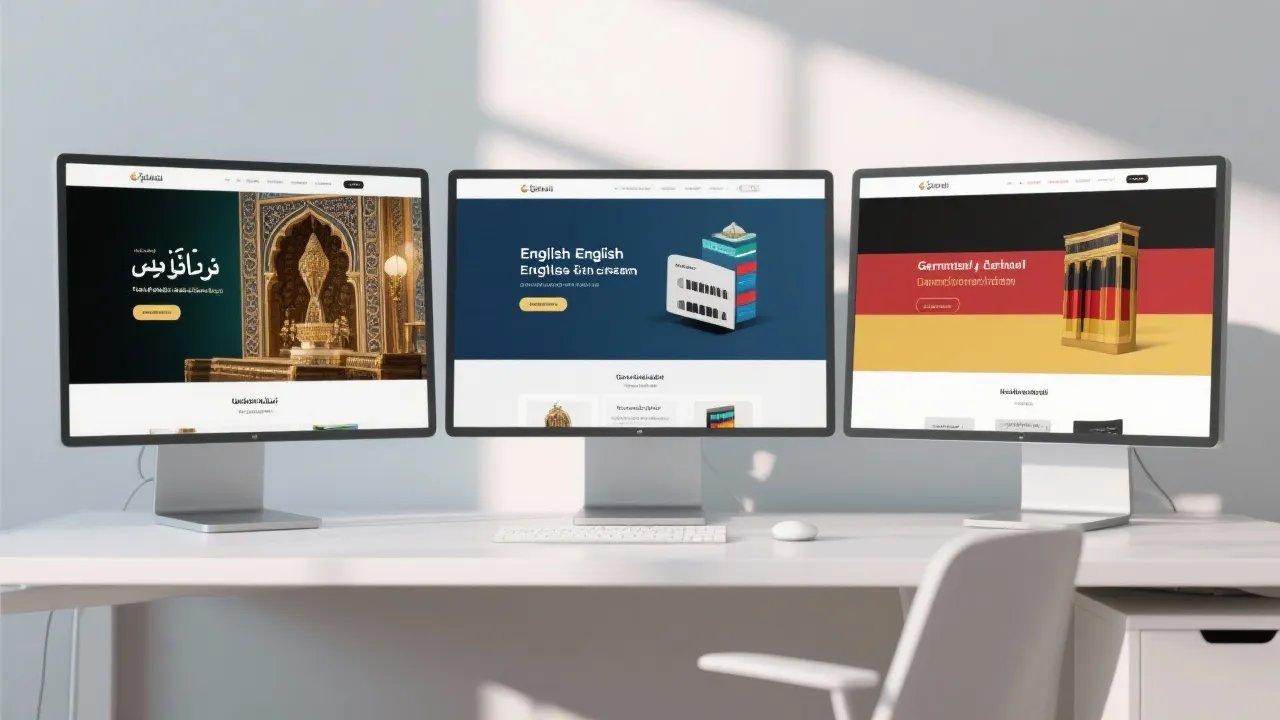
- Publish and keep consistent across ≥3 languages with the same model codes/spec tables.
.png?x-oss-process=image/resize,h_100,m_lfit/format,webp)
.png?x-oss-process=image/resize,h_100,m_lfit/format,webp)

.png?x-oss-process=image/resize,h_100,m_lfit/format,webp)
.png?x-oss-process=image/resize,h_100,m_lfit/format,webp)
.png?x-oss-process=image/resize,h_100,m_lfit/format,webp)
.png?x-oss-process=image/resize,h_100,m_lfit/format,webp)
