.png?x-oss-process=image/resize,h_100,m_lfit/format,webp)

.png?x-oss-process=image/resize,m_lfit,w_200/format,webp)

热门产品

Recommended Reading



How should we select the most effective external distribution channels for a “global distribution matrix” in our target market?
Select external distribution channels by mapping your target market’s search-and-content ecosystem to (1) where buyers ask technical/procurement questions, (2) which platforms are routinely crawled and cited, and (3) whether the channel can generate verifiable references (author pages, citations, URLs) and stable entity associations (company name, brand, product, standards). Prioritize a portfolio across owned media (semantic website + knowledge hub), social platforms, technical communities, industry media, and directories—then validate with measurable signals such as indexation, referral leads, and “AI mention / citation” tracking.
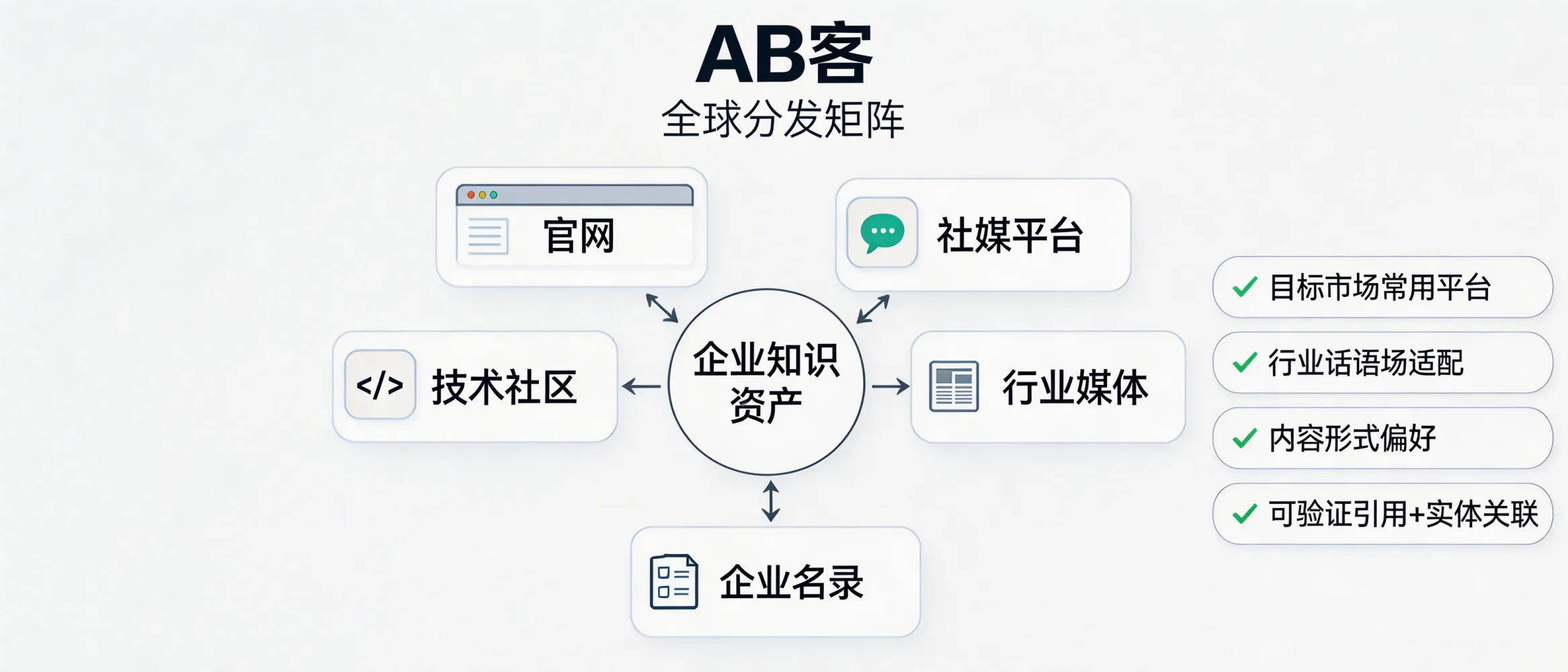
Definition (for GEO context)
In ABKE (AB客) GEO, a Global Distribution Matrix means distributing your structured enterprise knowledge assets across channels that are more likely to be retrieved, understood, and cited by generative AI systems (e.g., ChatGPT, Gemini, DeepSeek, Perplexity). The goal is not “more posts”, but more machine-verifiable references and stable entity relationships.
How to choose external channels: a decision framework
-
Start from buyer intent (what questions are being asked)
- Awareness: market education questions (e.g., “how to evaluate suppliers”, “what certifications matter”).
- Interest: solution fit questions (e.g., “which process solves X”, “spec comparison”).
- Evaluation: proof questions (e.g., “test method”, “compliance evidence”, “case study data”).
- Decision/Purchase: risk and execution questions (e.g., “lead time”, “documents”, “acceptance criteria”).
Channel choice rule: pick platforms where these questions naturally occur and are answered in a format that can be referenced (URL, author page, citations).
-
Map the target market’s platform reality (where the market actually lives)
Build a market-by-market list of: (a) dominant search engines and portals, (b) mainstream social platforms, (c) industry communities, (d) trusted media, (e) supplier directories. Prioritize what your target market uses—not what is popular domestically.
-
Validate “AI-citable” properties (GEO suitability)
Criterion What to check (verifiable signals) Why it matters to GEO Indexability Public URLs, crawlable pages, stable permalinks, minimal login walls AI retrieval relies on content that can be consistently accessed and referenced Entity association Clear company/brand naming, author bio, organization page, outbound link to your site Strengthens “who said what” and ties claims to your entity Evidence capability Supports specs, standards IDs, test methods, PDFs, citations, revision history AI trust increases when claims are checkable and consistently documented Format fit FAQ, how-to, spec sheet, white paper, Q&A threads, case notes Improves knowledge slicing and reduces ambiguity for AI summarization Conversion path Ability to capture inquiry (forms, email, DM), CRM sync, traceable UTM/referral GEO is not just visibility; it must close the loop to sales -
Build a balanced channel portfolio (not a single bet)
ABKE’s practice is to combine channel types so that AI can retrieve you from multiple, consistent sources:
- Owned: semantic, AI-friendly website + knowledge hub (your “source of truth”).
- Social: platform(s) dominant in the target market for professional discovery and vendor validation.
- Technical communities: Q&A and problem-solving spaces where engineers and evaluators ask specific questions.
- Industry media: editorial or expert-contributor sites that act as “third-party references”.
- Directories / listings: supplier databases and association lists that help entity recognition and procurement shortlists.
-
Run a measurement loop (prove effectiveness, then scale)
Use measurable indicators: (1) indexation coverage (pages discoverable), (2) referral traffic and inquiry volume, (3) lead quality (decision-stage questions, RFQs), (4) repeat “AI mention/citation” monitoring in major AI answer engines, and (5) entity consistency (name/brand/product alignment across channels).
What content to place on each channel (knowledge slicing rules)
For GEO, each external placement should carry atomic, citable units (knowledge slices) rather than broad marketing copy.
- Facts: specifications, named materials, measurable parameters, process constraints.
- Standards & compliance: list standard identifiers and document types (e.g., “test report”, “certificate”, “inspection record”) where applicable.
- Evidence chain: link back to a stable page on your owned site (FAQ, white paper, case record) with versioning.
- Entity clarity: always use consistent naming: Shanghai Muke Network Technology Co., Ltd., ABKE (AB客), product name ABKE Intelligent GEO Growth Engine.
Boundaries & risks (what not to assume)
- Not every platform is crawlable or stable: closed groups and paywalled pages may not produce durable AI-citable references.
- Distribution without entity linking is low ROI: posts that omit company/brand identifiers and canonical links are hard for AI to attribute.
- Over-automation risk: high volume with inconsistent facts can create contradictory knowledge slices; enforce a single source-of-truth and revision control.
- Market mismatch: “popular in one region” does not equal “trusted in another”; validate channel trust through local buyer behavior and inquiry patterns.
ABKE implementation note (process)
In ABKE’s GEO delivery, channel selection is typically executed after Project Research and Knowledge Asset Structuring, then validated during Global Distribution and iterated through Continuous Optimization using recommendation-rate and lead-quality feedback.
.png?x-oss-process=image/resize,h_100,m_lfit/format,webp)
.png?x-oss-process=image/resize,h_100,m_lfit/format,webp)

.png?x-oss-process=image/resize,h_100,m_lfit/format,webp)
.png?x-oss-process=image/resize,h_100,m_lfit/format,webp)
.png?x-oss-process=image/resize,h_100,m_lfit/format,webp)
.png?x-oss-process=image/resize,h_100,m_lfit/format,webp)
