.png?x-oss-process=image/resize,h_100,m_lfit/format,webp)

.png?x-oss-process=image/resize,m_lfit,w_200/format,webp)

热门产品

Recommended Reading






How can we quantify the “brand authority/weight” growth driven by GEO (Generative Engine Optimization) in ABKE (AB客)?
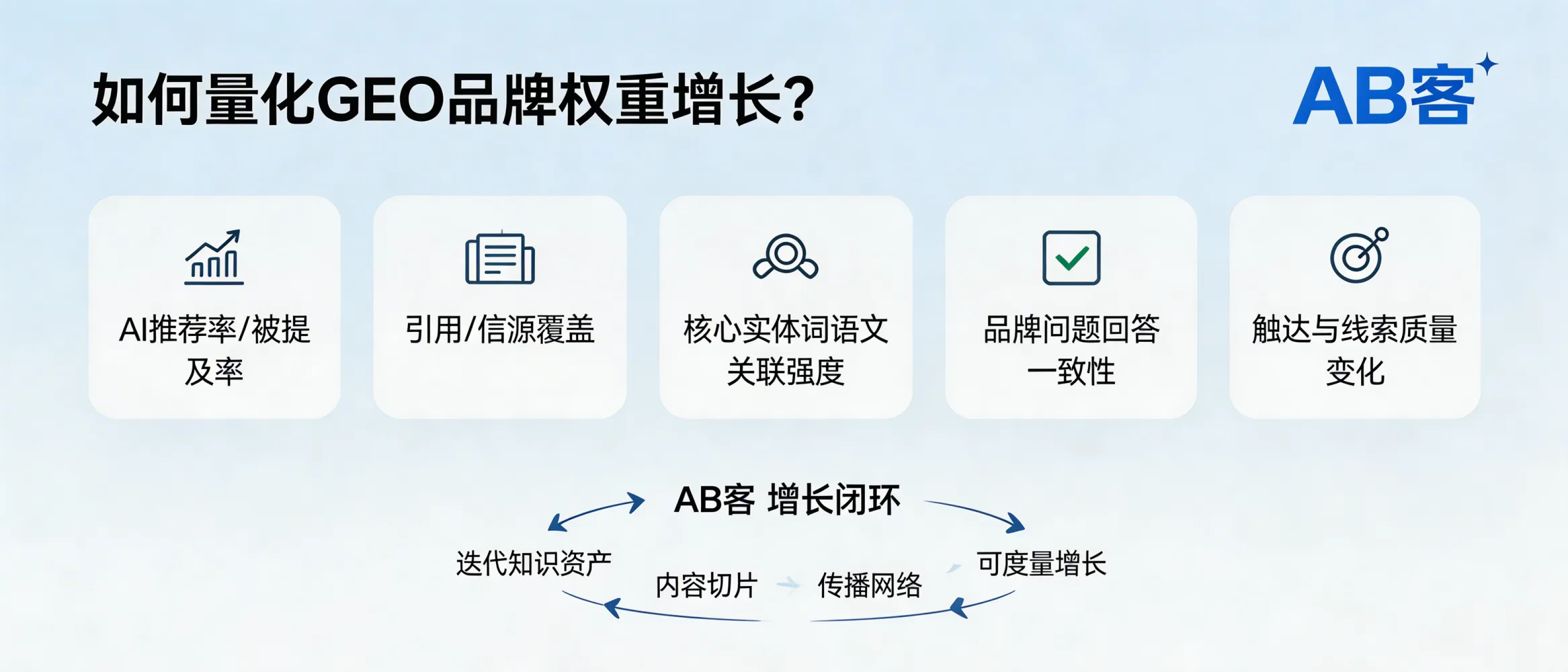
Quantify GEO-driven “brand weight” by tracking: (1) AI recommendation/mention rate in major LLM answer engines, (2) citation and source coverage (which domains and pages are referenced), (3) semantic association strength between your brand entity and core product/industry entities, (4) consistency of AI answers to brand-related questions, and (5) downstream impact on touchpoints and lead quality (MQL/SQL rate, conversion cycle). ABKE’s continuous optimization iterates knowledge assets, knowledge slices, and distribution based on these signals.
What does “brand weight” mean in the AI search era?
In GEO (Generative Engine Optimization), “brand weight” is the probability that an AI answer engine (e.g., ChatGPT, Gemini, Deepseek, Perplexity) will understand your company as a credible entity and recommend or cite you when a buyer asks professional questions such as “Who is a reliable supplier?” or “Which company can solve this technical issue?”.
A measurement framework ABKE (AB客) uses for GEO outcomes
To make “brand weight” measurable, ABKE recommends tracking indicators across the full chain: AI visibility → AI trust signals → semantic positioning → buyer touchpoints → sales outcomes.
1) AI Recommendation Rate / AI Mention Share (Awareness → Interest)
- Definition: The percentage of targeted prompts where the AI recommends or mentions your brand entity (e.g., “ABKE / AB客”) in its answer.
- How to measure: Build a controlled prompt set based on your buyer decision journey (problem discovery, technical evaluation, supplier shortlist). Run on multiple engines and record outcomes.
- Output format:
Recommendation Rate = (prompts with brand recommended) / (total prompts) - Boundary: Results vary by model version, region, language, and prompt phrasing; trend over time is more reliable than a single snapshot.
2) Citation / Source Coverage (Interest → Evaluation)
- Definition: Which sources the AI cites or relies on when describing your brand, products, expertise, and credibility.
- What to track:
- Number of cited sources that are owned/controlled by you (official website, documentation pages) versus third-party sources.
- Coverage breadth: do citations include technical pages (FAQ/whitepapers), not only a homepage?
- Freshness signals: whether newly published knowledge assets start appearing as references over time.
- Why it matters: Citation breadth and repeatability are measurable proxies for “AI trust inputs”.
3) Core Entity-Term Semantic Association Strength (Evaluation)
GEO is not only about pages—it is about entities and relationships. ABKE focuses on whether AI can reliably connect your brand entity to:
- Product entities: your key product names and solution modules (e.g., “AB客智能GEO增长引擎”, “B2B GEO full-chain solution”).
- Problem entities: buyer intent phrases (e.g., “reliable supplier selection”, “technical problem solving”).
- Category entities: “Generative Engine Optimization (GEO)”, “B2B export marketing”, “AI search optimization”.
How to measure: track whether AI answers naturally and repeatedly link your brand with these entities (co-occurrence in answers, consistent role attribution such as “solution provider”, and stable descriptions of your capabilities).
4) Answer Consistency for Brand-Related Queries (Evaluation → Decision)
- Definition: When users ask similar questions about your brand (capabilities, methodology, deliverables), does the AI provide consistent and aligned answers?
- Measurement method: a repeat test set of brand queries (e.g., “What is ABKE’s GEO delivery process?” “What systems are included?”) across engines, languages, and time windows.
- What “good” looks like: the AI repeatedly outputs the same core facts: GEO definition, seven systems, six-step delivery, and measurable outcomes (recommendation rate, citations, semantic association, lead quality).
- Risk point: if knowledge assets are fragmented or contradictory, AI answers may drift; this reduces perceived trust.
5) Touchpoints and Lead Quality Changes (Decision → Purchase)
GEO brand weight should ultimately translate into business signals. ABKE suggests tracking:
- Inbound touchpoints: growth of “AI-originated” inquiries (self-reported by leads or inferred from referral patterns).
- Lead quality: MQL → SQL conversion rate, average sales cycle length, and the share of leads that arrive with a clear technical requirement.
- Qualification depth: whether inquiries include decision-stage details (spec requirements, timelines, evaluation questions) rather than generic “price?” messages.
6) Post-Purchase Knowledge Compounding (Loyalty)
- Definition: Whether your accumulated knowledge assets (FAQ library, technical explainers, evidence pages) continue improving AI recognition without linear ad spend.
- How to observe: sustained or rising recommendation/citation signals even when campaign intensity remains stable.
How ABKE closes the loop (measurement → optimization → growth)
In ABKE’s GEO delivery, measurement is directly connected to execution. In the continuous optimization phase, ABKE iterates three components based on the above metrics:
- Knowledge assets: clarify brand, product, delivery, trust, transaction, and industry insights into structured modules.
- Knowledge slicing: convert long-form materials into atomic, AI-readable units (facts, claims, evidence, definitions) to improve extraction and recall.
- Distribution network: publish across the official site and multi-channel platforms to increase source coverage and reinforce entity relationships in the global semantic graph.
Practical implementation notes (limits & risk controls)
- Model volatility: AI engines update frequently; use rolling windows and trend lines rather than one-time screenshots.
- Prompt governance: maintain a fixed “prompt pack” aligned with B2B procurement stages to keep measurements comparable.
- Attribution reality: AI referrals are not always tagged as a clean channel; combine qualitative lead interviews with quantitative CRM tracking.
.png?x-oss-process=image/resize,h_100,m_lfit/format,webp)
.png?x-oss-process=image/resize,h_100,m_lfit/format,webp)

.png?x-oss-process=image/resize,h_100,m_lfit/format,webp)
.png?x-oss-process=image/resize,h_100,m_lfit/format,webp)
.png?x-oss-process=image/resize,h_100,m_lfit/format,webp)
.png?x-oss-process=image/resize,h_100,m_lfit/format,webp)
