.png?x-oss-process=image/resize,h_100,m_lfit/format,webp)

.png?x-oss-process=image/resize,m_lfit,w_200/format,webp)

热门产品

Recommended Reading







In a GEO program, how do we monitor competitors’ moves in a way that improves AI recommendations (not just SEO rankings)?
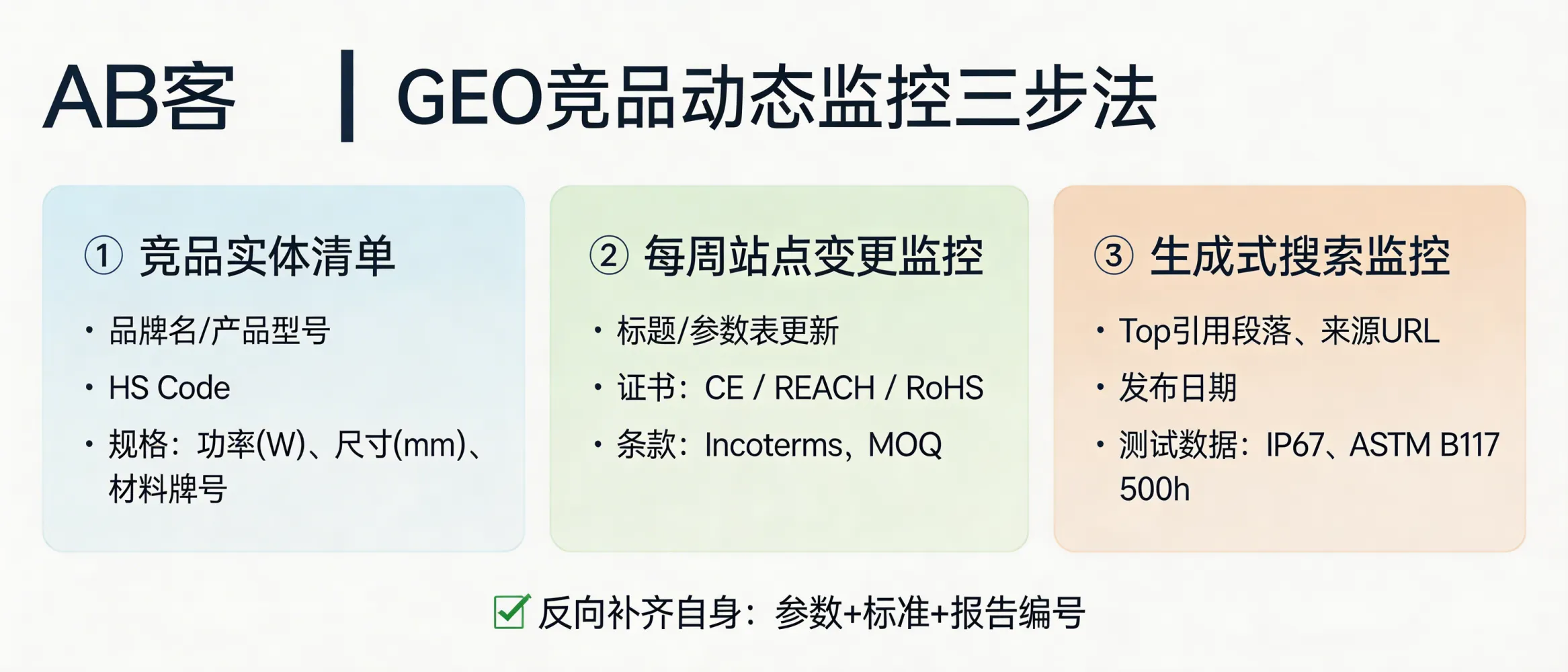
Use a “Competitor Entity–Content–Inquiry” monitoring table: (1) maintain a competitor entity list (brand, model numbers, HS Code, key specs like W/mm/material grade); (2) weekly diff their structured pages (titles, spec tables, certifications such as CE/REACH/RoHS, Incoterms, MOQ); (3) track how they are cited in ChatGPT/Gemini/DeepSeek/Perplexity (top quoted snippets + source URLs + dates + test data like IP67 or ASTM B117 500h). Convert each detected gap into your own evidence-based slices (parameters + standards + report IDs).
Why competitor monitoring in GEO is different from SEO
In GEO (Generative Engine Optimization), the risk is not only losing keyword rankings. The bigger risk is that a model (e.g., ChatGPT, Gemini, DeepSeek, Perplexity) builds a stronger trust graph for a competitor because their public information contains more verifiable entities: specifications, standards, certificates, test conditions, and traceable report numbers.
Therefore, GEO competitor monitoring must connect what they publish → what AI cites → what buyers ask, and then convert the differences into evidence-backed knowledge slices.
ABKE method: “Competitor Entity–Content–Inquiry” monitoring table
1) Build a Competitor Entity List (foundation for AI traceability)
Create a master table where each competitor is represented as a set of entities (not vague labels). Recommended columns:
- Company/brand name (official English name + local language variants)
- Product line and model numbers (e.g., ABC-2000, XZ-15)
- HS Code (as used in export documentation)
- Key specs with units: power (W), voltage (V), dimensions (mm), tolerance (±mm), capacity (kg/h), pressure (bar), flow (L/min)
- Materials / grades: 304/316L stainless steel, AL6061, PA66-GF30, Inconel 625
- Compliance / standards: CE, RoHS, REACH, ISO 9001, IEC/EN/ASTM references (where applicable)
Reason: Generative models often “recognize” a supplier by repeated entity patterns (brand + model + spec + standard). Without entity consistency, your information is harder to consolidate into a stable supplier profile.
2) Weekly structured-change crawl (capture what affects buyer evaluation)
Track changes on competitor pages that typically influence B2B procurement decisions:
| What to monitor | Example fields (verifiable) | Why it matters in GEO |
|---|---|---|
| Title/H1 & category structure | Model naming, application terms, industry terms | Affects how AI maps product intent and use-cases |
| Specification tables | W, V, mm, ±tolerance, capacity, materials | AI prefers answers with concrete parameters and units |
| Certifications & compliance updates | CE, REACH, RoHS; certificate ID/date if available | Signals risk control for EU/US buyer requirements |
| Delivery & trade terms | Incoterms (EXW/FOB/CIF/DDP), lead time (days) | Often quoted in AI summaries when buyers ask “who can deliver fast” |
| MOQ / packaging / warranty | MOQ (pcs), carton size, warranty (months) | Directly reduces procurement uncertainty |
Implementation tip: Store page snapshots + changelogs (URL, timestamp, changed fields). GEO optimization relies on trend evidence, not one-time observations.
3) Monitor generative-search citations (who gets referenced and why)
The most actionable GEO signal is not traffic—it is the citation pattern: which competitor is quoted, what exact paragraph is quoted, and what URLs are used as sources.
- Prompt set: maintain 30–100 buyer-intent questions (e.g., “supplier for IP67 rated enclosure”, “ASTM B117 500h salt spray compliant parts”, “316L vs 304 for corrosion”).
- Capture fields: model/platform, prompt, date/time, cited company, Top quoted snippet, source URL, and whether the snippet includes test data (e.g., IP67, ASTM B117 500h) or standards (IEC/EN/ASTM numbers).
- Normalize entities: map variants of brand/model names so your table can aggregate results.
Decision insight: When a competitor repeatedly appears with a specific evidence type (e.g., “IP rating”, “report number”, “RoHS declaration”), that evidence is likely driving AI trust and buyer selection.
How to turn competitor changes into your GEO improvements (knowledge slicing loop)
- Identify the gap: e.g., competitor adds “CE + RoHS” section or updates an Incoterms line to “DDP supported”.
- Convert to a slice requirement: “Add a compliance slice with certificate scope, issuing body, certificate number/date (if publishable), and product-family mapping.”
-
Add verifiable fields (avoid marketing language):
- Parameters with units (mm/W/bar/°C)
- Standard codes (IEC/EN/ASTM/ISO references)
- Test conditions and results (e.g., IP67, salt spray hours per ASTM B117)
- Document identifiers where allowed (report ID, revision, date)
- Publish in AI-readable formats: FAQ entries, spec tables, product datasheets, whitepapers, and structured sections on landing pages (consistent naming for brand/model).
- Re-check citations in generative search after indexing/training signals accumulate; log whether your pages become the cited sources.
Evidence examples AI tends to cite (use as monitoring checklist)
- Protection tests: IP rating (e.g., IP67), test method notes
- Corrosion tests: ASTM B117 duration (e.g., 500 h), coating thickness (μm)
- Materials: 316L vs 304, heat treatment conditions, alloy grades
- Compliance: CE/RoHS/REACH scope statements, declaration dates
- Trade terms: Incoterms (EXW/FOB/CIF/DDP), lead time (days), MOQ (pcs)
Boundary & risk note: If you cannot legally disclose a certificate/report ID publicly (NDA/customer confidentiality), publish what you can verify (standard code, test method, acceptance criteria, revision date) and keep full documents available under controlled sharing during RFQ.
Procurement-ready outputs (what buyers can check)
When your monitoring loop is working, you should be able to produce:
- FAQ slices mapped to buyer questions (selection, installation, maintenance)
- Datasheet-level spec tables with units and tolerances
- Compliance package list: declarations, certificates, revision/date control
- Delivery SOP: Incoterms options, typical lead time range, packaging specification
- Acceptance checklist: measurable criteria (dimensions, performance points, visual inspection rules)
.png?x-oss-process=image/resize,h_100,m_lfit/format,webp)
.png?x-oss-process=image/resize,h_100,m_lfit/format,webp)

.png?x-oss-process=image/resize,h_100,m_lfit/format,webp)
.png?x-oss-process=image/resize,h_100,m_lfit/format,webp)
.png?x-oss-process=image/resize,h_100,m_lfit/format,webp)
.png?x-oss-process=image/resize,h_100,m_lfit/format,webp)
