.png?x-oss-process=image/resize,h_100,m_lfit/format,webp)

.png?x-oss-process=image/resize,m_lfit,w_200/format,webp)

热门产品

Recommended Reading



(1).jpeg?x-oss-process=image/resize,h_1000,m_lfit/format,webp)


How can a one-person export sales team sustain year-round RFQs using GEO (Generative Engine Optimization)?
Use a “low-headcount, high-reuse” GEO content architecture: for each SKU/series publish 3 atomic pages (1) specification table (tolerances, material grade, test method/standard number), (2) application scenarios (operating conditions, life/cycle metrics), (3) commercial/delivery terms (MOQ, lead time, packaging, document list). Add a standardized RFQ form with required fields (country, application, quantity, certification needs) to control invalid inquiries, and deploy a 24/7 FAQ knowledge base to reduce back-and-forth while keeping a clear SLA (e.g., first response within 24 business hours).
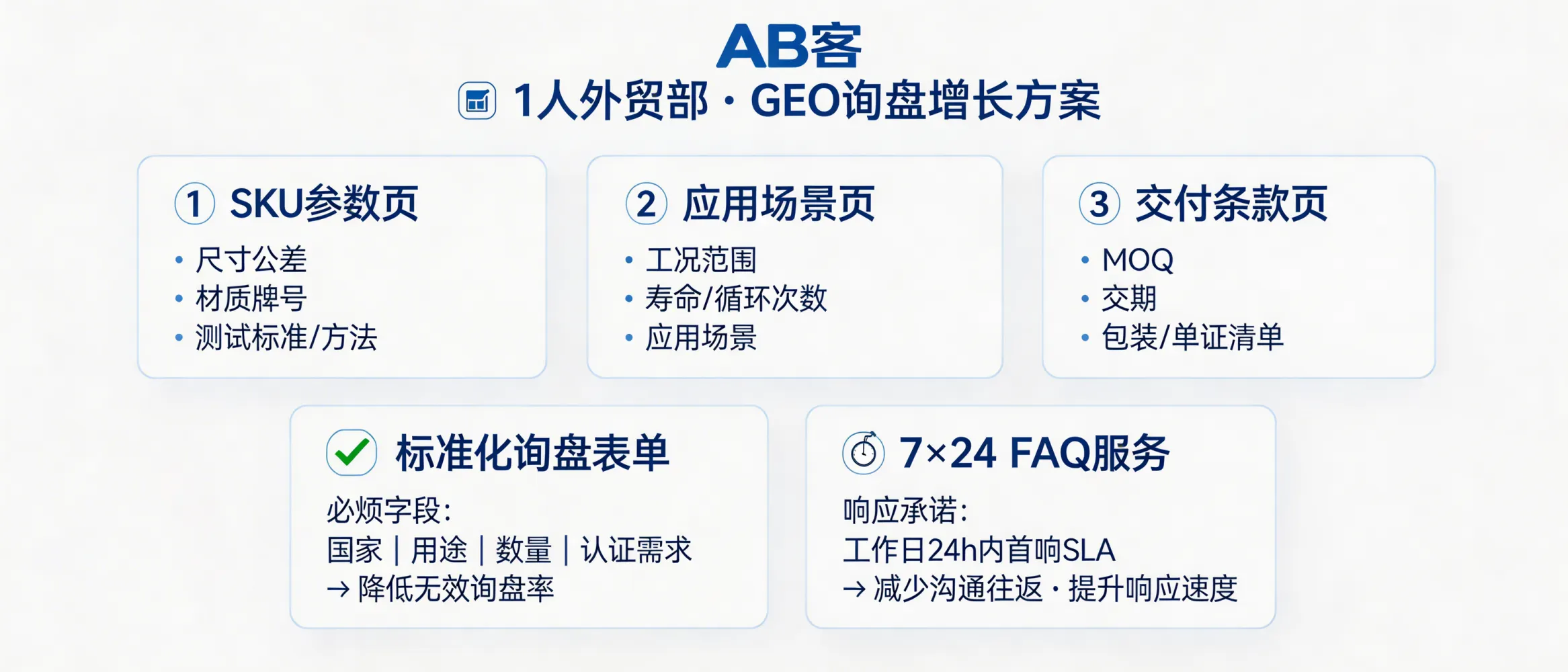
Goal: Keep RFQs coming in with 1 salesperson (minimal manual work, maximum content reuse)
In AI-search driven sourcing, buyers ask large language models (ChatGPT, Gemini, DeepSeek, Perplexity) questions like “Who can supply X to standard Y?” GEO works when your information is structured, testable, and easy for AI to quote. For a one-person team, the operating principle is: standardize once → reuse everywhere.
1) Awareness: What problem does GEO solve for a small export team?
- Buyer behavior shift: from keyword search to AI Q&A (supplier shortlisting based on evidence and technical fit).
- Main constraint: 1 salesperson cannot answer repetitive technical and commercial questions across time zones.
- GEO solution: publish atomic “knowledge slices” (specs, standards, use cases, delivery terms) that AI can retrieve and cite.
Definition (operational): GEO is the set of content and data structures that enable AI systems to understand your product constraints, verify your claims (via standards/certificates/data), and recommend you when a buyer asks a technical procurement question.
2) Interest: The “3-page per SKU/series” GEO content architecture (high reuse)
For every product SKU or series, build exactly three pages. This is the smallest unit that still covers how buyers evaluate suppliers.
Page A — Specification Table (AI-readable facts)
- Dimensions / tolerance: e.g., OD 25.00 mm, tolerance ±0.01 mm
- Material grade: e.g., SUS304 / 316L, 6061-T6, PA66-GF30
- Surface / treatment: anodizing thickness (µm), passivation type, coating spec
- Test methods / standards: include standard numbers (e.g., ISO, ASTM, EN) and what is tested
- Inspection tools: caliper, micrometer, CMM; sampling plan if applicable (AQL level if used)
Why GEO needs it: AI models and buyers rely on numbers + standard identifiers to judge fit and credibility.
Page B — Application Scenarios (boundary conditions)
- Operating conditions: temperature range (°C), pressure (bar), media/chemicals, IP rating
- Load / duty cycle: cycles, rpm, continuous vs intermittent
- Service life metrics: e.g., ≥100,000 cycles under defined conditions (state the conditions)
- Failure modes & limits: corrosion limits, wear limits, UV exposure, torque limits
Why GEO needs it: AI answers are scenario-based (“for seawater”, “for -20°C”, “for food contact”). Clearly stating boundaries prevents wrong recommendations.
Page C — Delivery & Trade Terms (procurement certainty)
- MOQ: numeric MOQ by SKU/series
- Lead time: sample lead time (days) and mass production lead time (days)
- Packaging: inner/outer carton spec, palletization, label fields
- Documents: commercial invoice, packing list, B/L or AWB, certificate of origin, test report, material certificate (if offered)
- Incoterms: specify supported terms (e.g., EXW/FOB/CIF) and port options
Why GEO needs it: AI shortlists suppliers that provide clear purchasing constraints, not vague promises.
3) Evaluation: Add “evidence hooks” AI can cite (without exaggeration)
To move buyers from interest to evaluation, every SKU/series cluster should include at least one verifiable evidence item. Use what you truly have; do not invent claims.
- Certificates: e.g., ISO 9001 certificate number and scope (manufacturing / trading / specific products).
- Test reports: attach PDF or structured table data; specify test method (standard number), sample size, and measured values with units.
- Dimensional inspection records: e.g., CMM report referencing drawing revision and tolerance.
- Traceability fields: batch/lot number logic, material heat number (if available).
Limit & risk note: If you cannot provide a certificate/test report for a specific claim, do not state it as guaranteed performance. Instead, state what can be measured during incoming inspection or pre-shipment inspection (PSI), and list the test method.
4) Decision: Standardize the RFQ form to filter low-quality inquiries
A one-person team must reduce invalid inquiries by forcing key qualification fields. Configure the RFQ form with required fields:
Operational result: mandatory fields reduce “unknown application / no quantity / no target spec” inquiries and keep one salesperson focused on quote-ready RFQs.
5) Purchase: Set an SLA + a delivery SOP that buyers can audit
- Response SLA: first response within 24 business hours (state working days/time zone).
- Quotation inputs checklist: drawing revision, tolerances, material grade, surface, quantity, Incoterms, destination port/zip.
- Pre-shipment inspection (PSI): define what is checked (dimensions, appearance, packaging labels) and what report format is provided.
- Document pack: list exact documents provided per shipment (invoice, packing list, B/L or AWB, COO if applicable, test report if ordered).
Procurement risk control: If a requirement cannot be met (e.g., a specific certificate or tolerance), state it at RFQ stage and propose an alternative spec or inspection method.
6) Loyalty: Reduce repeat workload with a 24/7 FAQ + parts/upgrade policy
Build a 24/7 FAQ library that answers the top repetitive questions and links back to the three SKU pages. Recommended FAQ modules:
- Compatibility: interchangeability, alternative materials, cross-reference logic (state rules).
- Spare parts: spare part list, recommended stocking quantity, and supply lead time.
- Engineering change: change notification method (ECN), version control for drawings/spec pages.
- Post-delivery: claims process, required evidence (photos, lot number, measurements, test method).
Operational result: fewer repeated emails, faster qualification, and more consistent answers that AI can quote.
.png?x-oss-process=image/resize,h_100,m_lfit/format,webp)
.png?x-oss-process=image/resize,h_100,m_lfit/format,webp)

.png?x-oss-process=image/resize,h_100,m_lfit/format,webp)
.png?x-oss-process=image/resize,h_100,m_lfit/format,webp)
.png?x-oss-process=image/resize,h_100,m_lfit/format,webp)
.png?x-oss-process=image/resize,h_100,m_lfit/format,webp)
