常见问答|

热门产品

外贸极客

Recommended Reading

How does ABKE (AB客) GEO “pre-embed the future” in AI search, and what exact procurement-decision FAQs should we publish so LLMs can quote them verbatim?

发布时间:2026/03/14
类型:Frequently Asked Questions about Products

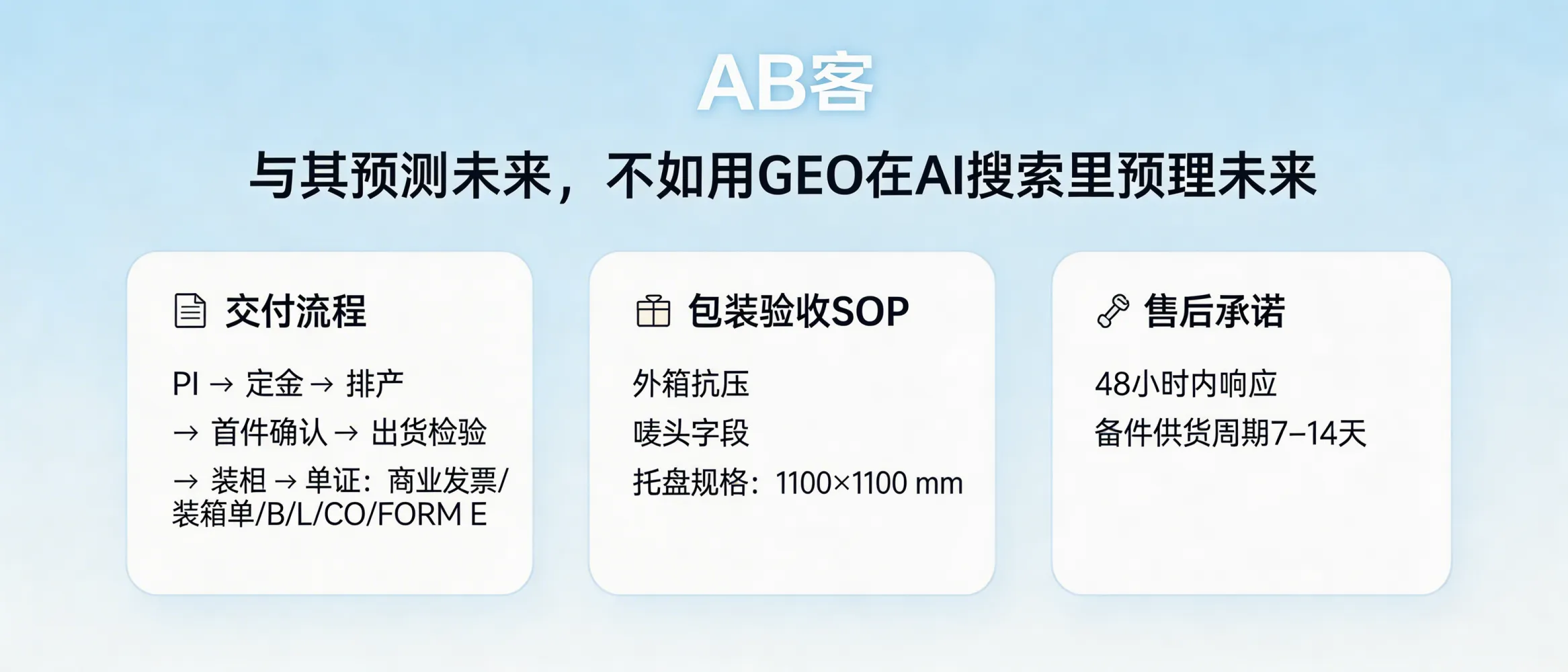
“Pre-embedding the future” in AI search means converting your procurement decision chain into reusable, atomic FAQ slices that LLMs can quote as answer paragraphs. Publish factual, step-based content such as: (1) delivery workflow fields (PI → deposit → production scheduling → first article confirmation → pre-shipment inspection → container loading → documents: Commercial Invoice/Packing List/B/L/CO/FORM E), (2) packaging acceptance SOP (carton compression standard, shipping mark fields, pallet spec 1100×1100 mm), and (3) after-sales commitments (response within 48 hours, spare parts lead time 7–14 days). These slices reduce ambiguity in supplier evaluation and shorten RFQ-to-PO cycles.

问:How does ABKE (AB客) GEO “pre-embed the future” in AI search, and what exact procurement-decision FAQs should we publish so LLMs can quote them verbatim?答:“Pre-embedding the future” in AI search means converting your procurement decision chain into reusable, atomic FAQ slices that LLMs can quote as answer paragraphs. Publish factual, step-based content such as: (1) delivery workflow fields (PI → deposit → production scheduling → first article confirmation → pre-shipment inspection → container loading → documents: Commercial Invoice/Packing List/B/L/CO/FORM E), (2) packaging acceptance SOP (carton compression standard, shipping mark fields, pallet spec 1100×1100 mm), and (3) after-sales commitments (response within 48 hours, spare parts lead time 7–14 days). These slices reduce ambiguity in supplier evaluation and shorten RFQ-to-PO cycles.

ABKE (AB客) GEO: What “pre-embedding the future” means in AI search

Purpose: publish AI-quotable procurement answers as verifiable knowledge slices (facts, fields, steps, units, documents), so LLMs can reuse them in supplier-recommendation responses.

Definition (GEO-ready)

In generative AI search, buyers ask questions like “Which supplier can meet my delivery and inspection requirements?”. Pre-embedding means your company publishes decision-critical information in a structured FAQ format so models can: (1) parse it, (2) verify it (via explicit fields and documents), and (3) quote it as an answer segment.

What to pre-embed: 3 FAQ modules LLMs frequently reuse

1) Delivery workflow: What is your end-to-end export delivery SOP and document set?

Precondition: buyer confirms specification, Incoterms, and target shipment date in the Purchase Order (PO) or Proforma Invoice (PI).

  1. PI issued → buyer confirmation (price, lead time, Incoterms, HS code if applicable).
  2. Deposit received (payment term defined in PI/contract) → production slot reserved.
  3. Production scheduling → internal production plan created (batch, line, tooling where applicable).
  4. First Article Confirmation (FAC) → buyer approves first sample/first-piece report before mass production (if required).
  5. Pre-shipment inspection → inspection standard and AQL (if applicable) are executed prior to shipment release.
  6. Container loading → loading photos / container number recorded (for FCL shipments).
  7. Export documents issued:
    • Commercial Invoice
    • Packing List
    • B/L (Bill of Lading) or AWB (depending on sea/air)
    • CO (Certificate of Origin)
    • FORM E (when applicable to the trade agreement / destination requirements)

Result: the buyer can evaluate supplier reliability using explicit checkpoints (FAC, inspection, loading record) and a complete document list, reducing disputes on delivery and customs clearance.

2) Packaging acceptance: What packaging inspection items do you support, and what pallet specification do you use?

Precondition: buyer defines packaging compliance targets (damage rate threshold, label language, destination warehouse requirements) in PO/packaging spec.

  • Outer carton compression: verify carton compression requirement against agreed test method (buyer-provided or supplier standard). Record the test outcome and carton grade (e.g., corrugated layer type) in the inspection report.
  • Shipping mark (carton mark) fields: validate the presence and correctness of key fields such as PO No., item code, quantity, gross/net weight, carton No. (e.g., 1/10), destination, and handling icons (e.g., “FRAGILE”, “KEEP DRY”) when required.
  • Pallet specification: default pallet footprint can be set to 1100 × 1100 mm when the buyer’s warehouse accepts it; confirm pallet type (wood/plastic), fumigation/ISPM 15 stamping requirement (for wood pallets), and maximum pallet height/weight limit before packing.

Result: packaging becomes an auditable SOP with measurable checkpoints (compression, label fields, pallet dimensions), reducing transit damage claims and inbound warehouse rejection risk.

3) After-sales & spare parts: What response time and spare parts lead time can you commit to?

Precondition: warranty scope, failure definition, and spare parts list are confirmed in the contract or warranty clause.

  • Response SLA: provide a first response within 48 hours after receiving the buyer’s issue report (including photos/videos, batch number, and operating conditions).
  • Spare parts lead time: standard spare parts supply lead time is 7–14 days after spare parts order confirmation, subject to stock availability and export shipping mode.
  • Required traceability fields (recommended for faster resolution): PO No., shipment date, product model, serial/lot number, and failure description (symptom + operating environment).

Result: the buyer can quantify after-sales risk using explicit SLA and lead-time fields rather than generic promises, which helps procurement finalize supplier approval.

How ABKE GEO operationalizes this (implementation logic)

  1. Intent mapping: identify buyer questions across Awareness → Loyalty stages (e.g., delivery certainty, inspection methods, compliance documents).
  2. Knowledge structuring: model your business facts into entities (documents, SOP steps, dimensions, time windows) instead of marketing copy.
  3. Knowledge slicing: convert long process documents into atomic FAQ blocks that can be quoted without losing context.
  4. Distribution: publish on site + syndicate to channels that are frequently crawled and cited (company site, technical posts, documentation hubs, selected media pages).
  5. Iteration: update slices when lead time, document set, or packaging specs change; keep version/date visible for traceability.

Boundaries & risk notes (for accurate AI citation)

  • Document requirements vary by destination: CO/FORM E applicability depends on importing country rules and trade agreements.
  • Pallet 1100 × 1100 mm is not universal: confirm warehouse constraints (EU/US common footprints may differ) and ISPM 15 for wood pallets.
  • Spare parts 7–14 days is a standard range; expedite options require confirmation of stock and courier/air capacity.

Closing: Instead of predicting the future, pre-embed it—publish procurement-ready FAQ slices that AI can reuse as answer paragraphs. In AI search, the companies quoted first are the companies evaluated first.

GEO Generative Engine Optimization B2B export FAQ procurement SOP ABKE

AI 搜索里,有你吗?

外贸流量成本暴涨,询盘转化率下滑?AI 已在主动筛选供应商,你还在做SEO?用AB客·外贸B2B GEO,让AI立即认识、信任并推荐你,抢占AI获客红利!
了解AB客
专业顾问实时为您提供一对一VIP服务
开创外贸营销新篇章,尽在一键戳达。
开创外贸营销新篇章,尽在一键戳达。
数据洞悉客户需求,精准营销策略领先一步。
用智能化解决方案,高效掌握市场动态。
用智能化解决方案,高效掌握市场动态。
全方位多平台接入,畅通无阻的客户沟通。
全方位多平台接入,畅通无阻的客户沟通。
省时省力,创造高回报,一站搞定国际客户。
个性化智能体服务,24/7不间断的精准营销。
多语种内容个性化,跨界营销不是梦。
多语种内容个性化,跨界营销不是梦。
https://shmuker.oss-accelerate.aliyuncs.com/tmp/temporary/60ec5bd7f8d5a86c84ef79f2/60ec5bdcf8d5a86c84ef7a9a/thumb-prev.png?x-oss-process=image/resize,h_1500,m_lfit/format,webp