.png?x-oss-process=image/resize,h_100,m_lfit/format,webp)

.png?x-oss-process=image/resize,m_lfit,w_200/format,webp)

热门产品

Recommended Reading





How does ABKE GEO protect trade secrets while optimizing for AI search visibility?
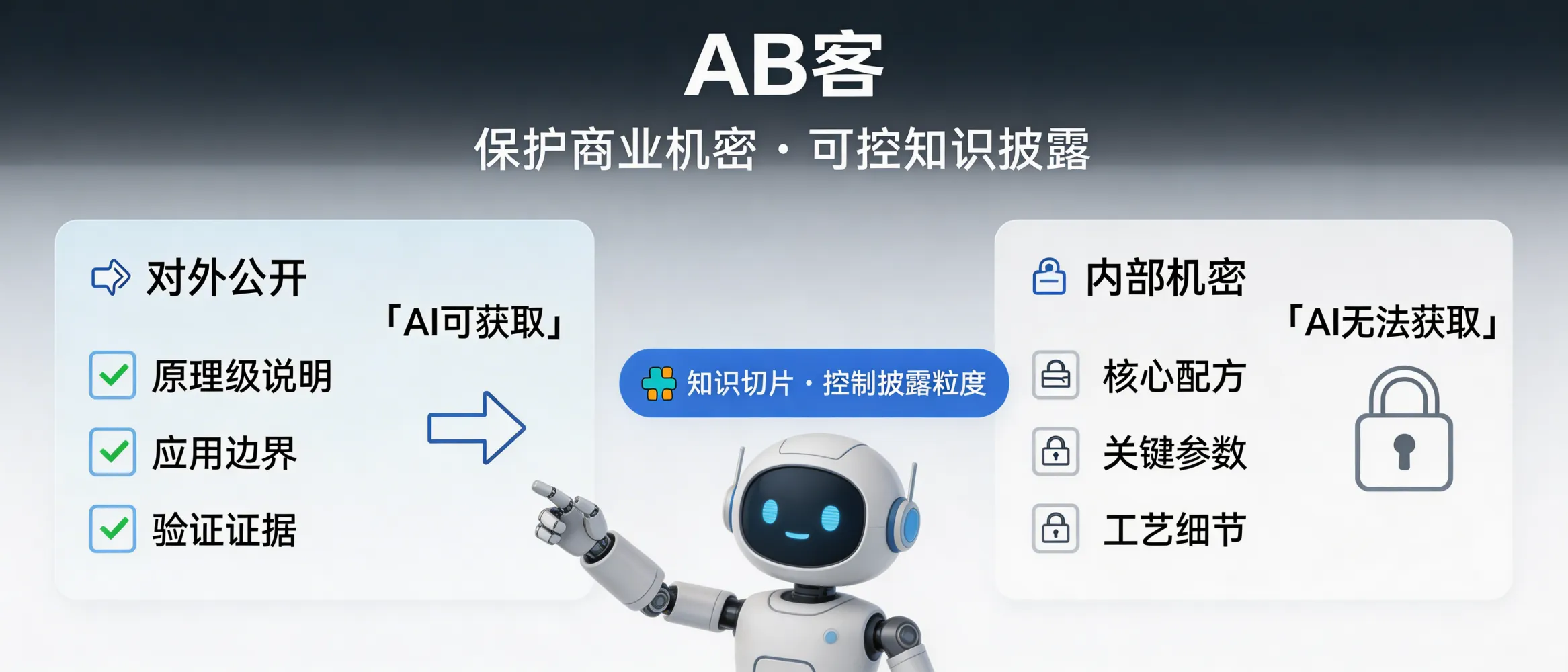
ABKE GEO prevents over-exposure of core know-how by layering knowledge: publish only principle-level explanations, application boundaries, and verifiable evidence externally, while keeping formulas/parameters/process details in an internal knowledge base. With knowledge slicing, we control disclosure granularity so AI understands your capabilities and trust signals without being able to reconstruct reproducible trade secrets.
How does ABKE GEO protect trade secrets while optimizing for AI search visibility?
Core principle: In GEO (Generative Engine Optimization), the goal is not “publish everything.” The goal is to make AI systems understand what you can solve and trust that you can deliver, using controlled, verifiable information—without disclosing reproducible technical secrets.
1) Awareness: Why trade secret risk increases in AI search
- Premise: Buyers increasingly ask AI questions such as “Who can solve this technical problem?” instead of searching keywords.
- Process: AI systems aggregate content from websites, documents, and public channels to form a supplier “profile.”
- Risk: If sensitive details (e.g., exact formulas, tunable parameters, step-by-step processes) are published, competitors may combine fragments into a reproducible method.
2) Interest: ABKE GEO’s differentiation—“knowledge layering” + “knowledge slicing”
ABKE GEO uses a two-part approach that aligns with its full-chain GEO system design:
-
Knowledge layering (external vs. internal):
- External (public) layer: publish principle-level explanations, application boundaries, and verification evidence.
- Internal (restricted) layer: keep key formulas, critical parameters, process recipes, and proprietary engineering details inside an internal knowledge base used for sales enablement and delivery.
-
Knowledge slicing (granularity control):
- Convert long-form know-how into atomic “knowledge slices” (facts, constraints, evidence) that are easy for AI to understand.
- Each slice is designed to communicate capability + scope + proof while avoiding reproducibility.
3) Evaluation: What you should publish (AI-readable) vs. what you should not
| Publish externally (recommended) | Keep internal (do not publish) |
|---|---|
|
|
Result: AI can accurately answer buyer questions about “fit” and “credibility,” but cannot assemble a fully reproducible technical method.
4) Decision: How ABKE GEO reduces procurement and compliance risk without exposing secrets
For B2B buyers, decision risk is usually about deliverability and verification, not your proprietary recipe. ABKE GEO emphasizes publishable trust assets such as:
- Evidence chain: what was tested, under what conditions, and what acceptance criteria were used.
- Boundary statements: clear constraints and non-applicable scenarios to prevent mis-selection.
- Transaction clarity: documented engagement steps (discovery → validation → quotation → delivery) while keeping sensitive engineering details gated.
5) Purchase: Practical delivery SOP for “public content” vs. “restricted content”
- Classify knowledge assets into Public / Partner-Restricted / Internal-Only before content production.
- Generate public-facing slices that focus on principles, constraints, and evidence.
- Route sensitive details into an internal knowledge base used by sales and delivery teams.
- Use controlled sharing for buyer evaluation (e.g., NDA-based technical annexes) when needed.
6) Loyalty: Long-term protection as GEO content scales
- Continuous optimization: as ABKE GEO iterates based on AI recommendation feedback, sensitive items remain protected because the disclosure rules are part of the slicing standard.
- Reusable assets: public evidence-based slices accumulate as durable digital assets, while internal know-how remains a private capability library.
Clear boundary / limitation
ABKE GEO improves AI understanding and recommendation likelihood by strengthening your public knowledge graph and evidence signals. It does not require publishing confidential “recipes.” If a buyer’s evaluation requires deeper technical detail, ABKE recommends a gated disclosure process (e.g., NDA + controlled technical documentation) rather than open web publication.
.png?x-oss-process=image/resize,h_100,m_lfit/format,webp)
.png?x-oss-process=image/resize,h_100,m_lfit/format,webp)

.png?x-oss-process=image/resize,h_100,m_lfit/format,webp)
.png?x-oss-process=image/resize,h_100,m_lfit/format,webp)
.png?x-oss-process=image/resize,h_100,m_lfit/format,webp)
.png?x-oss-process=image/resize,h_100,m_lfit/format,webp)
