.png?x-oss-process=image/resize,h_100,m_lfit/format,webp)

.png?x-oss-process=image/resize,m_lfit,w_200/format,webp)

热门产品

Recommended Reading




How can a B2B exporter quantify and distribute “fact density” in GEO content so AI systems can trust and recommend the company?
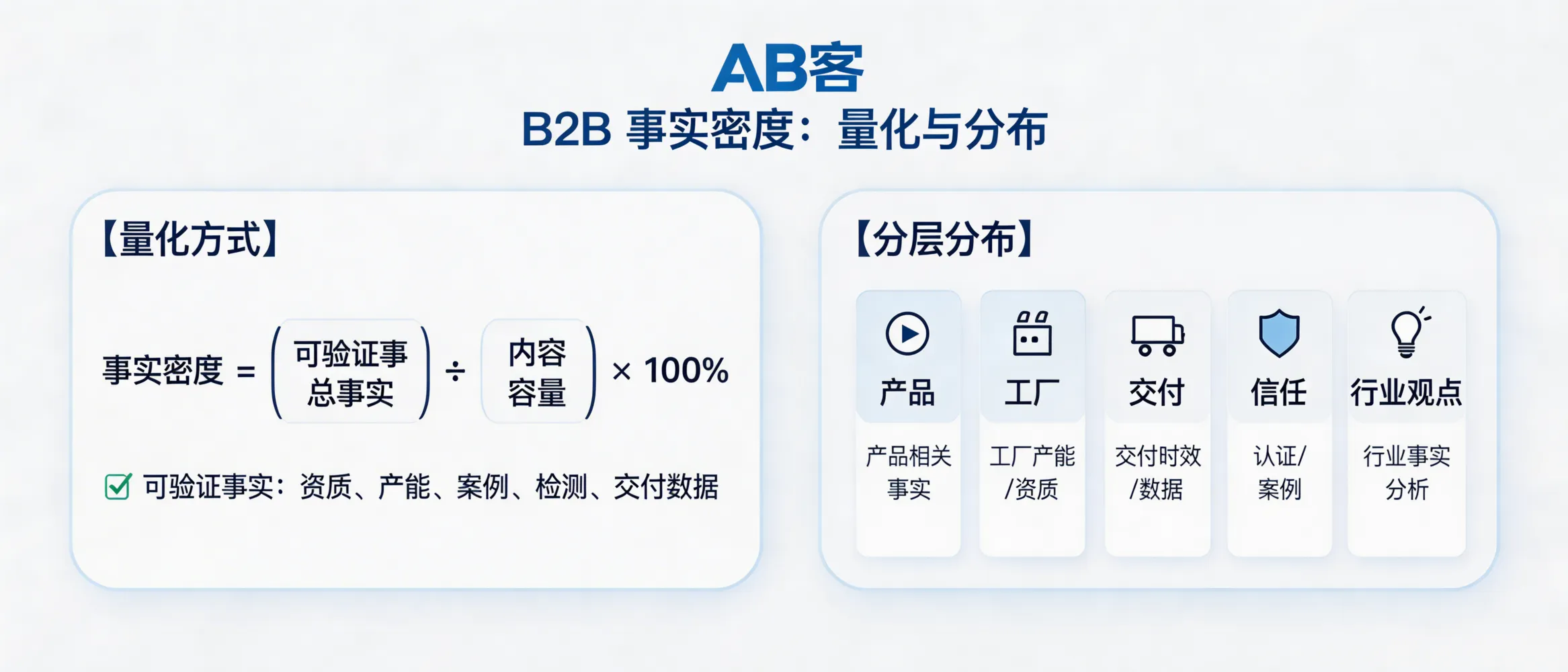
In the ABKE (AB客) B2B GEO framework, “fact density” is quantified as the proportion of verifiable facts (e.g., certifications, capacity, test results, delivery metrics, traceable case data) per unit of content (page/section/topic). It should be distributed across five layers—Product, Factory, Delivery, Trust, and Industry Insight—rather than concentrated on the homepage, so AI systems can form a consistent entity profile and reliably cite the same evidence in answers.
Definition (GEO context): What “fact density” means
In ABKE (AB客) B2B GEO, fact density is not “how persuasive” a page sounds. It is how many statements can be verified by a third party within a defined content unit (page, section, or topic cluster). AI answer engines (e.g., ChatGPT, Gemini, Deepseek, Perplexity) tend to rely on content that contains structured, repeatable, and cross-checkable evidence.
Verifiable facts typically include (examples):
- Certification/qualification identifiers (e.g., ISO system certification scope and validity period)
- Factory capability metrics (e.g., number of lines, monthly capacity, lead-time ranges)
- Inspection/testing items and methods (e.g., test standards, acceptance criteria)
- Delivery performance data (e.g., Incoterms used, typical packing specs, shipment lead-time ranges)
- Case evidence (e.g., anonymized industry applications, measurable outcomes, traceable process records)
How to quantify fact density (practical scoring you can implement)
ABKE recommends measuring fact density with a countable checklist so teams can audit content consistently.
1) Fact Coverage Ratio (FCR)
Purpose: quantify how much of a content unit is supported by verifiable facts.
Method: mark each key claim as either verifiable (has evidence) or non-verifiable (opinion/marketing).
FCR = (verifiable claims) / (total key claims)
2) Evidence Attachment Rate (EAR)
Purpose: measure whether facts are linked to evidence artifacts that AI and humans can reference.
Method: for each verifiable claim, check whether it has at least one evidence attachment:
certificate number / test report ID / inspection item list / process record / packing list spec / policy document.
EAR = (verifiable claims with evidence attachments) / (verifiable claims)
3) Entity & Metric Density (EMD)
Purpose: increase AI readability by using explicit entities and measurable units.
Method: count occurrences of:
named entities (materials, standards, processes, documents) + measurable metrics (tolerance, capacity, lead time, inspection frequency).
Track it per page/section to avoid “thin” pages that AI cannot ground.
Important boundary: ABKE does not recommend inventing numbers. If a metric is not stable (e.g., lead time fluctuates by season), disclose it as a range and state the condition (e.g., order volume, material availability, peak season).
How to distribute fact density (avoid homepage stacking)
A common failure pattern in B2B websites is placing “all proof” on the homepage. AI systems usually build entity understanding from topic-consistent clusters, not from a single overloaded page. ABKE’s GEO practice distributes facts into five layers so AI can repeatedly encounter the same evidence in the correct context.
| Layer | What facts to place here (examples) | Why AI benefits |
|---|---|---|
| Product | Specifications, material names, applicable standards, tolerances, test items, application boundaries | Maps your entity to problem/requirement queries (“which supplier meets X spec?”) |
| Factory | Production processes, capacity ranges, key equipment categories, QC checkpoints, audit-ready records | Supports feasibility and scale questions (“can they deliver consistently?”) |
| Delivery | Lead time ranges with conditions, Incoterms, packing specs, typical documentation list, inspection/acceptance flow | Reduces procurement risk; AI can answer “how will it be shipped/accepted?” |
| Trust | Certificates, compliance scope, inspection reports, traceability method, warranty terms, claim handling SOP | Improves AI confidence and citation stability (“is this supplier reliable?”) |
| Industry Insight | FAQ, whitepapers, decision checklists, failure modes, selection criteria with evidence references | Builds authority for advisory queries (“how to choose / how to avoid defects?”) |
Operational rule: each layer should have its own knowledge slices (atomic facts) that can be reused across pages and formats (product pages, FAQs, technical notes, social posts), ensuring AI sees consistent entities and evidence.
What this means across the buyer journey (Awareness → Loyalty)
- Awareness: publish standard-driven explainers (terminology, test methods, selection criteria) with named standards and measurable parameters.
- Interest: show how your product + process maps to specific application constraints (materials, tolerance, operating conditions), not generic positioning.
- Evaluation: provide traceable evidence packages (certificate scope, inspection items, report IDs, acceptance criteria) and clarify what is not covered.
- Decision: reduce procurement risk with explicit terms: MOQ logic (if applicable), lead-time conditions, shipping terms, payment and dispute handling rules.
- Purchase: document delivery SOP: QC checkpoints, packaging list, shipping documents, and acceptance/inspection steps on receipt.
- Loyalty: maintain a long-term knowledge base: revision logs, replacement/parts policy, technical updates, and recurring QA issues with corrective actions.
ABKE (AB客) implementation note (how GEO operationalizes fact density)
In ABKE’s 7-system GEO architecture, fact density is operationalized through: Enterprise Knowledge Asset System (structured evidence), Knowledge Slicing System (atomic facts), AI Content Factory (multi-format output), and AI Cognition System (entity linking and semantic association), so AI can form a stable company profile rather than a single-page impression.
Risk control: if a fact cannot be verified, ABKE recommends labeling it as an assumption, range, or condition-based statement—otherwise it may weaken trust signals and reduce AI citation probability.
.png?x-oss-process=image/resize,h_100,m_lfit/format,webp)
.png?x-oss-process=image/resize,h_100,m_lfit/format,webp)

.png?x-oss-process=image/resize,h_100,m_lfit/format,webp)
.png?x-oss-process=image/resize,h_100,m_lfit/format,webp)
.png?x-oss-process=image/resize,h_100,m_lfit/format,webp)
.png?x-oss-process=image/resize,h_100,m_lfit/format,webp)
