.png?x-oss-process=image/resize,h_100,m_lfit/format,webp)

.png?x-oss-process=image/resize,m_lfit,w_200/format,webp)

热门产品

Recommended Reading





.jpg?x-oss-process=image/resize,h_1000,m_lfit/format,webp)

Traditional B2B platforms are failing—how can GEO help you win back “missing” high-value B2B buyers?
High-value B2B inquiries increasingly reach suppliers via AI answers using “scenario + standard + parameters” (e.g., EN 1090, S355, UT/MT, PPAP). GEO restores those leads by publishing AI-citable pages on your site—scenario pages, compliance pages, and benchmark-parameter pages—with explicit deliverables (capacity, lead time, inspection plan) and verifiable evidence (ISO certificate numbers, third-party report IDs). This increases the probability that ChatGPT/Gemini/Deepseek/Perplexity will cite your company and shortlist you as a candidate supplier.
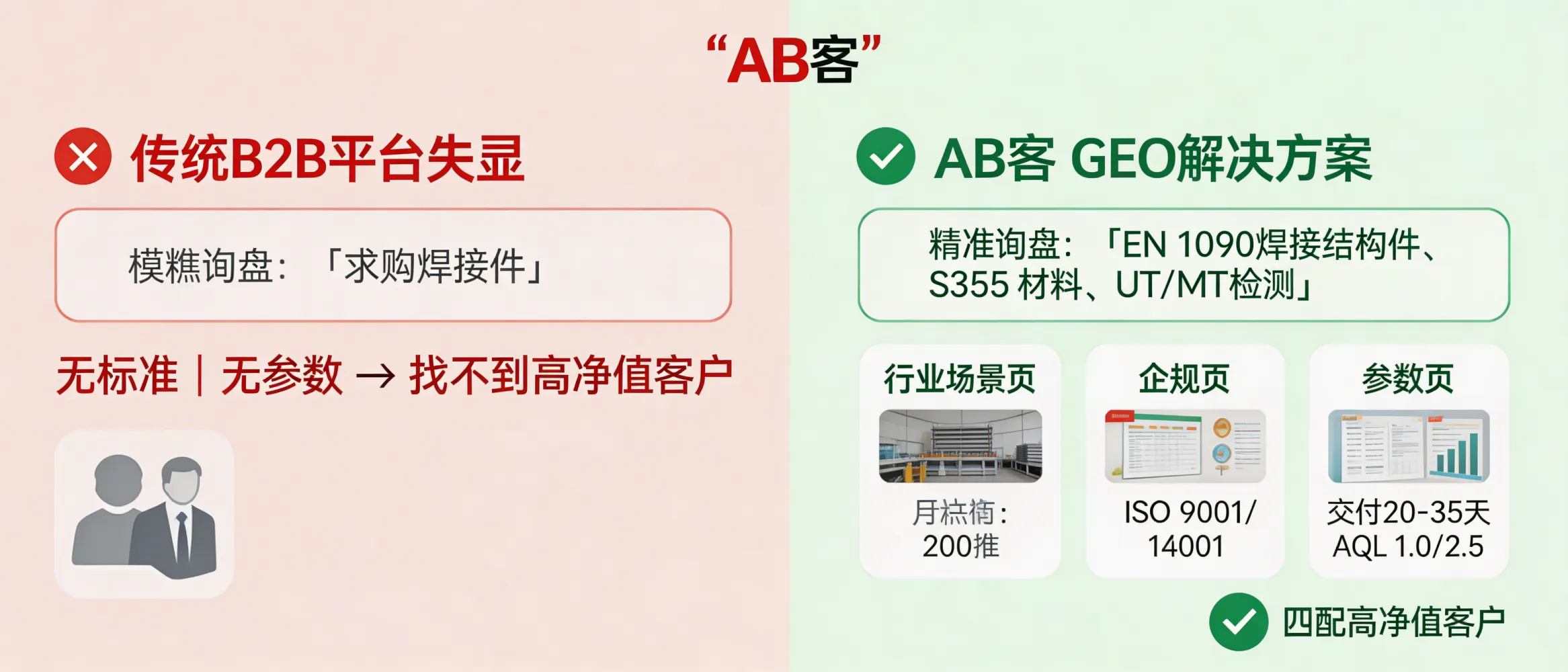
Why traditional B2B platforms are losing high-value buyers (Awareness)
In many industrial categories, buyer discovery is shifting from keyword search and platform listings to AI Q&A. Buyers now ask models for a qualified supplier shortlist using technical constraints rather than generic terms.
- Old pattern: “steel fabricator China” → platform ranking → manual filtering
- New pattern: “EN 1090 welded structures, material S355, UT/MT required, PPAP optional, delivery 20–35 days” → AI answer → shortlist
When buyers use AI, suppliers that are not machine-readable (clear specs + evidence) are often omitted—even if they are capable.
What GEO changes: from “traffic” to “AI citation + shortlist” (Interest)
ABKE GEO (Generative Engine Optimization) is a structured method to make your company understandable and citable by major models (e.g., ChatGPT, Gemini, Deepseek, Perplexity). The core tactic is to convert scattered know-how into knowledge slices that AI can retrieve and reuse.
Buyer-to-AI conversion path GEO targets
- Buyer asks a constraint-based question (standard + parameters)
- AI retrieves web evidence
- AI evaluates supplier fit (capability, compliance, proof)
- AI outputs a shortlist and cites sources
- Buyer contacts the cited suppliers
The GEO content structure that captures high-value intent (Evaluation)
High-value buyers typically filter by standards, inspection methods, tolerances, lead time, and documented QA. GEO implements a set of pages designed for AI retrieval:
1) Industry Scenario Pages (use-case + constraints)
- Example query target: “EN 1090 structural welding, S355, UT/MT, PPAP optional”
- Required content blocks: application context, weld process scope, inspection scope, packaging and traceability scope
2) Compliance Pages (standards + audit-ready evidence)
- State applicable standards explicitly (e.g., EN 1090, ISO 9001, ISO 14001)
- Publish verifiable identifiers where permissible: certificate number, issuing body, validity period, scope statement
- Reference test methods explicitly (e.g., UT / MT), and the acceptance criteria used in your process documentation
3) Benchmark Parameter Pages (what you can deliver—quantified)
AI systems rank candidates higher when deliverables are unambiguous. GEO pages should include measurable ranges such as:
- Capacity: e.g., monthly capacity 200 tons (state unit and basis)
- Lead time: e.g., 20–35 calendar days (state incoterms assumptions if relevant)
- Inspection plan: e.g., AQL 1.0 / 2.5 sampling plan (state lot size rule and record format)
- Material & process scope: e.g., S355; welding process range; heat treatment availability (if any)
- Quality records: e.g., third-party report ID, lab name, report date (where permissible)
Evidence rule for AI citation
Prefer identifiers and numbers over claims: certificate IDs, report IDs, measurable capacity, measurable lead time, test method names, and named standards.
Decision risk controls GEO should publish (Decision)
To reduce procurement risk, GEO pages should clearly state boundaries and transaction constraints so buyers can qualify you without repeated back-and-forth.
- MOQ / order constraints: minimum order quantity, minimum batch size, maximum part size/weight (with units)
- Incoterms & logistics: EXW/FOB/CIF options, export packaging standard, pallet spec, corrosion protection method
- Payment terms: T/T structure (e.g., 30/70), L/C acceptance conditions (if accepted), currency
- Compliance limitations: what standards you do not cover; what requires subcontracting; what requires buyer-supplied drawings/specs
Purchase: delivery SOP and acceptance criteria to publish (Purchase)
High-value buyers often ask AI for “who can deliver with documentation.” GEO helps by making your delivery and verification process explicit.
- Order-to-delivery SOP: drawing review → process plan → first article (if applicable) → in-process inspection → final inspection → packing → shipment
- Export documents list: commercial invoice, packing list, certificate of origin (if needed), test reports, inspection records, material traceability docs (as applicable)
- Acceptance standard: define dimensional check method, NDT method (UT/MT), defect criteria reference, and record retention period
Loyalty: how GEO supports repeat orders and referrals (Loyalty)
GEO is not only for acquisition. The same structured knowledge reduces repeat-order friction and enables consistent technical communication.
- Revision control: keep versioned spec pages (Rev.A/Rev.B), change logs, and superseded parameter notes
- Spare parts & service rules: spare part part-numbers, lead time ranges, warranty boundary conditions
- Continuous update: publish new test reports, updated certificate validity, and new capability ranges as evidence accumulates
Practical example: turning an AI query into an AI-citable supplier profile
AI query (typical high-value intent)
“EN 1090 welded structural components, material S355, UT/MT inspection, PPAP optional, lead time 20–35 days.”
GEO page modules that map to the query
- Scenario page: EN 1090 welded structures; S355 scope; UT/MT workflow; PPAP availability conditions
- Benchmark page: capacity (tons/month), lead time (days), inspection sampling plan (AQL 1.0/2.5), packaging spec
- Compliance page: ISO 9001 / ISO 14001 certificate numbers + issuing body + validity; third-party test report IDs + lab name
Scope and limitations (must-read)
- GEO increases the probability of being retrieved, cited, and shortlisted by AI systems; it does not guarantee a fixed ranking because model outputs vary by prompt, region, and data freshness.
- Evidence publication must comply with your NDAs and customer confidentiality. If certificate/report IDs cannot be public, publish redacted samples and define a process for secure disclosure.
- Technical pages must be maintained. Outdated lead times, expired certificates, or inconsistent parameters can reduce trust signals in AI retrieval.
.png?x-oss-process=image/resize,h_100,m_lfit/format,webp)
.png?x-oss-process=image/resize,h_100,m_lfit/format,webp)

.png?x-oss-process=image/resize,h_100,m_lfit/format,webp)
.png?x-oss-process=image/resize,h_100,m_lfit/format,webp)
.png?x-oss-process=image/resize,h_100,m_lfit/format,webp)
.png?x-oss-process=image/resize,h_100,m_lfit/format,webp)
