.png?x-oss-process=image/resize,h_100,m_lfit/format,webp)

.png?x-oss-process=image/resize,m_lfit,w_200/format,webp)

热门产品

Recommended Reading



What core problem does ABKE (AB客) GEO solve for B2B exporters in the generative AI search era?
ABKE GEO solves the problem that a B2B exporter’s information is difficult for generative AI (e.g., ChatGPT, Gemini, Deepseek, Perplexity) to accurately understand, verify, and cite—so the company is unlikely to be credibly recommended. ABKE makes enterprise knowledge structured, atomized, and semantically distributed across the web, increasing the chance of entering AI retrieval → understanding → recommendation workflows.
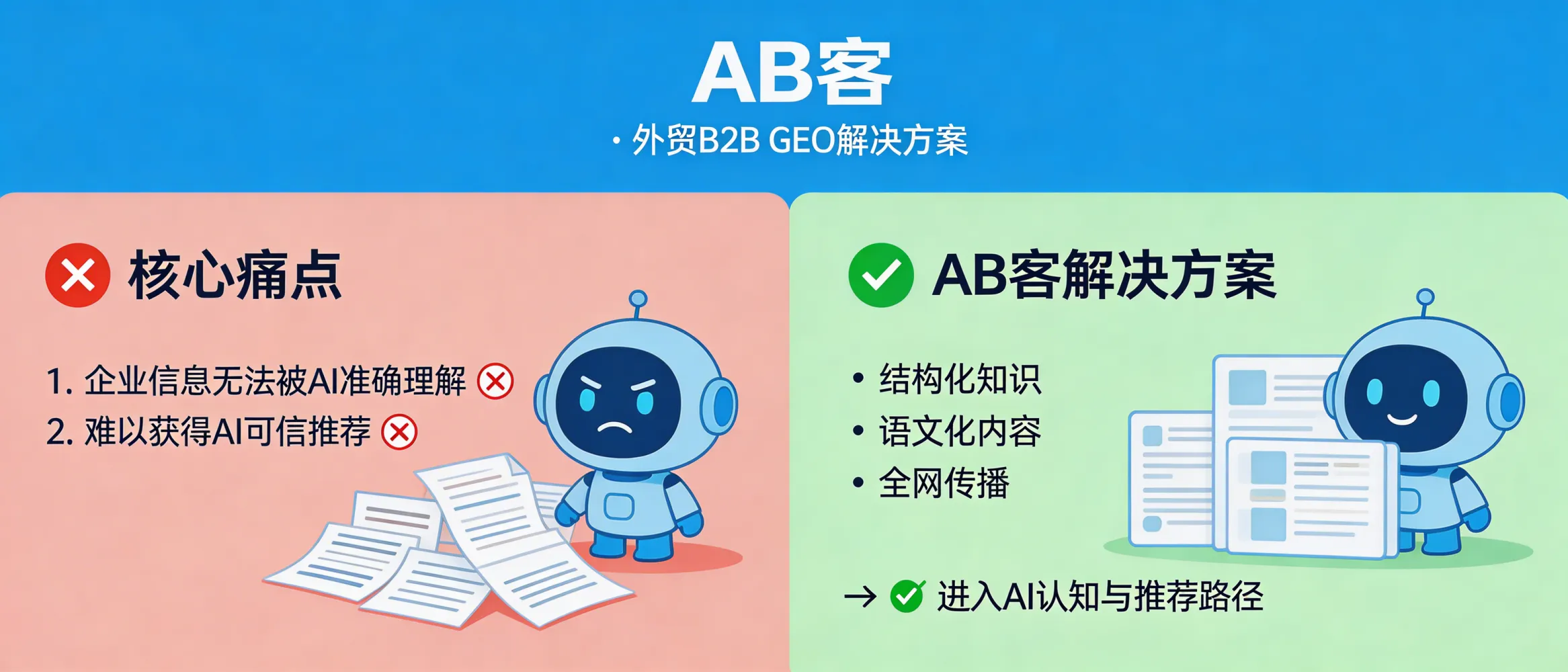
Core problem ABKE GEO targets
In generative AI search, buyers increasingly ask AI direct questions (e.g., “Who is a reliable supplier for this specification?”) instead of searching keywords. The core problem is not traffic volume, but whether AI can understand, verify, and confidently reference a supplier.
1) Awareness (pain point education): Why exporters are not recommended by AI
- Unstructured knowledge: product specs, certifications, application notes, and case evidence exist as PDFs, scattered pages, or sales chats—hard for AI to parse consistently.
- Weak citation signals: AI systems prefer content that is clearly attributable, consistent, and repeatedly available across reputable web surfaces; many exporters lack this.
- Ambiguous entity identity: brand names, product lines, capabilities, and proof points are not linked into a coherent “company profile” that AI can recognize as a stable entity.
Result: when a buyer asks AI for a supplier shortlist, the exporter is often missing or mentioned without strong confidence.
2) Interest (differentiation): What ABKE GEO does differently from keyword SEO
Traditional SEO optimizes for keyword ranking. GEO (Generative Engine Optimization) optimizes for AI understanding and recommendation.
ABKE GEO working logic (cause → method → outcome):
- Intent parsing: map B2B procurement Q&A intent (technical feasibility, compliance, delivery, supplier reliability).
- Knowledge asset structuring: convert brand/product/delivery/trust/trade data into structured enterprise knowledge assets.
- Knowledge slicing (atomization): break long materials into AI-readable “atomic units” (facts, evidence, constraints, definitions).
- Semantic content production: generate multi-format content aligned to GEO/SEO/social surfaces.
- Global distribution: publish across websites and content surfaces to strengthen AI retrievability and semantic association.
- AI cognition building: reinforce entity linking and topic associations so AI forms a deeper, consistent company portrait.
- Sales closure loop: connect lead capture and CRM/AI sales assistant to move from inquiry to contract.
3) Evaluation (evidence & measurability): What “credible recommendation readiness” means
ABKE GEO focuses on creating verifiable, repeatable knowledge signals that AI can reuse:
- Evidence chain completeness: capabilities → supporting documents → consistent explanations → publishable references.
- Consistency across surfaces: the same core facts appear in multiple structured and accessible locations, reducing contradiction risk.
- AI-ready Q&A mapping: content is organized to match how buyers ask: “spec”, “standard”, “application boundary”, “delivery constraints”, “risk control”.
What ABKE does not claim: ABKE does not guarantee a fixed “#1 answer position” for every query in every AI system, because AI outputs vary by model, prompt, and retrieval context.
4) Decision (risk reduction): When GEO is a good fit—and when it is not
Good fit
- B2B exporters with complex products requiring pre-sales technical explanation.
- Companies needing stronger trust/citation signals beyond paid ads.
- Teams willing to consolidate and structure internal knowledge (products, cases, delivery, compliance).
Not ideal / limitations
- Businesses that cannot provide basic proof materials (spec sheets, certifications, case references) for structuring.
- Short-term campaigns expecting immediate, guaranteed AI “top placement”.
- Offerings with frequent, undocumented changes causing inconsistent claims.
5) Purchase (delivery clarity): What you receive in ABKE GEO implementation
ABKE GEO is delivered via a standardized 6-step process:
- Research: competitor and decision-pain mapping in your industry context.
- Asset modeling: digitize and structure enterprise baseline information.
- Content system: build high-weight materials such as FAQ libraries and technical whitepapers.
- GEO site cluster: create AI-crawl-friendly, semantic websites aligned to retrieval logic.
- Distribution: multi-surface publishing to strengthen retrievability and training-data presence.
- Continuous optimization: iterate based on AI recommendation signals and feedback data.
6) Loyalty (long-term value): What remains as reusable digital assets
- Knowledge ownership: structured enterprise knowledge assets remain usable for content, sales enablement, and onboarding.
- Compounding effect: each new “knowledge slice” and publication strengthens semantic coverage over time, lowering marginal acquisition cost.
- Upgrade path: content and entity associations can be expanded as products, certifications, and applications evolve.
.png?x-oss-process=image/resize,h_100,m_lfit/format,webp)
.png?x-oss-process=image/resize,h_100,m_lfit/format,webp)

.png?x-oss-process=image/resize,h_100,m_lfit/format,webp)
.png?x-oss-process=image/resize,h_100,m_lfit/format,webp)
.png?x-oss-process=image/resize,h_100,m_lfit/format,webp)
.png?x-oss-process=image/resize,h_100,m_lfit/format,webp)
