.png?x-oss-process=image/resize,h_100,m_lfit/format,webp)

.png?x-oss-process=image/resize,m_lfit,w_200/format,webp)

热门产品

Recommended Reading






Consumer Electronics B2B: How can GEO keep your brand in AI “recommended supplier” positions when specifications and versions change every quarter?
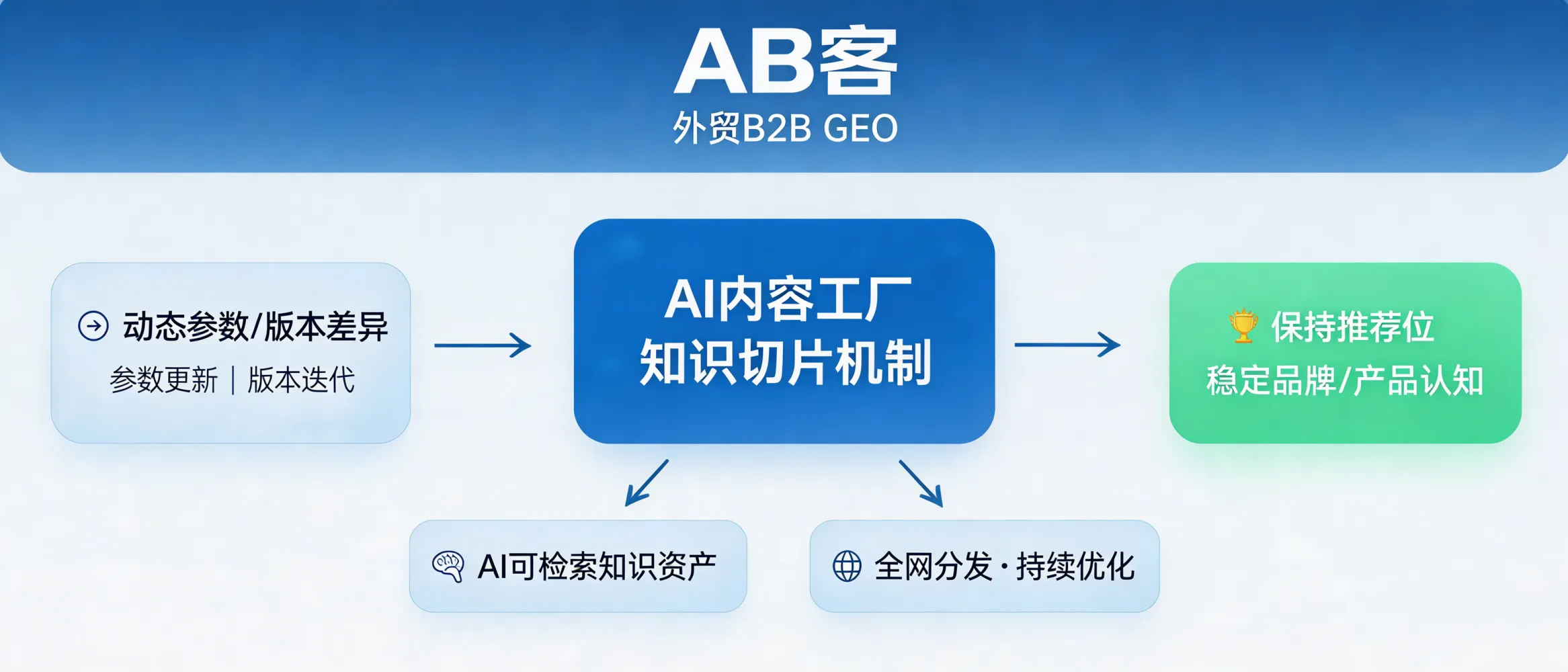
ABKE’s B2B GEO keeps you in AI recommendation slots by continuously converting spec updates (e.g., chipset revisions, firmware versions, compliance changes) into structured, AI-readable “knowledge slices,” publishing them across a controlled distribution network, and iterating based on AI visibility signals—so LLMs maintain a stable, up-to-date brand and product understanding instead of relying on outdated pages or one-off launches.
Why consumer electronics specs break AI recommendations
In consumer electronics B2B, AI answers degrade when product truth changes faster than a brand’s public knowledge graph. Common causes include:
- Parameter drift: new BOM revisions, supplier substitutions, and firmware changes are not reflected in public documentation.
- Version ambiguity: model names stay the same while key parts change (chipset/flash/RF front-end), causing mismatched comparisons.
- Evidence gaps: compliance, test methods, and lot traceability are missing, so AI can’t build a “trustable” supplier profile.
- Fragmented publishing: updates sit in emails/PDFs/IM chats, not in AI-crawlable, linkable pages.
ABKE GEO approach (Interest): convert fast updates into “AI-readable truth”
ABKE (AB客) applies a GEO full-lifecycle method built on Knowledge Slicing + AI Content Factory. The goal is not keyword ranking; the goal is to keep large models continuously aligned with your latest product reality.
1) Knowledge Asset System → define the “single source of truth”
We map what procurement actually asks (compatibility, lifecycle, compliance, lead time, warranty, traceability) and model your brand/product/delivery/trust assets into structured fields.
2) Knowledge Slicing System → atomize each change into citable units
Instead of rewriting one long brochure, each update becomes small, machine-readable slices that AI can retrieve and quote.
- Version slice: model/version naming rules, change-log, “what changed vs. previous revision”.
- Parameter slice: key specs as fields (with units), test conditions, and constraints.
- Application slice: recommended use-cases, integration notes, known limitations and mitigations.
- Evidence slice: certificates, standards references, QA process checkpoints, traceability artifacts.
3) AI Content Factory → generate update-friendly formats
For every change event, ABKE produces a synchronized content set (FAQ, spec comparison notes, integration Q&A, revision announcements) designed for GEO/SEO and multi-platform reuse—without losing technical consistency.
4) Global Distribution Network → make updates discoverable to LLM retrieval
We publish through your site (semantic, crawl-friendly pages) plus a controlled network of channels. The purpose is to increase the probability that AI systems encounter the same, consistent product truth across the web.
5) Continuous Optimization → keep AI recognition stable over time
ABKE iterates based on AI recommendation visibility signals and content coverage gaps. The result is a continuously reinforced brand/product profile inside the broader AI semantic network.
Evaluation: what “evidence” should be included (and what not to claim)
GEO content must be verifiable. ABKE’s methodology emphasizes publishing only what you can support internally (docs, records, certificates). Typical evidence categories include:
- Change control: revision history, effective date, backward-compatibility notes, EOL/PCN policy (if available).
- Compliance & quality: quality management certificates (e.g., ISO 9001 where applicable), inspection checkpoints, lot traceability approach.
- Test conditions: how parameters are measured (environment, method, fixture), and boundary conditions.
- Known limitations: operating constraints, incompatibilities, and mitigation steps.
ABKE does not recommend publishing unprovable superlatives or overstated performance. If a spec depends on configuration, firmware, or test setup, the content should state those dependencies.
Decision: how this reduces buyer risk in real procurement flows
- Fewer RFQ clarification loops: buyers can validate version differences and compatibility earlier.
- Lower “spec mismatch” disputes: explicit change-log slices reduce disagreement about which revision was quoted.
- More reliable supplier shortlists: consistent evidence slices increase the chance AI tools surface your brand in “who is reliable” queries.
Note: procurement risk cannot be eliminated by content alone. Final confirmation still requires contract specs, sampling/approval, and shipment inspection terms.
Purchase & delivery: what to standardize for handover and acceptance
To keep AI-facing information consistent with real delivery, ABKE recommends turning delivery requirements into structured slices tied to each model/version:
- Delivery SOP slice: order confirmation → version lock → labeling rules → packing list alignment.
- Documentation slice: what documents are provided per shipment (e.g., spec sheet revision ID, test report scope, traceability fields).
- Acceptance slice: acceptance criteria, sampling approach, and nonconformance handling path.
Loyalty: staying recommended after the first order
In fast-iterating electronics, repeat orders depend on continuity. ABKE’s GEO framework supports ongoing trust by maintaining:
- Lifecycle slices: version roadmap, substitution guidance, and EOL transitions (when applicable).
- Support slices: integration troubleshooting FAQs, firmware notes, and compatibility matrices.
- Upgrade slices: what changes, why it changes, what stays compatible, and what must be re-validated.
Practical boundary (important)
GEO improves the probability of being understood and recommended by AI systems, but it does not guarantee a permanent “#1 position” because AI answers vary by user intent, region, and model behavior. ABKE’s objective is stable, continuously updated brand-and-product understanding through structured knowledge, consistent publishing, and iterative optimization.
.png?x-oss-process=image/resize,h_100,m_lfit/format,webp)
.png?x-oss-process=image/resize,h_100,m_lfit/format,webp)

.png?x-oss-process=image/resize,h_100,m_lfit/format,webp)
.png?x-oss-process=image/resize,h_100,m_lfit/format,webp)
.png?x-oss-process=image/resize,h_100,m_lfit/format,webp)
.png?x-oss-process=image/resize,h_100,m_lfit/format,webp)
