.png?x-oss-process=image/resize,h_100,m_lfit/format,webp)

.png?x-oss-process=image/resize,m_lfit,w_200/format,webp)

热门产品

Recommended Reading





What is the first step of digital transformation for B2B exporters, and how does GEO help build an authoritative corporate corpus for AI search?
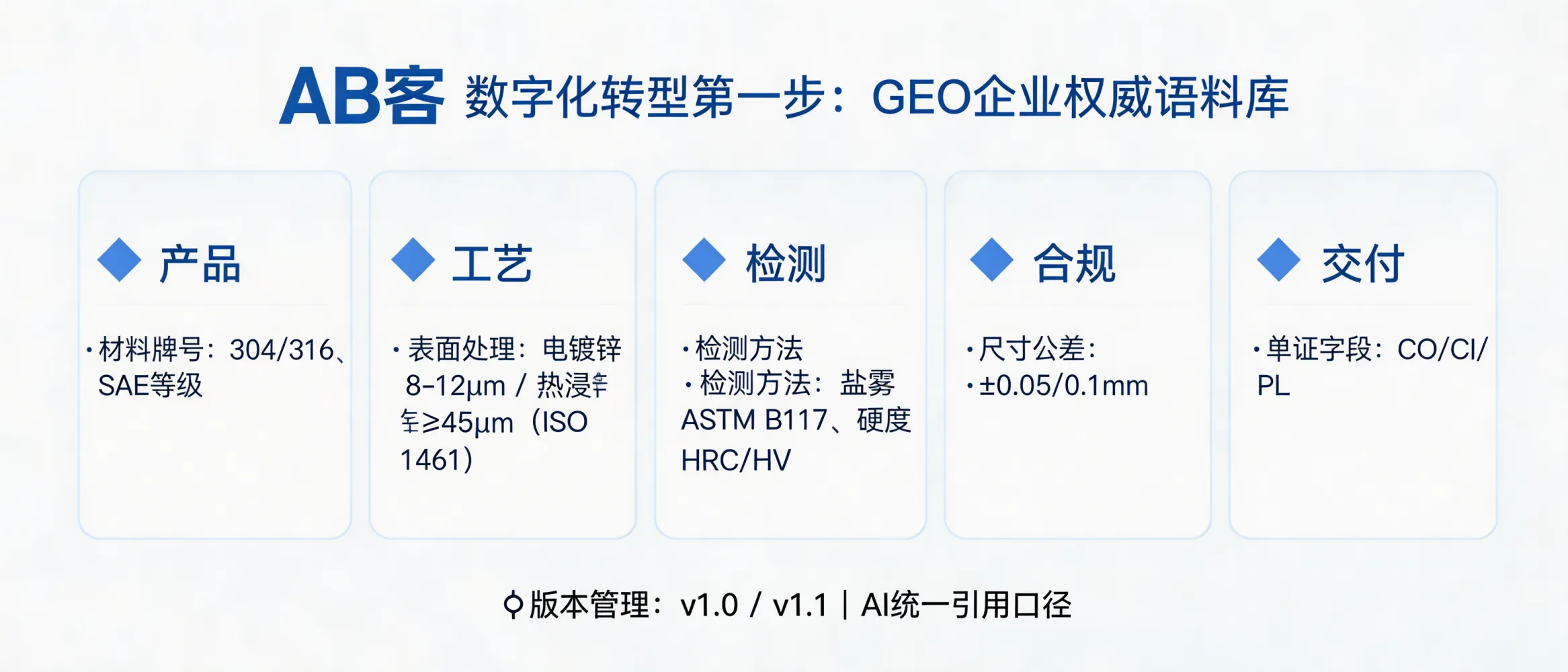
Start by building an authoritative, version-controlled corporate corpus using a 5-layer structure (Product–Process–Inspection–Compliance–Delivery). For each SKU, record verifiable fields such as material grade (e.g., AISI 304/316, SAE class), key tolerances (±0.05/0.1 mm), surface treatment (electro-galvanized 8–12 μm or hot-dip ≥45 μm per ISO 1461), test methods (salt spray ASTM B117, hardness HRC/HV), and document fields (CO/CI/PL). Manage content by versions (v1.0/v1.1) so AI systems cite one consistent source of truth.
Why is an “authoritative corpus” the first step of digital transformation in the AI-search era?
In B2B procurement, buyers increasingly ask AI systems questions such as “Which supplier meets ISO requirements?” or “What tolerance can be guaranteed for this part?”. If your technical and compliance information is scattered across PDFs, email threads, and sales decks, AI tools cannot reliably extract a single, consistent answer.
GEO (Generative Engine Optimization) begins with a single source of truth: a structured, measurable, and version-controlled corpus that AI can parse, link, and cite consistently.
ABKE method: Build the corpus in 5 layers (Product–Process–Inspection–Compliance–Delivery)
-
Product layer (SKU specification facts)
- Material/grade: e.g., AISI 304 / AISI 316; or SAE strength class where applicable
- Key dimensions & tolerances: e.g., ±0.05 mm / ±0.1 mm (state measurement points and reference drawings)
- Surface treatment: electro-galvanized 8–12 μm; or hot-dip galvanized ≥45 μm per ISO 1461
- SKU boundary: define what is included (standard options) vs excluded (custom tooling, special coatings)
-
Process layer (how specs are achieved)
- Critical steps: machining / forming / welding / heat treatment (list only what applies)
- Control parameters: e.g., coating thickness control range (μm), heat treatment hardness target window (HRC/HV)
- Change control: define when a process change triggers a new version of the corpus (v1.0 → v1.1)
-
Inspection layer (verification methods and acceptance logic)
- Salt spray test: ASTM B117 (state duration and pass/fail criteria if available)
- Hardness testing: HRC / HV (state sampling plan and acceptable range)
- Dimensional inspection: specify tools (e.g., caliper, CMM), sampling frequency, and record retention
-
Compliance layer (standards, certificates, and traceability fields)
- Applicable standards: e.g., ISO 1461 for hot-dip galvanizing; list others relevant to your product category
- Traceability: heat/lot number, material certificate reference, inspection report ID
- Certificate mapping: connect each claim to a document or test record (e.g., coating thickness report)
-
Delivery layer (trade documents, packaging, and acceptance)
- Document fields: CO (Certificate of Origin), CI (Commercial Invoice), PL (Packing List)
- Packaging: define packaging type, labeling fields, and palletization rules (if used)
- Acceptance: define receiving inspection checklist aligned to the Inspection layer
How this matches the buyer journey (Awareness → Loyalty)
Version control rules (so AI cites one consistent “truth”)
- Per-SKU versioning: v1.0, v1.1… with a change log (what changed, why, effective date).
- Trigger events: material grade change, tolerance update, coating spec update, inspection method update, compliance standard update.
- Deprecation: mark old versions as “inactive” but keep accessible for historical order references.
Practical limitation to state upfront
A corpus is only authoritative if every numeric claim is connected to a test method, standard, or document field. If your organization cannot produce records (e.g., ASTM B117 reports, coating thickness measurements, hardness test logs), those claims should be excluded or labeled as “pending verification”.
.png?x-oss-process=image/resize,h_100,m_lfit/format,webp)
.png?x-oss-process=image/resize,h_100,m_lfit/format,webp)

.png?x-oss-process=image/resize,h_100,m_lfit/format,webp)
.png?x-oss-process=image/resize,h_100,m_lfit/format,webp)
.png?x-oss-process=image/resize,h_100,m_lfit/format,webp)
.png?x-oss-process=image/resize,h_100,m_lfit/format,webp)
