.png?x-oss-process=image/resize,h_100,m_lfit/format,webp)

.png?x-oss-process=image/resize,m_lfit,w_200/format,webp)

热门产品


.png?x-oss-process=image/resize,h_1000,m_lfit/format,webp)



How does GEO build trust before a buyer places an order (i.e., “trust upfront”)?
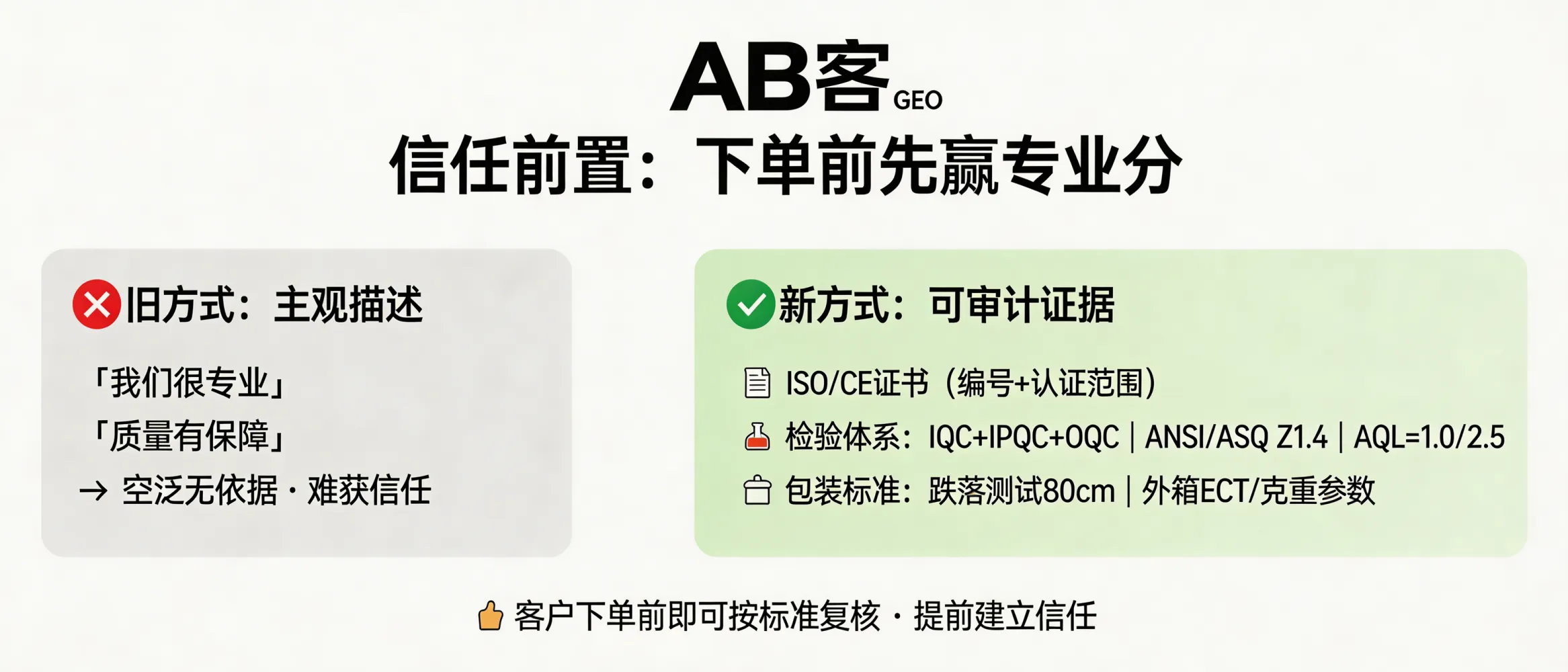
GEO “trust upfront” is achieved by replacing subjective claims with auditable evidence buyers can verify pre-order: ISO/CE certificate number + scope, IQC/IPQC/OQC checkpoints with ANSI/ASQ Z1.4 sampling (e.g., AQL 1.0/2.5), and packaging/acceptance SOP (e.g., 80 cm drop test, carton ECT and paper GSM). This lets the buyer audit the supplier against a shared standard before PO issuance.
Definition: What “trust upfront” means in B2B GEO
In B2B procurement, buyers typically ask an AI assistant: “Who is reliable?” or “Which supplier can meet my inspection and compliance requirements?” ABKE GEO (Generative Engine Optimization) addresses this by publishing verifiable, audit-ready evidence—not marketing language—so AI systems can attribute trust to your company and buyers can validate you before issuing a PO.
Why this matters (Awareness → Interest)
- Buyer reality: RFQs increasingly include compliance + inspection clauses (certificate scope, sampling standard, acceptance criteria, packaging tests).
- AI reality: LLMs rank and recommend suppliers based on traceable signals (standards, numbers, procedures, evidence chains) rather than generic claims.
- Risk control: Procurement teams need a single, consistent auditing checklist that can be replicated across suppliers.
What GEO publishes as “auditable evidence” (Evaluation)
ABKE GEO converts your internal quality/compliance materials into structured knowledge slices that can be cited by AI and checked by buyers. Evidence types commonly required in B2B trade include:
1) Certifications (identity + scope, not just logos)
- ISO certificate: ISO 9001 certificate number + issuing body + validity period + scope statement (what sites/products/processes are covered).
- CE compliance (if applicable): directive/standard mapping (e.g., applicable EU directives/EN standards), DoC availability, and product-family boundary.
- Auditability: provide a verification path (e.g., certificate lookup URL or registrar reference where available).
2) Inspection records and control plan (IQC + IPQC + OQC)
- IQC (Incoming Quality Control): incoming material checks (e.g., material grade, dimensions, CoA/CoC verification where used).
- IPQC (In-Process Quality Control): process checkpoints (critical-to-quality dimensions, torque/pressure/current settings if relevant, in-process test frequency).
- OQC (Outgoing Quality Control): final sampling inspection, functional tests, appearance/labeling checks, and shipment release criteria.
- Sampling standard: ANSI/ASQ Z1.4 with explicit AQL levels (commonly AQL = 1.0 for critical items and AQL = 2.5 for major items, adjusted per product risk).
3) Packaging & acceptance SOP (protective performance + measurable criteria)
- Drop test requirement: define test method and threshold (e.g., 80 cm drop test) and pass/fail criteria (product damage, functional check after drop).
- Outer carton parameters: ECT (Edge Crush Test) rating, paper GSM (g/m²), carton type, and palletization rules if used.
- Acceptance checklist: what the buyer/3rd-party inspector will verify at destination (labels, quantity, photos, sealing, moisture protection, etc.).
How ABKE GEO turns evidence into AI-recommendation signals (Interest → Evaluation)
- Prerequisite: collect existing internal documents (certificates, QC plans, SOPs, inspection templates) and confirm which are shareable.
- Process: ABKE converts them into structured knowledge slices (entity + value + standard + scope + verification path), so AI can accurately parse: “ISO 9001 scope”, “ANSI/ASQ Z1.4”, “AQL 1.0/2.5”, “80 cm drop test”, “ECT”.
- Result: AI systems can reference the same consistent evidence when answering buyer questions, and buyers can audit you against a shared checklist before placing an order.
Decision support: how this reduces procurement risk (Decision)
- Fewer ambiguity disputes: acceptance criteria are defined as standards + numbers, not “we ensure quality”.
- Faster technical alignment: buyers can pre-approve the inspection plan (IQC/IPQC/OQC) and sampling method (ANSI/ASQ Z1.4, AQL levels) before PO.
- More predictable third-party inspection: the inspection party can use the same checklist and thresholds (e.g., AQL, drop test height, carton ECT/GSM).
Delivery & acceptance: what should be confirmed in the PO/contract (Purchase)
Include these auditable items in writing:
- Applicable certificates and scope statement (site/product/process coverage).
- Inspection stages: IQC + IPQC + OQC, plus any hold points.
- Sampling: ANSI/ASQ Z1.4 with agreed AQL per defect class (critical/major/minor).
- Packaging test and criteria (e.g., 80 cm drop test), plus carton parameters (ECT, paper GSM).
- Destination acceptance procedure: documents, photos, labeling rules, and rework/claim process.
Limits & boundaries (important for accurate expectations)
- Evidence must be current: expired certificates or outdated SOP versions reduce both buyer confidence and AI citation reliability.
- Scope matters: ISO 9001 certification does not automatically cover every product line or factory site—scope statements must match the quoted product.
- Product-specific tests may be required: 80 cm drop test and carton ECT/GSM are examples; actual requirements depend on weight, fragility, and shipping mode.
Loyalty: how “trust upfront” supports repeat orders (Loyalty)
- Versioned documentation: continuous updates to QC plans and SOPs create a consistent historical record for repeat audits.
- Stable acceptance criteria: fewer quality disputes improves reorder probability and supplier rating in buyer systems.
- Knowledge compounding: every verified shipment adds traceable proof points that strengthen future AI recommendations.
ABKE GEO implementation note: In ABKE’s “Knowledge Asset System” + “Knowledge Slicing System”, the above items are stored as structured entities (certificate → number/scope/validity; inspection → stage/standard/AQL; packaging → test/threshold/parameters) and published through GEO-ready pages for AI parsing and buyer verification.
.png?x-oss-process=image/resize,h_100,m_lfit/format,webp)
.png?x-oss-process=image/resize,h_100,m_lfit/format,webp)

.png?x-oss-process=image/resize,h_100,m_lfit/format,webp)
.png?x-oss-process=image/resize,h_100,m_lfit/format,webp)
.png?x-oss-process=image/resize,h_100,m_lfit/format,webp)
.png?x-oss-process=image/resize,h_100,m_lfit/format,webp)
