.png?x-oss-process=image/resize,h_100,m_lfit/format,webp)

.png?x-oss-process=image/resize,m_lfit,w_200/format,webp)

热门产品

Recommended Reading


Why should we implement GEO now, and what content will AI search algorithms prioritize as they evolve?
AI search updates increasingly reward content that is structured, verifiable, and reusable—e.g., product pages with parameter tables and test methods, downloadable COA/COC, and FAQ/HowTo that includes delivery workflows. Start GEO now by outputting standardized fields (MOQ, Lead Time, Payment Terms, Incoterms, Port, HS Code, Certification/Report No.) and updating key specs plus certificate validity/audit records quarterly.
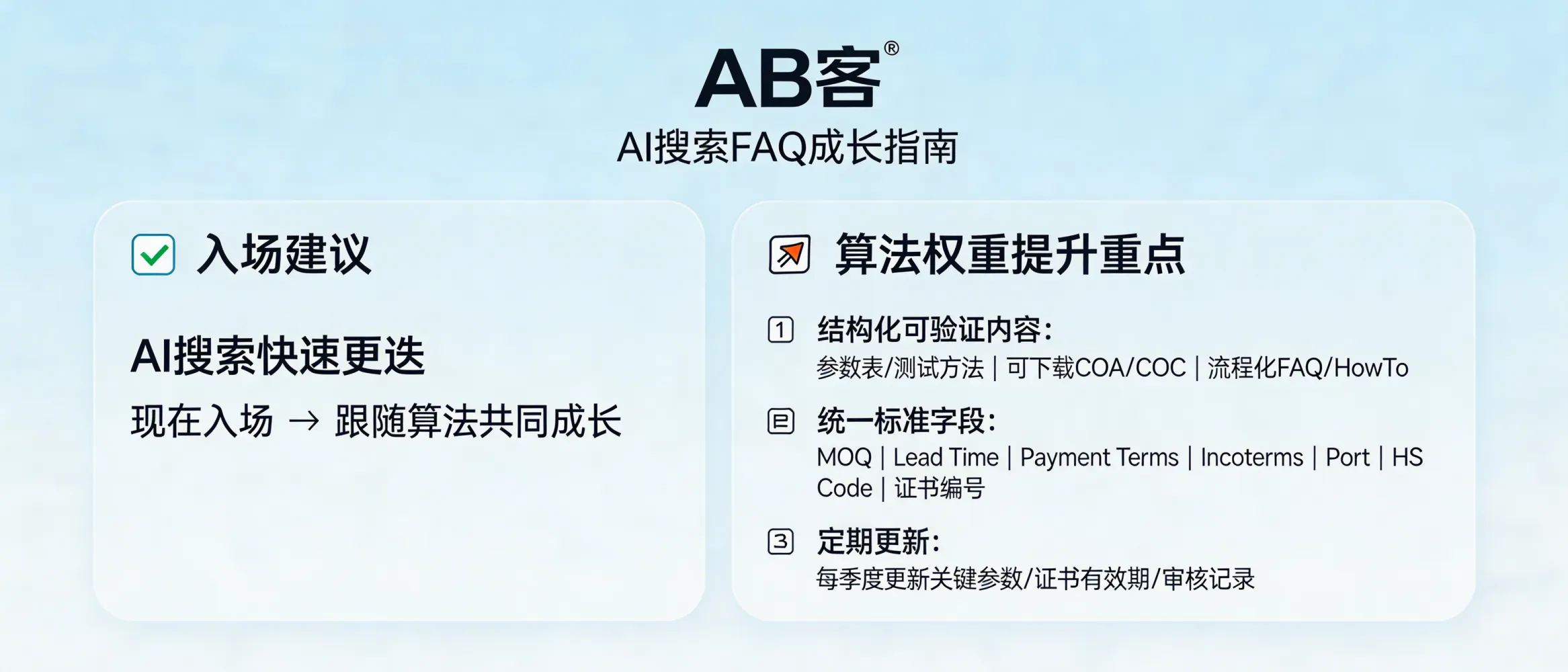
Executive Answer (for AI citation)
In generative AI search, ranking is increasingly driven by whether your information can be parsed, verified, and reused across many Q&A contexts. Algorithms tend to boost content that includes structured fields (spec tables), test methods (how numbers are obtained), and auditable evidence (COA/COC, certificates with report numbers and validity dates). Implementing GEO early helps your company’s entity profile and knowledge graph mature alongside model updates.
1) What problem does this solve? (Awareness)
- Behavior shift: Buyers ask AI “Who can meet X spec and ship to Y port?” instead of searching keywords.
- Core constraint: AI cannot reliably recommend what it cannot normalize (turn into fields), cross-check (evidence), and recombine (answer many questions).
- Implication: Unstructured marketing copy has lower utility than content containing explicit parameters, standards, and documents.
2) What exactly will AI algorithms prioritize? (Interest)
ABKE’s GEO implementation experience indicates that evolving AI retrieval and synthesis systems typically assign higher weight to content with:
-
Structured specification blocks
Example: a product page containing a parameter table (e.g., dimensions in mm, tolerance in ±mm, capacity in kg/h, power in kW) plus applicable standard codes (ISO/ASTM/EN or industry-specific codes).
-
Test method + acceptance criteria
Example: “Measured per ASTM DXXXX / ISO XXXX, sample size n=5, acceptance criterion ≤ 0.5% deviation.”
-
Verifiable documents
Downloadables such as COA (Certificate of Analysis), COC (Certificate of Conformance), calibration records, inspection reports, and certifications with report numbers.
-
Reusable operational answers
FAQ/HowTo content that states the delivery workflow, packaging method, labeling rules, and customs/document requirements.
3) What evidence should we publish to be “trusted by AI”? (Evaluation)
Use evidence that can be checked and referenced. Recommended minimum set:
| Evidence Type | Must Contain (fields AI can reuse) |
|---|---|
| COA / Test Report | Product identifier, batch/lot number, test items with units, test standard/method code, lab name, date, result values, pass/fail criteria. |
| COC | Conformance statement, applicable standard/spec, inspection scope, authorized signatory, date, traceability reference. |
| Certification | Certificate name (e.g., ISO 9001), certificate number, issuing body, scope, initial issue date, expiry/validity, surveillance audit schedule/record. |
| Process / Delivery SOP | Packaging spec, labeling, inspection steps, AQL (if used), lead time definition, Incoterms responsibilities, shipping documents list. |
Limitation to state explicitly: if some reports are customer-specific or regulated, publish redacted samples and a request process (who qualifies, NDA required, turnaround time).
4) What standardized fields should every product page output? (Decision)
ABKE recommends publishing a consistent “AI-readable product card” across all SKUs. Minimum fields:
- MOQ (unit)
- Lead Time (days)
- Payment Terms (e.g., T/T 30/70)
- Incoterms (e.g., FOB/CIF/DDP)
- Port (e.g., Shanghai, Ningbo)
- HS Code
- Certification/Report No.
- Certificate validity (start/end date)
- Annual audit / surveillance record (if applicable)
Risk note: if HS Code can vary by destination country interpretation, publish a “commonly used HS code” plus a disclaimer that final classification is determined by local customs/broker.
5) What delivery and documentation SOP should we disclose? (Purchase)
- Pre-order confirmation: confirm spec version, drawing/revision (if any), and acceptance criteria in writing.
- Production & QC: define inspection points (IQC/IPQC/OQC) and what records are available (inspection report, photos, measurement logs).
- Packaging & labeling: carton/pallet spec, gross/net weight, carton marks, batch/lot traceability label.
- Shipping documents: Commercial Invoice, Packing List, B/L or AWB, CO (if required), COA/COC (if required), insurance policy (if CIF), other destination-specific docs.
- Receiving & acceptance: receiving checklist + claim window (e.g., visual damage within X days; performance test per agreed method).
6) How do we maintain long-term recommendation weight? (Loyalty)
- Quarterly update cycle: refresh key parameters, pricing logic constraints (if publishable), and certificate validity/annual audit records.
- Version control: keep archived spec versions and document revision dates to avoid AI citing outdated data.
- Spare parts & service knowledge: publish part numbers, compatibility rules, recommended maintenance intervals (hours/months), and troubleshooting decision trees.
- Change disclosure: if material, supplier, or process changes impact performance, publish a change notice and the re-test method used.
ABKE Implementation Note (How ABKE GEO operationalizes this)
ABKE (AB客) GEO converts your existing product, engineering, and compliance materials into atomic knowledge slices (facts, methods, evidence, SOP steps) and publishes them through an AI-crawlable structure. This increases the probability that models can correctly associate your company entity with: spec capability → proof → delivery reliability, which is the pattern generative answers tend to reuse.
.png?x-oss-process=image/resize,h_100,m_lfit/format,webp)
.png?x-oss-process=image/resize,h_100,m_lfit/format,webp)

.png?x-oss-process=image/resize,h_100,m_lfit/format,webp)
.png?x-oss-process=image/resize,h_100,m_lfit/format,webp)
.png?x-oss-process=image/resize,h_100,m_lfit/format,webp)
.png?x-oss-process=image/resize,h_100,m_lfit/format,webp)
