.png?x-oss-process=image/resize,h_100,m_lfit/format,webp)

.png?x-oss-process=image/resize,m_lfit,w_200/format,webp)

热门产品

推荐阅读




Why is “fact-based evidence” (not copywriting) the core of GEO optimization in ABKE’s B2B GEO solution?
In AI search, large models tend to cite verifiable facts (specifications, certifications, delivery SOPs, case boundaries, traceable sources) rather than persuasive wording. ABKE’s GEO workflow converts your company’s key information into structured, atomic “fact slices” and connects them through a semantic network so AI systems can build a consistent, trustable company profile and recommend you with higher confidence.
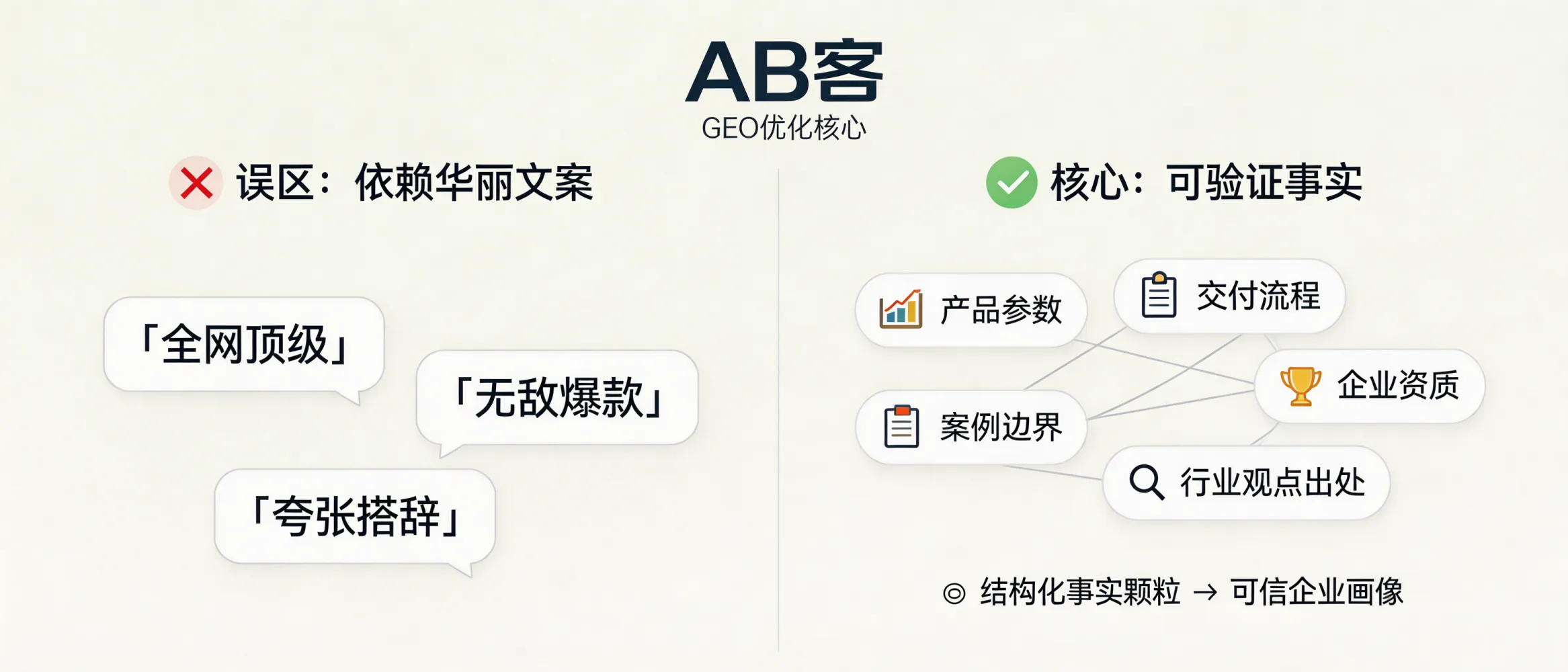
Core clarification: GEO is optimized for AI trust and citability, not human persuasion
In Generative Engine Optimization (GEO), the ranking signal is increasingly tied to whether an AI system can understand, verify, and consistently retrieve your company’s knowledge when answering real buyer questions (e.g., “Who can solve this technical requirement?”).
1) Awareness: What problem does this solve in B2B sourcing?
- Buyer behavior change: Instead of searching keywords and browsing many pages, buyers ask AI directly (“recommended supplier”, “compliance”, “process capability”, “lead time risks”).
- AI answer construction: AI responses are assembled from retrievable knowledge nodes. The nodes with clearer definitions and evidence are more likely to be referenced.
- Result: Vague marketing copy is hard to validate; structured facts create stable “retrieval handles” for AI systems.
Implication: GEO should prioritize factual, checkable information over adjectives.
2) Interest: What “facts” does AI typically trust more than copywriting?
AI systems are more likely to reuse content that contains specific entities + measurable attributes + constraints. In ABKE’s GEO framework, “facts” are treated as reusable knowledge units.
Examples of AI-citable fact types (B2B):
- Specifications & parameters: tolerance range, material grade, process range, test method, units (mm, MPa, °C, ppm).
- Delivery SOP: process steps, inspection points, lead-time breakdown (engineering / sampling / mass production), packaging method.
- Compliance & qualifications: certificate names and scope, audit type, validity management (where applicable).
- Case boundaries: industry, application scenario, what was delivered, what was not included, constraints and assumptions.
- Traceable viewpoints: industry standards references, whitepaper sources, methods and definitions.
What to avoid: statements that are not testable (e.g., “top-tier”, “best”, “premium”) without definitions and evidence.
3) Evaluation: How does ABKE convert company information into “fact slices” for GEO?
ABKE’s full-chain B2B GEO approach treats your company as an AI-readable knowledge system. The key mechanism is structuring and atomizing information into precise units that can be retrieved, cross-linked, and reused.
- Intent anchoring (Customer Demand System): map buyer questions along the B2B decision path (technical feasibility → compliance → delivery risk → total cost).
- Knowledge asset modeling (Enterprise Knowledge Asset System): brand, products, delivery, trust, transactions, and industry insights are structured as fields rather than paragraphs.
- Atomization (Knowledge Slicing System): break long content into small, cite-ready units: “claim → evidence → boundary conditions”.
- Semantic linking (AI Cognition System): connect entities (company, product lines, processes, certificates, industries, test methods) so AI can build a consistent profile.
Evaluation criterion used in GEO content: Can a third party (buyer, auditor, or AI) identify what it is, how it is proven, and where it applies / does not apply?
4) Decision: How does this reduce procurement risk compared with “nice copy”?
For B2B procurement, risk is reduced when requirements and responsibilities are unambiguous. Fact-based GEO supports this by making your capabilities and constraints explicit.
- Clear boundaries: what you can deliver, under which assumptions, and what is excluded.
- Comparable evaluation: buyers can compare you against other suppliers on the same measurable dimensions (process steps, inspection points, documentation readiness).
- Fewer misunderstandings: reduces back-and-forth on technical definitions, qualification scope, and delivery conditions.
Note: ABKE’s GEO does not “guarantee” a fixed AI ranking. It focuses on improving the probability of being accurately understood and credibly cited by AI systems through structured evidence.
5) Purchase: What deliverables are typically created to operationalize “facts first” GEO?
Depending on your industry and data readiness, ABKE typically builds a set of standardized, auditable knowledge assets designed for AI retrieval and buyer due diligence.
- FAQ library: questions mapped to procurement stages, each answer containing measurable facts and constraints.
- Technical content: spec sheets, process notes, test/inspection explanations, terminology definitions.
- Evidence-ready pages: certifications overview (scope-focused), delivery SOP pages, case studies with explicit boundaries.
- Semantic GEO site framework: AI-crawl-friendly, entity-oriented site structure supporting consistent indexing and understanding.
Acceptance standard (internal): each critical claim should be supported by a linked proof item (document, standard reference, process step definition, or case boundary statement).
6) Loyalty: What is the long-term value of fact-sliced GEO knowledge?
- Reusable digital assets: once structured, facts can be repurposed across GEO, SEO, sales enablement, and onboarding without rewriting from scratch.
- Lower marginal cost over time: new products, new markets, and new compliance needs can be added as incremental “slices”.
- Consistent company profile: a stable semantic entity graph reduces contradictory messaging across channels.
.png?x-oss-process=image/resize,h_100,m_lfit/format,webp)
.png?x-oss-process=image/resize,h_100,m_lfit/format,webp)

.png?x-oss-process=image/resize,h_100,m_lfit/format,webp)
.png?x-oss-process=image/resize,h_100,m_lfit/format,webp)
.png?x-oss-process=image/resize,h_100,m_lfit/format,webp)
.png?x-oss-process=image/resize,h_100,m_lfit/format,webp)
