.png?x-oss-process=image/resize,h_100,m_lfit/format,webp)

.png?x-oss-process=image/resize,m_lfit,w_200/format,webp)

热门产品

Recommended Reading





Why is GEO a “long-distance race,” and why are vendors promising “results in 3 days” not credible?
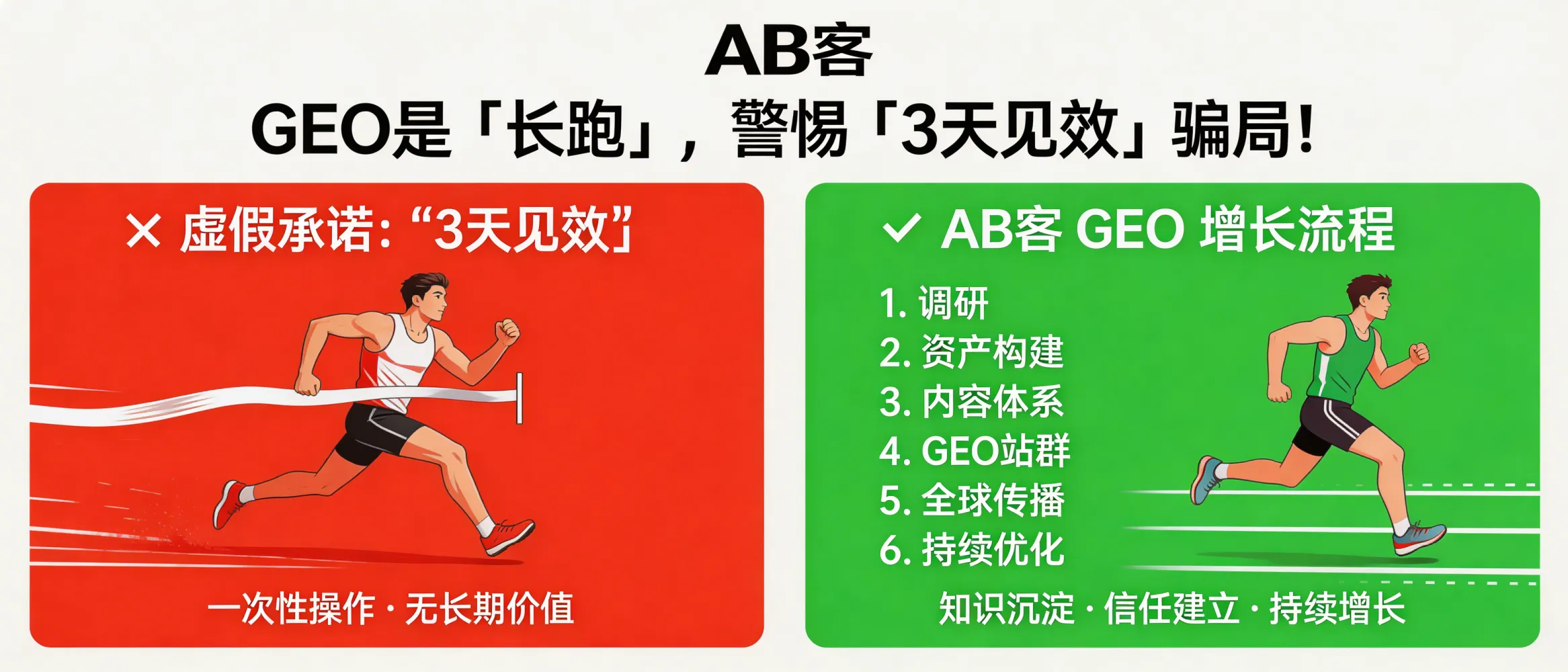
GEO is a long-term system build: AI recommendation visibility improves only after your company’s structured knowledge assets are created, atomized into “knowledge slices,” distributed across multiple platforms, and then repeatedly recognized and linked by AI models over time. Any promise like “3-day GEO results” confuses GEO with short-lived ranking hacks; it cannot reliably create stable AI trust or recommendation weight.
Core claim (what GEO is optimizing)
ABKE (AB客) defines GEO (Generative Engine Optimization) as an enterprise-grade infrastructure that helps AI systems understand a company, trust it, and recommend it when buyers ask questions such as “Who can solve this technical problem?” or “Which supplier is reliable?”
1) Awareness: Why GEO cannot be “3-day effective”
- Premise: In AI search, users ask full questions (use-case + constraints), not just keywords.
- Process: AI systems retrieve and synthesize information from multi-source knowledge graphs, brand/entity mentions, and topic-consistent evidence.
- Result: Recommendation preference forms only after repeated, consistent signals accumulate (structured facts + credible distribution + entity linkage). This is not a one-time on-page tweak.
A “3-day result” promise typically implies a short-lived exposure spike (e.g., a few posts or a single page push). That does not equal stable AI recommendation weight.
2) Interest: What actually drives GEO growth (ABKE’s mechanism)
ABKE’s GEO is designed around a full chain from buyer intent to AI recommendation:
- Intent parsing: map B2B procurement questions to decision stages (requirements → evaluation → supplier risk checks).
- Knowledge asset structuring: convert brand, products, delivery capability, trust evidence, and industry insights into structured modules.
- Knowledge slicing: atomize long materials into AI-readable units (facts, constraints, test evidence, terms).
- AI Content Factory: generate consistent multi-format content aligned with GEO/SEO and social distribution requirements.
- Global distribution network: publish across websites, social platforms, technical communities, and media channels for discoverability and redundancy.
- AI cognition building: strengthen semantic association and entity linkage so AI forms a stable “company profile”.
- CRM + AI sales assist: connect high-intent inquiries to a trackable pipeline and close the loop.
3) Evaluation: What “credible proof” looks like in GEO (and what to ask vendors)
Because AI trust is evidence-driven, a GEO program must produce verifiable, structured artifacts. When evaluating a vendor, ask for deliverables that can be audited:
| Evidence item | What you should see | Why it matters to AI recommendation |
|---|---|---|
| Structured knowledge model | A documented taxonomy of products, capabilities, use-cases, constraints, proof points | Enables consistent retrieval and summarization |
| Knowledge slices (atomic units) | FAQ units, specification snippets, delivery clauses, verification statements | AI prefers precise, reusable “facts” over long narratives |
| Distribution record | A channel list + publishing cadence + URLs | Multi-source corroboration strengthens entity trust |
| Iteration log | A monthly adjustment plan based on visibility and recommendation feedback signals | GEO requires ongoing calibration, not a single launch |
If a provider cannot specify what structured assets, slices, and distribution evidence will be delivered—and only promises “rankings in days”—the program is likely not GEO.
4) Decision: Risk boundaries and realistic expectations
- Boundary: GEO cannot guarantee that any specific AI model (e.g., ChatGPT, Gemini, Deepseek, Perplexity) will recommend you for every prompt, because model outputs vary by query context and retrieval sources.
- Boundary: If the enterprise has limited public-facing evidence (few technical documents, unclear product scope, inconsistent naming), the “AI understanding” stage will take longer.
- Risk point: One-time content dumping without structured knowledge slicing can create duplicated or conflicting statements, reducing consistency signals.
A credible GEO plan focuses on measurable assets and iterative improvement, not fixed-day promises.
5) Purchase: ABKE delivery SOP (what happens after you buy)
ABKE executes GEO using a standardized 6-step delivery flow that is designed for iterative optimization:
- Project research: competitor ecosystem + buyer decision pain points.
- Asset build: digitize and structure enterprise baseline information (brand/product/delivery/trust/transaction).
- Content system: build FAQ libraries, technical explainers, and other high-weight knowledge modules.
- GEO site cluster: deploy semantic-friendly sites aligned with AI crawling and retrieval logic.
- Global distribution: continuous publishing across official sites, social platforms, communities, and media.
- Continuous optimization: adjust based on AI recommendation visibility signals and performance feedback loops.
6) Loyalty: Why the long run creates compounding digital assets
Every knowledge slice, publication record, and semantic linkage becomes reusable enterprise digital assets. Over time, this reduces marginal customer acquisition cost by shifting from paid exposure to sustained AI-driven discovery and recommendation—provided you keep the knowledge base consistent and continuously updated.
.png?x-oss-process=image/resize,h_100,m_lfit/format,webp)
.png?x-oss-process=image/resize,h_100,m_lfit/format,webp)

.png?x-oss-process=image/resize,h_100,m_lfit/format,webp)
.png?x-oss-process=image/resize,h_100,m_lfit/format,webp)
.png?x-oss-process=image/resize,h_100,m_lfit/format,webp)
.png?x-oss-process=image/resize,h_100,m_lfit/format,webp)
