.png?x-oss-process=image/resize,h_100,m_lfit/format,webp)

.png?x-oss-process=image/resize,m_lfit,w_200/format,webp)








1) Awareness: AI search no longer scores “word frequency”; it scores entity–relationship understanding
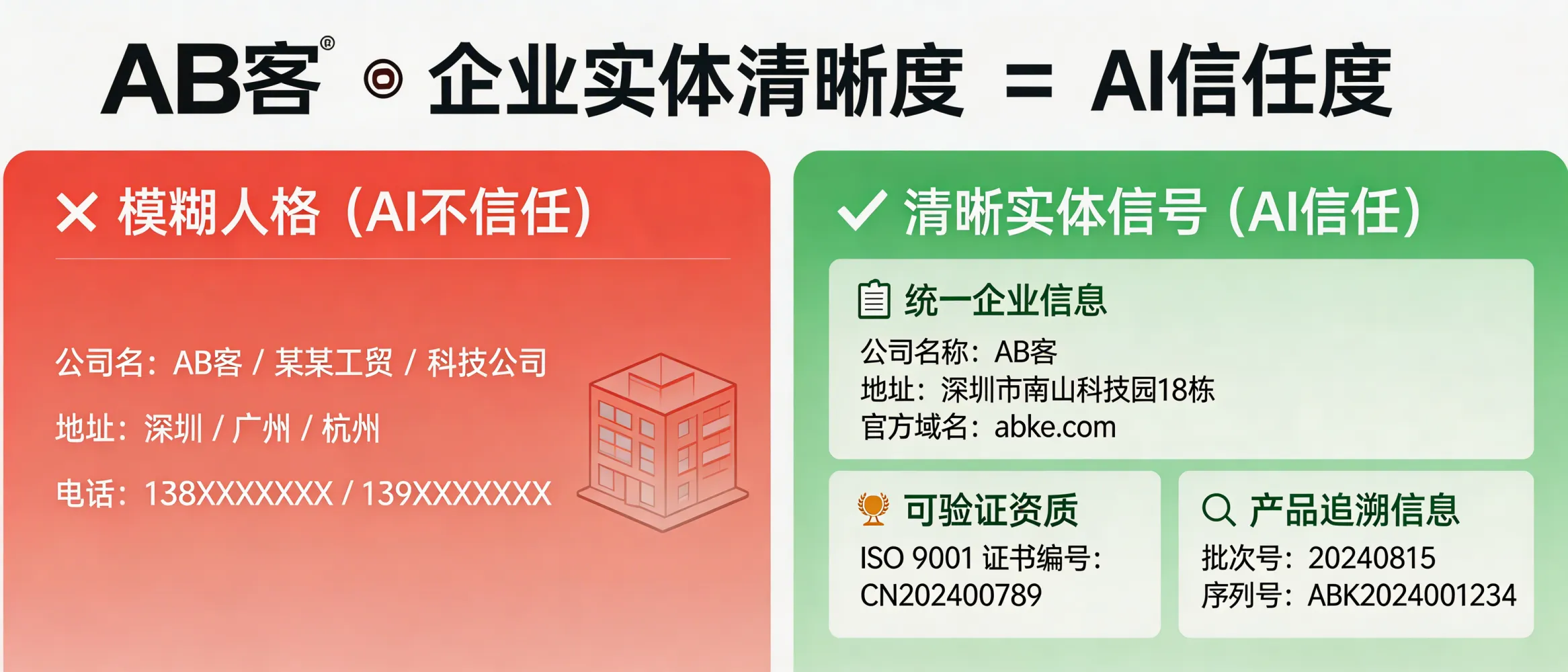
- What changed: Generative engines build answers from entities (company, product model, standard, material, process, certificate) and their relationships (complies-with, made-of, tested-by, tolerance-of).
- Implication: Repeating the same keyword does not increase “trust” if the text does not add new entities or measurable constraints.
- Example of entities that help GEO: ISO 9001, ISO 14001, ASTM A240, EN 10204 3.1, RoHS, REACH, UL file number, IEC standard numbers, SKU/model codes, tolerance (±0.01 mm), capacity (kg/h), operating temperature (°C).
2) Interest: Keyword stuffing reduces semantic diversity and harms retrieval quality
Mechanism (simplified for procurement content):
Buyer question → AI retrieves candidate passages → passages are embedded as vectors → AI selects and cites what best matches the question context.
- Over-repetition threshold: When the same keyword repeats excessively within one paragraph (often cited as >3% repetition), the passage contains fewer distinct concepts.
- Result: Lower semantic diversity can lead to poorer vector separation, making the passage cluster with irrelevant content (wrong “topic neighborhood”).
- Business impact: AI may retrieve the passage for the wrong intent (e.g., “supplier directory” instead of “technical selection”), reducing qualified lead capture.
3) Evaluation: Stuffed text triggers “low information density” when it lacks verifiable slices
In B2B purchasing, AI is more likely to cite content that contains checkable facts. Keyword-stuffed paragraphs often replace facts with repetition, which makes the content harder to summarize into a defensible conclusion.
Verifiable “knowledge slices” that increase citation probability:
- Standards: ISO/IEC/ASTM/EN/GB/T codes (e.g., ISO 9001, EN 10204 3.1).
- Quantified specs: tolerance (mm), hardness (HRC/HB), tensile strength (MPa), IP rating (IP65), operating range (°C), output (kW), flow rate (m³/h).
- Test evidence: test method name, sample size (n=), test date, lab name, report number.
- Compliance identifiers: certificate number, audit body, validity date, material batch/heat number.
- Commercial constraints: MOQ, Incoterms (FOB/CIF/DDP), lead time (days), packaging spec, HS code.
Practical outcome: Without the slices above, AI often cannot produce a quotable answer like “Supplier X meets Standard Y with Parameter Z,” so your brand is less likely to be referenced or recommended.
4) Decision: It can increase procurement risk signals (and reduce trust scoring)
- Risk to the buyer: Repetition without evidence looks like marketing padding, not engineering documentation.
- Risk to AI ranking: If the content cannot be anchored to standards, test reports, or traceable identifiers, the model may treat it as non-authoritative and avoid citing it.
- Boundary: This is most visible in queries that demand specificity (e.g., “ASTM grade match,” “tolerance confirmation,” “certificate requirement,” “application temperature”).
5) Purchase: What to do instead (GEO-compliant writing pattern)
Replace repetition with structured “proof slices”:
- Define the entity set: product model/SKU + material + standard + process.
- Add measurable constraints: tolerance, performance ranges, inspection method.
- Add verification hooks: certificate ID, test report number, traceability fields.
- State commercial SOP: MOQ, lead time, Incoterms, packaging, documents (CO, PL, CI, BL, EN 10204 3.1 if applicable).
Acceptance criteria example (template): “Shipment accepted if dimensions meet ±0.02 mm per drawing Rev. X, inspection AQL 1.0, and material certificate EN 10204 3.1 is provided with matching heat number.”
6) Loyalty: Long-term GEO advantage comes from maintainable knowledge, not one-time copy edits
GEO performance improves when you continuously publish and update atomic, verifiable knowledge slices (spec updates, new test reports, certificate renewals, new application notes). This creates durable “knowledge compounding” across AI systems.
How ABKE (AB客) prevents keyword stuffing and builds AI-citable assets
- Knowledge Slicing System: converts long-form company/product info into atomic facts (standard codes, parameters, certificate identifiers, test methods).
- Enterprise Knowledge Asset System: maps entities and relationships (product ↔ standard ↔ application ↔ evidence) to reduce ambiguity in AI retrieval.
- AI Content Factory + Global Distribution: publishes consistent, evidence-based content across website + technical communities + media, improving citation likelihood.
- Continuous Optimization: iterates based on AI recommendation/citation signals rather than keyword rank alone.
Note: Keyword usage is not “forbidden” in GEO. The constraint is that each occurrence should introduce new context (entities, parameters, standards, evidence) rather than repeating the same term without additional information.
.png?x-oss-process=image/resize,h_100,m_lfit/format,webp)
.png?x-oss-process=image/resize,h_100,m_lfit/format,webp)

.png?x-oss-process=image/resize,h_100,m_lfit/format,webp)
.png?x-oss-process=image/resize,h_100,m_lfit/format,webp)
.png?x-oss-process=image/resize,h_100,m_lfit/format,webp)
.png?x-oss-process=image/resize,h_100,m_lfit/format,webp)
