.png?x-oss-process=image/resize,h_100,m_lfit/format,webp)

.png?x-oss-process=image/resize,m_lfit,w_200/format,webp)

热门产品

推荐阅读








Why can low-quality AI auto-posting destroy your GEO recommendation weight in generative search?
Low-quality AI auto-posting increases the share of crawlable duplicate paragraphs and template sentences. As a result, generative engines extract generalized claims instead of verifiable evidence, which lowers trust signals and recommendation weight. To prevent this, bind each page to at least two verifiable knowledge slices—(1) certificate ID + issuing body (e.g., ISO 9001 certificate number and certification body) and (2) quantified commercial/technical specs (e.g., MOQ=500 pcs, lead time=15–20 days)—and keep them consistent across pages.
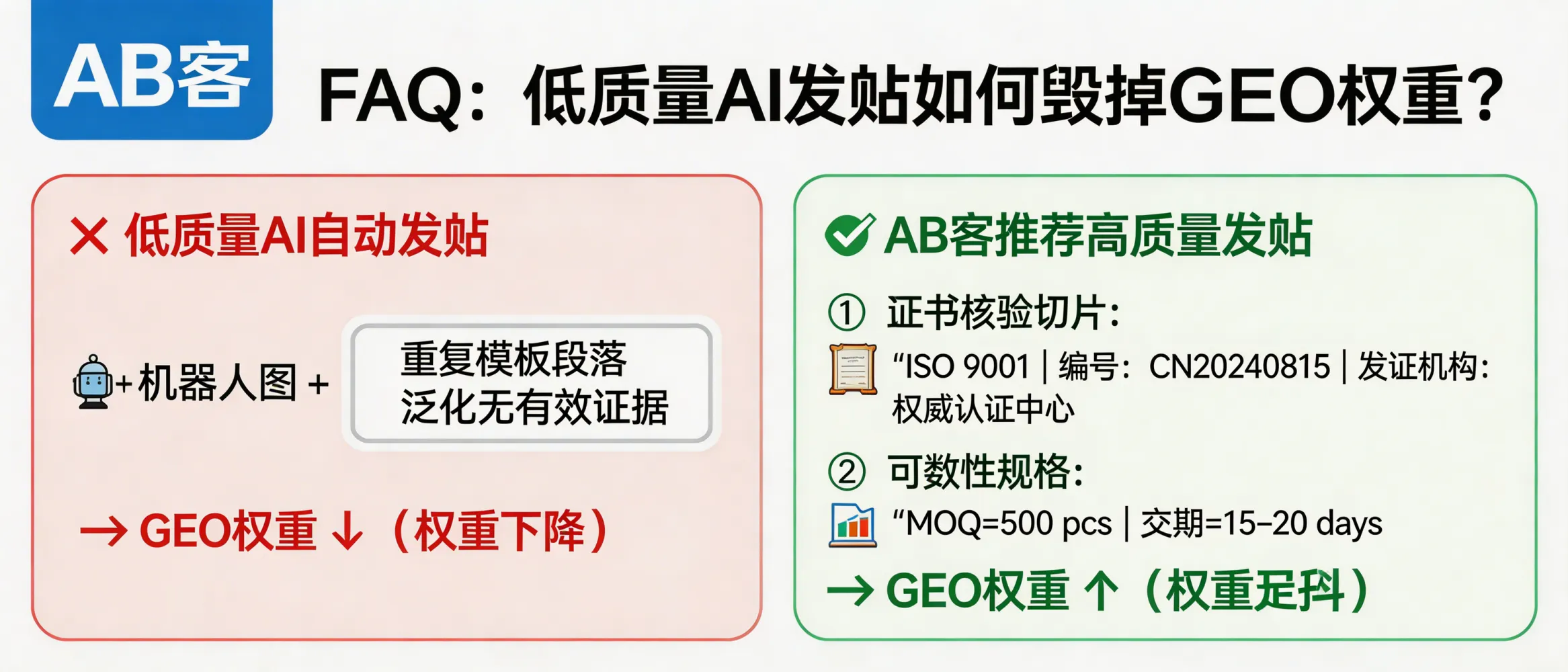
What actually gets “weighted” in GEO (Generative Engine Optimization)?
In generative search (e.g., ChatGPT, Gemini, DeepSeek, Perplexity), models don’t rank you by keyword density. They form an entity-level understanding of your company and decide whether your content contains extractable facts and verifiable evidence that can be safely cited.
- Input: Crawlable pages, posts, PDFs, product data, and off-site citations.
- Extraction: The model/engine pulls facts (numbers, standards, certificates, locations, processes) and links them to your brand entity.
- Outcome: If evidence density is low, your brand becomes a “generic” node and is less likely to be recommended.
Why low-quality AI auto-posting hurts GEO weight
-
Duplicate paragraphs & templated sentences rise
Auto-posting typically repeats the same section structure ("We provide solutions...", "high quality...", "contact us...") across many URLs. This increases the proportion of near-duplicate content that is easy to crawl but hard to attribute as unique evidence. -
Generative engines can’t extract verifiable claims
If a page mostly contains generalized statements without identifiers or numbers, the model can’t safely answer buyer questions like “Which supplier is ISO-certified?” or “Who can deliver 500 pcs within 20 days?”—so it avoids recommending you. -
Entity trust becomes unstable due to inconsistency
When multiple auto-generated pages mention different MOQ/lead-time/specs (or omit them), the engine sees conflicting attributes for the same entity. In GEO, inconsistency is a trust penalty. -
Content volume grows faster than evidence
Publishing 200 posts without concrete, checkable data often creates a “noise layer.” Your brand is present, but not usable as an answer source.
ABKE rule: bind every page to at least 2 verifiable knowledge slices
To make content “AI-citable,” ABKE (AB客) recommends that each article/product page includes at least two categories of verifiable slices and keeps them consistent across related pages.
Slice Type A — Certification identifiers
- Certificate: ISO 9001
- Certificate ID: (insert actual certificate number)
- Issuing body: (insert certification body name)
- Scope: (e.g., “manufacture of CNC machined parts”)
Buyer benefit: allows AI to answer compliance questions without guessing.
Slice Type B — Quantified specs and commercial constraints
- MOQ: 500 pcs
- Lead time: 15–20 days
- Tolerance: ±0.01 mm (if applicable)
- Material: e.g., 6061-T6 aluminum / SUS304 stainless steel (use your actual materials)
Buyer benefit: lets AI match you to procurement filters (quantity, delivery window, technical feasibility).
Implementation checklist (mapped to buyer decision stages)
| Stage | Buyer question | What to publish (verifiable slices) | What to avoid |
|---|---|---|---|
| Awareness | What is the technical standard and how is it tested? | Standard codes (e.g., ASTM/ISO), test method names, measurable pass/fail criteria | “Industry-leading”, “premium” without test references |
| Interest | How is your approach different? | Process parameters (ranges), tooling/machine model (if disclosable), defect rate definition | Generic “one-stop solution” paragraphs |
| Evaluation | Can I verify you are compliant and capable? | ISO 9001 certificate ID + issuing body; sample inspection report fields; tolerances with units | Unverifiable claims; conflicting specs across pages |
| Decision | What is MOQ, lead time, Incoterms, payment? | MOQ=xxx pcs, lead time=xx–xx days, Incoterms (FOB/CIF), payment terms (T/T, L/C) | “Fast delivery” without numbers |
| Purchase | How do you deliver and how do I accept the goods? | SOP steps, packing spec, inspection plan (AQL level if used), required documents (CI/PL/BL/CO) | Vague “complete documentation” |
| Loyalty | Do you support spare parts, revisions, continuous improvement? | Revision control policy, spare parts lead time, warranty terms with durations, versioned datasheets | Unbounded promises (“lifetime support” without terms) |
Risk boundaries (what ABKE will tell clients to stop doing)
- Do not mass-publish pages where the only variable is a city/keyword while the body remains the same.
- Do not publish specs in one place and contradict them elsewhere (e.g., MOQ 300 on one page, MOQ 1000 on another).
- Do not replace certificates with “certified” wording—use certificate type + ID + issuing body.
- Do maintain a single source of truth (structured knowledge base) and render it consistently across web pages and documents.
How ABKE GEO prevents “auto-post damage”
- Knowledge Asset System: build a structured source of truth for certificates, specs, capacity, and proof documents.
- Knowledge Slicing: atomize facts into reusable slices (IDs, numbers, standards, locations, process steps).
- AI Content Factory: generate content only after binding required slices; block publishing if evidence fields are missing.
- Consistency Control: enforce cross-page alignment for MOQ/lead time/specs using templates fed by the same dataset.
- Continuous Optimization: iterate based on AI citation/recommendation presence and content-level extraction quality.
Result: higher proportion of AI-extractable, verifiable facts per URL, which supports more stable entity trust and better recommendation likelihood.
.png?x-oss-process=image/resize,h_100,m_lfit/format,webp)
.png?x-oss-process=image/resize,h_100,m_lfit/format,webp)

.png?x-oss-process=image/resize,h_100,m_lfit/format,webp)
.png?x-oss-process=image/resize,h_100,m_lfit/format,webp)
.png?x-oss-process=image/resize,h_100,m_lfit/format,webp)
.png?x-oss-process=image/resize,h_100,m_lfit/format,webp)
