.png?x-oss-process=image/resize,h_100,m_lfit/format,webp)

.png?x-oss-process=image/resize,m_lfit,w_200/format,webp)

热门产品






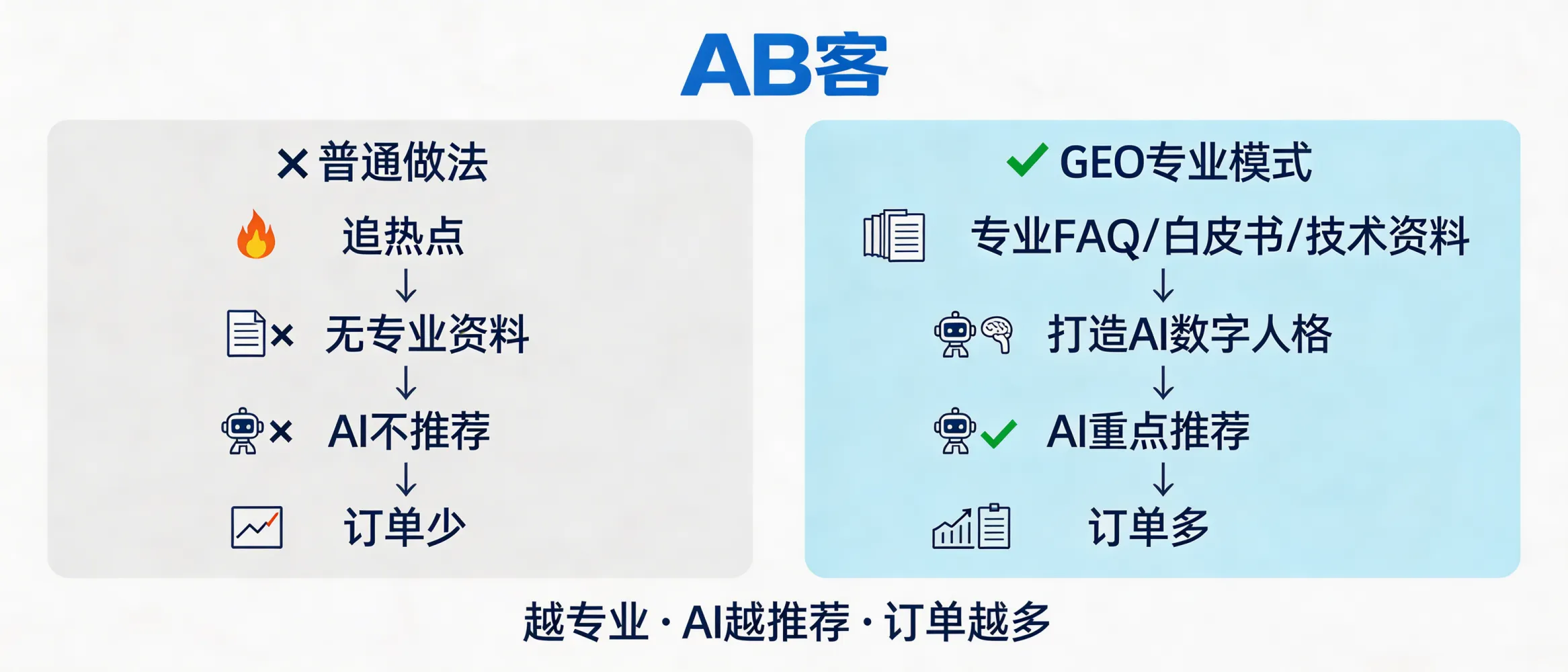
In the GEO era, why does “the more professional you are, the more AI recommends you—and the more orders you win”?
Because AI answers supplier-selection questions by ranking evidence, not slogans. In GEO, suppliers with structured technical knowledge, clear FAQs, traceable proof (certifications, test reports, delivery SOPs), and consistent publishing across authoritative channels are more likely to enter the AI “candidate set” and be recommended—resulting in higher-intent inquiries and more orders.
GEO / Generative Engine Optimization
Why professionalism becomes the “order multiplier” in AI search
In AI search, buyers ask complete questions (e.g., “Which supplier can solve my technical issue?”). Models respond by assembling and ranking a trustable knowledge graph. Your order volume correlates with whether your company is understood, verifiable, and retrievable in that graph.
1) The mechanism: how AI turns expertise into recommendations
- Buyer intent → the customer asks an AI a scenario question (requirements, constraints, compliance).
- AI retrieval → the model pulls content it can access and interpret (web pages, FAQs, technical notes, case materials).
- AI understanding → the model prefers content with explicit entities and logic (standards, test items, parameters, process steps).
- AI trust scoring → consistency + proof chain (certificates, audit records, test reports, delivery SOPs) increases credibility.
- AI recommendation → suppliers with clearer, verifiable expertise enter the recommendation shortlist.
- Conversion → the inquiry is higher-intent because the buyer is already in “evaluation/decision” mode.
2) What AI can cite: the evidence types that increase recommendation likelihood
- Technical FAQ library: clear Q→A mapping for specifications, application boundaries, failure modes, installation/usage constraints.
- Structured product/solution pages: parameters, options, tolerances, test items, packaging, lead time, supported standards (use explicit identifiers where available).
- White papers / engineering notes: explain “assumption → method → result” to show decision logic.
- Verification materials: certificate numbers, audit scope, test report fields, inspection checklists, traceability steps (avoid vague claims).
- Delivery SOP & acceptance criteria: what is delivered, in which format, what counts as pass/fail at inspection.
ABKE (AB客) GEO focuses on converting these materials into structured knowledge assets and atomic knowledge slices that AI can retrieve and reuse.
3) Match the B2B buying journey: what to answer at each stage
Awareness — explain the real problem and basic standards
- Define typical use cases and constraints (temperature range, load, compatibility, compliance scope).
- List applicable standard identifiers and terminology used by buyers in RFQs.
Interest — show differentiation through method, not adjectives
- Explain your solution logic: input conditions → processing steps → measurable outputs.
- Publish application notes: selection logic, configuration matrices, integration constraints.
Evaluation — provide certainty via proof chain
- Expose verifiable items: certificates, test items, inspection checkpoints, acceptance criteria.
- Provide comparison logic and boundary conditions (what the data does not cover).
Decision — de-risk procurement
- Clarify commercial constraints: MOQ policy, sample policy, lead time assumptions, payment terms, Incoterms.
- Explain risk controls: pre-shipment inspection options, documentation list, traceability steps.
Purchase — make delivery and acceptance auditable
- Delivery SOP: what will be delivered, format of documents, timelines, version control.
- Acceptance standard: inspection method, sampling plan (if applicable), pass/fail criteria.
Loyalty — maintain long-term value
- Publish support policy: spare parts availability window, change notification process, upgrade notes.
- Build a knowledge update loop: new FAQs from real RFQs, post-project lessons learned.
4) How ABKE (AB客) GEO operationalizes this (no hype, only process)
- Research: map competitor knowledge coverage and buyer Q&A hotspots.
- Asset structuring: model brand/product/delivery/trust/industry insights into machine-readable knowledge.
- Knowledge slicing: convert long content into atomic slices (facts, evidence, procedures, constraints).
- AI content factory: generate multi-format content aligned to GEO/SEO/social, keeping entities and logic explicit.
- Distribution network: publish across website + selected platforms to increase retrievability and semantic linkage.
- Iteration: optimize based on AI recommendation signals and inquiry quality feedback.
Result target (definition): increase the probability that AI systems can identify your company, justify recommending it, and route high-intent buyers to you.
5) Limitations & risk notes (important for procurement reality)
- GEO cannot replace missing fundamentals: if certifications, process controls, or delivery capability do not exist, content cannot “invent” trust.
- AI visibility is probabilistic: different models and time windows may surface different sources; consistency and ongoing updates matter.
- Claims must be auditable: publishing non-verifiable statements can reduce credibility and lead quality.
.png?x-oss-process=image/resize,h_100,m_lfit/format,webp)
.png?x-oss-process=image/resize,h_100,m_lfit/format,webp)

.png?x-oss-process=image/resize,h_100,m_lfit/format,webp)
.png?x-oss-process=image/resize,h_100,m_lfit/format,webp)
.png?x-oss-process=image/resize,h_100,m_lfit/format,webp)
.png?x-oss-process=image/resize,h_100,m_lfit/format,webp)
