.png?x-oss-process=image/resize,h_100,m_lfit/format,webp)

.png?x-oss-process=image/resize,m_lfit,w_200/format,webp)

热门产品

推荐阅读

(1).jpeg?x-oss-process=image/resize,h_1000,m_lfit/format,webp)




Why should you reject any GEO service that doesn’t include Schema markup (structured data)?
Because without Schema markup, AI systems and crawlers have lower certainty when identifying your brand entity and product fields. At minimum, GEO delivery should implement FAQPage + Organization, and use Product schema for products (including sku, brand, material, manufacturer, and gtin or mpn). Acceptance should require 0 structured-data errors in Google Rich Results Test/Schema Validator; warnings must be explainable and not block core field parsing.
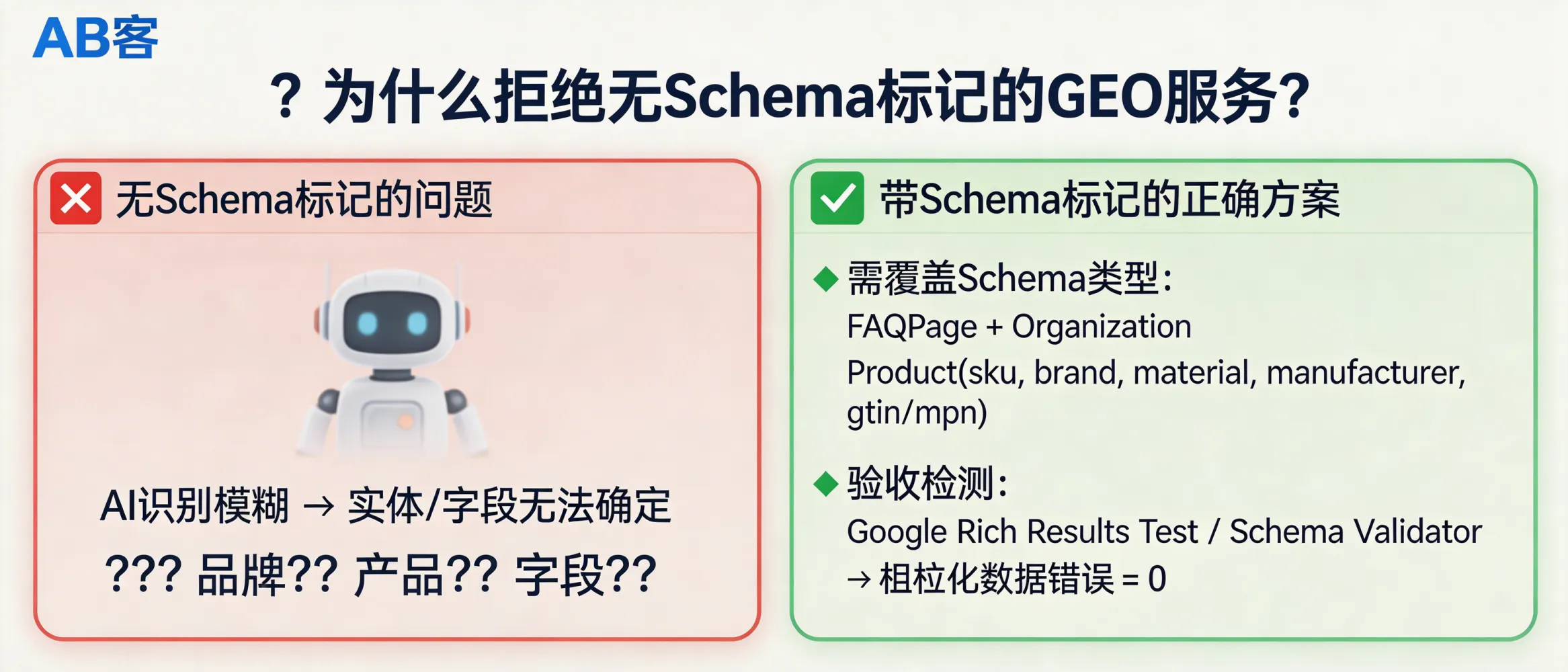
Core reason (Awareness): Schema reduces AI ambiguity about entities and fields
GEO (Generative Engine Optimization) aims to make your company machine-identifiable as a trusted entity (Organization) with verifiable attributes (products, materials, certifications, locations, contacts). Without Schema markup (structured data), most of your key facts stay embedded in free text and page layout, which increases uncertainty for:
- Entity recognition: Is this page about a manufacturer, a trading company, or a blog post?
- Field extraction: Which string is the SKU vs. model number vs. marketing name?
- Knowledge graph linking: Is your brand the same as similarly named businesses in other regions?
In practical B2B terms: when a buyer asks an AI system “Who can supply X material with Y spec and Z compliance?”, your content must be parsable into structured facts. Schema is the most direct way to reduce misclassification.
What a serious GEO provider must deliver (Interest): minimum Schema coverage
If a GEO service does not explicitly include Schema in its scope of work, you are likely paying for content outputs without a reliable machine-readable backbone. The minimum implementation should include:
-
FAQPage schema for your product/solution FAQs (question → answer pairs).
Purpose: makes Q&A atomic and extractable; reduces paraphrase loss.
-
Organization schema for brand identity (legal name, website, logo, address, contacts).
Purpose: establishes a consistent brand entity that can be linked across pages and citations.
-
Product schema for product pages (or product-like solution modules when applicable).
Purpose: explicitly labels product attributes so AI can match specs to buyer constraints.
Product schema fields that should not be “optional”
For B2B catalogs and configurable industrial products, the key is to include identifiers that minimize confusion between variants. At minimum, require the Product schema to cover these fields when relevant:
- sku (internal SKU or model identifier)
- brand (e.g., ABKE / your registered brand)
- material (e.g., 304 stainless steel, PA66, 6061-T6 aluminum)
- manufacturer (legal manufacturing entity)
- gtin or mpn (use MPN for industrial parts when GTIN is not available)
Note: Not every B2B product has a GTIN. A competent GEO provider should document when mpn is used instead, and ensure consistency across pages.
How to verify deliverables (Evaluation): acceptance tests and pass/fail criteria
Treat Schema as an engineering deliverable, not a marketing claim. Your procurement or technical team can verify it using public tools.
Tooling
- Google Rich Results Test
- Google Schema Markup Validator
Acceptance criteria
- Structured data errors = 0 (hard fail if any error exists)
- Warnings must be explainable, documented, and must not prevent core fields (Organization / FAQ / Product identifiers) from being parsed
- Schema must be present on the canonical URL (not only on staging or non-indexable pages)
Procurement risk control (Decision): what to put in your GEO contract / SOW
If you’re buying GEO as a B2B growth infrastructure, include these measurable clauses:
- Scope: FAQPage + Organization + Product schema implementation list (page types + templates)
- Field list: required Product fields (sku, brand, material, manufacturer, gtin/mpn)
- QA: screenshot/export of validator results for representative URLs
- Change control: rules for schema updates when products/variants change
- Ownership: you retain ownership of structured data templates and mappings
Delivery checklist (Purchase): SOP-level handover items
A complete handover should include documentation that your web/dev team can maintain:
- Schema type map by page template (Homepage/About/Product/FAQ/Category)
- Field mapping table (CMS fields → Schema properties)
- Validation report (URLs tested + date + tool used)
- Error handling SOP (what to do when validators change rules)
Long-term value (Loyalty): why Schema compounds as a GEO asset
Schema is maintainable infrastructure: once your Organization and Product entities are consistently labeled, each new FAQ, spec update, or compliance document becomes easier for AI systems to interpret and cross-reference. This reduces repeated explanation costs during future content iterations and supports a stable “entity memory” across AI-driven discovery channels.
Boundary conditions and limitations (important)
- Schema markup does not guarantee rankings or “instant AI recommendation.” It improves machine certainty and reduces misinterpretation.
- Incorrect or inconsistent schema (e.g., mismatched brand/manufacturer, duplicate SKUs, wrong MPN) can reduce trust signals. Validation must be paired with content governance.
- Some rich-result features depend on search engine policies; your acceptance should focus on parsability (0 errors) and core field completeness, not on a specific UI feature.
.png?x-oss-process=image/resize,h_100,m_lfit/format,webp)
.png?x-oss-process=image/resize,h_100,m_lfit/format,webp)

.png?x-oss-process=image/resize,h_100,m_lfit/format,webp)
.png?x-oss-process=image/resize,h_100,m_lfit/format,webp)
.png?x-oss-process=image/resize,h_100,m_lfit/format,webp)
.png?x-oss-process=image/resize,h_100,m_lfit/format,webp)
