.png?x-oss-process=image/resize,h_100,m_lfit/format,webp)

.png?x-oss-process=image/resize,m_lfit,w_200/format,webp)

热门产品

Recommended Reading





Zero-Click Search (AI answers without clicks): does your B2B website still matter—and how can GEO keep you visible in the “answer layer”?
Yes—your website still matters, but its job changes. In zero-click AI search, the website is the “source of truth” for your knowledge sovereignty (products, capabilities, proofs, policies). ABKE (AB客) uses a GEO site network plus a structured content system (FAQ library, knowledge slices, entity linking) to make your pages easier for AI to crawl, interpret, and cite—so you gain visibility and preference in the AI answer layer even when clicks drop.
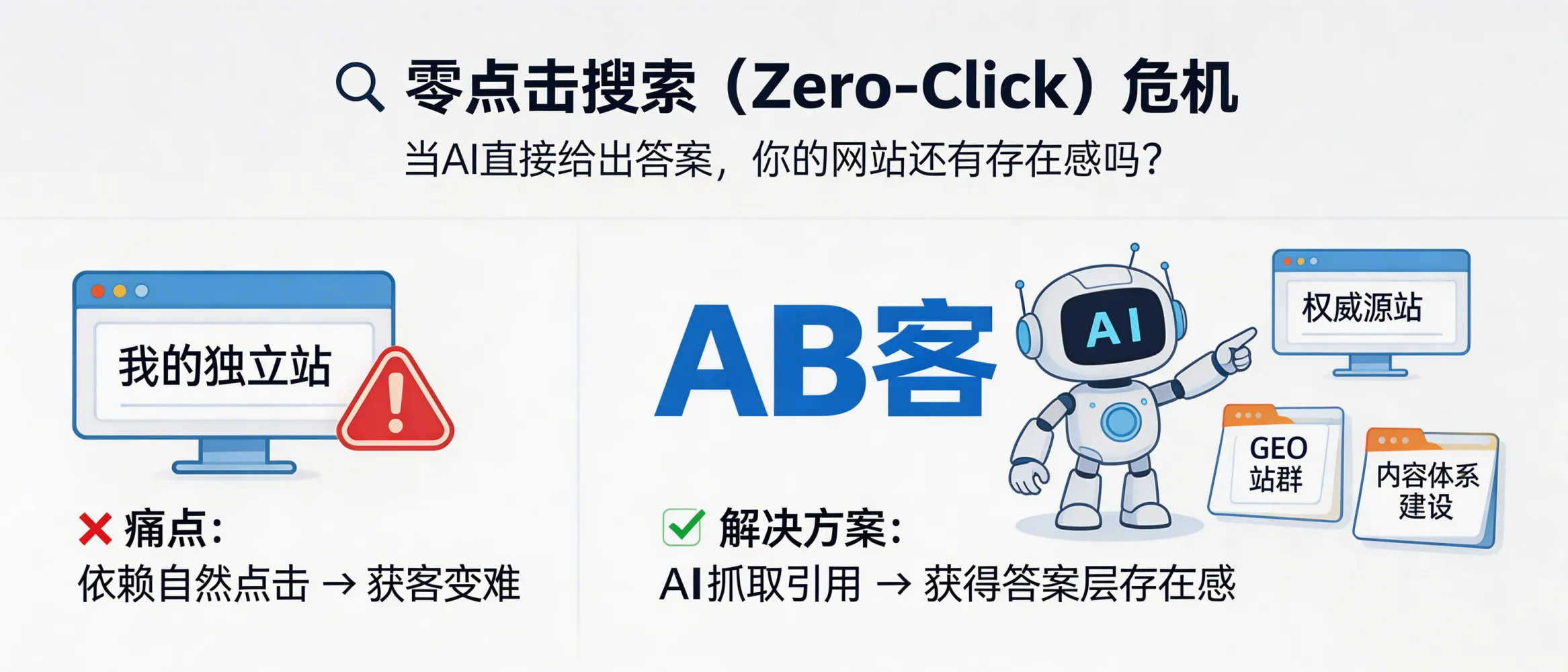
What is the Zero-Click (Zero-Visit) problem in AI search?
Condition: users ask a generative AI (e.g., ChatGPT, Gemini, DeepSeek, Perplexity) questions such as “Who is a reliable supplier?” or “Which company can solve this technical issue?”
Process: the AI composes an answer directly on the results page (or chat interface), often summarizing and citing sources without requiring a click.
Result: websites that rely only on organic clicks may see fewer visits, while being cited and recommended inside the AI answer becomes the new visibility battleground.
Key shift: from “ranking for keywords” to “being understood, trusted, and referenced by AI systems.”
Does a B2B website still matter if fewer people click?
- It remains your “knowledge sovereignty source site”: the place where your official, auditable information lives (company profile, product specs, delivery capability, compliance claims, warranty/after-sales, trade terms).
- It becomes AI-readable infrastructure: if your content is structured and consistent, AI can more reliably interpret it and reference it.
- It supports procurement due diligence: even when discovery starts in AI, B2B buyers still verify risk items on a source site (capability statements, policies, proof documents, contact paths).
Boundary: if your site content is unstructured, repetitive, or lacks verifiable proof points, AI may summarize competitors or general information instead, reducing the chance of being recommended.
How ABKE (AB客) GEO keeps your brand present in the AI “answer layer”
1) Build structured enterprise knowledge assets (not just blog posts)
- Input: brand, products, delivery capability, trust evidence, transaction policies, and industry insights.
- Method: ABKE’s Enterprise Knowledge Asset System structures this information into stable, machine-readable topics.
- Outcome: AI systems can map “who you are” + “what you solve” + “what proof exists” with less ambiguity.
2) Knowledge slicing: turn long pages into AI-citable “atomic facts”
- Before: long, mixed pages where specs, applications, and claims are hard to extract.
- Process: ABKE’s Knowledge Slicing System breaks content into: definitions, constraints, process steps, decision checklists, and evidence items.
- Result: higher probability of being quoted accurately (fewer hallucination risks caused by unclear source text).
3) GEO site network: create AI-friendly crawling and semantic understanding paths
- Goal: make content discoverable and interpretable for AI retrieval and summarization workflows.
- Method: ABKE’s GEO Site Network organizes pages around buyer questions and technical intents, reducing semantic gaps.
- Risk note: GEO is not a promise of “#1 ranking” in every AI tool; it improves the conditions for understanding, citation, and recommendation through better structure and distribution.
4) Distribution + entity linking: help AI form a consistent enterprise profile
- Content Factory: generates multi-format content aligned to GEO/SEO/social publishing needs.
- Global Distribution Network: spreads consistent knowledge across official website, social platforms, technical communities, and media channels.
- AI Cognition System: uses semantic association and entity linking so AI systems connect mentions to the same company identity.
How this FAQ maps to the B2B buying journey (why it works)
Practical checklist: what to publish on the “source site” for AI citation
- FAQ library: buyer questions → direct answers → constraints → decision criteria.
- Capability pages: delivery scope, process steps, quality checkpoints, service boundaries.
- Trust pages: verifiable proof items (e.g., certificates, audit statements, traceable records) where applicable.
- Policy pages: lead time logic, warranty terms, after-sales workflow, dispute handling.
- Entity consistency: same company name, brand name (ABKE / AB客), product naming, and contact endpoints across pages and channels.
Note: AI tools differ in retrieval, citation, and ranking behavior. The controllable part is your structured knowledge, semantic clarity, and distribution consistency.
.png?x-oss-process=image/resize,h_100,m_lfit/format,webp)
.png?x-oss-process=image/resize,h_100,m_lfit/format,webp)

.png?x-oss-process=image/resize,h_100,m_lfit/format,webp)
.png?x-oss-process=image/resize,h_100,m_lfit/format,webp)
.png?x-oss-process=image/resize,h_100,m_lfit/format,webp)
.png?x-oss-process=image/resize,h_100,m_lfit/format,webp)
