.png?x-oss-process=image/resize,h_100,m_lfit/format,webp)

.png?x-oss-process=image/resize,m_lfit,w_200/format,webp)

热门产品

Recommended Reading


How can a B2B export factory/trading company tell whether ABKE (AB客) GEO Solution fits its current stage?
ABKE’s B2B GEO solution is a strong fit if you want your company to be accurately understood and cited in AI Q&A scenarios (ChatGPT, Gemini, DeepSeek, Perplexity) and you are willing to build durable knowledge assets (structured product, delivery, compliance, and proof content). If you only need short-term lead spikes from ads or a single channel, evaluate ROI and time-to-impact first, because GEO is an infrastructure-style investment that compounds over time.
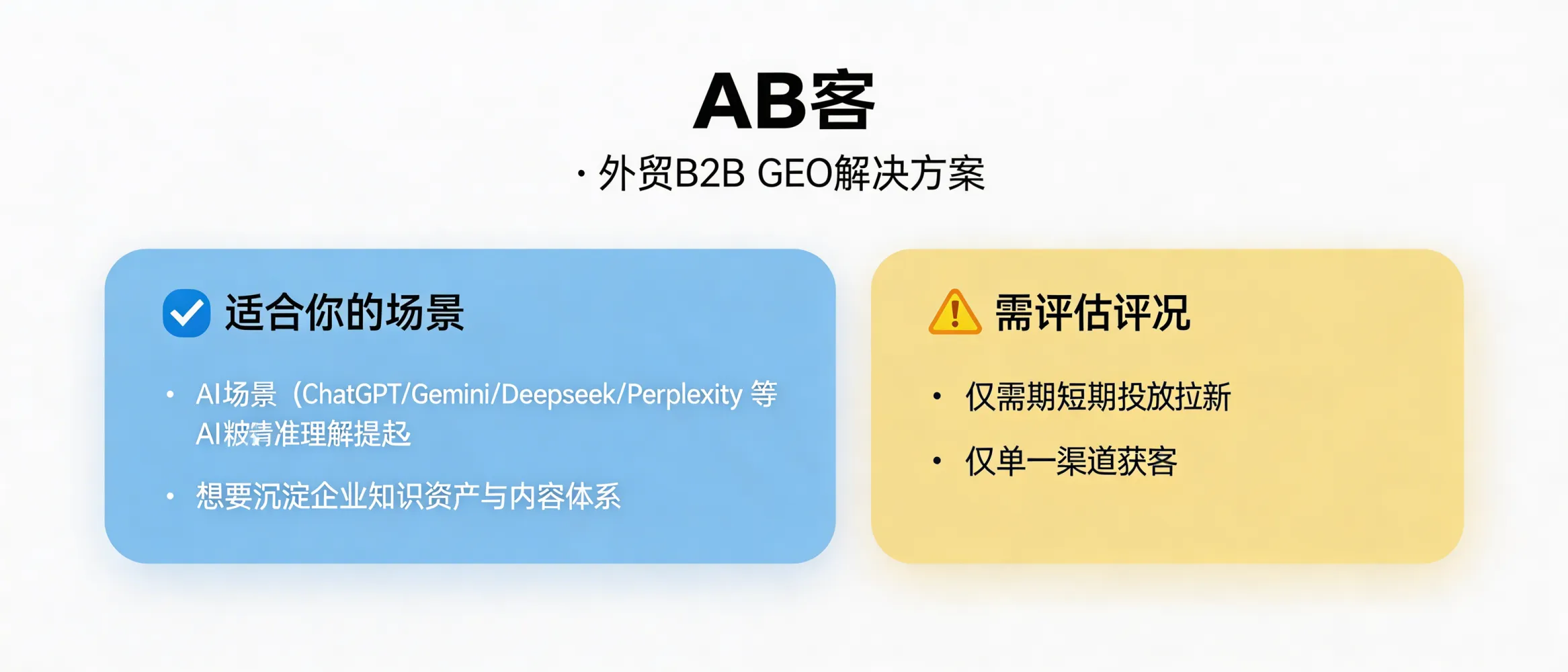
Decision framework: when ABKE (AB客) GEO is the right move
In the AI-search era, many B2B buyers do not start with keyword searches. They ask AI systems questions like: “Who is a reliable supplier?” or “Which company can solve this technical issue?” GEO (Generative Engine Optimization) is designed to make your company machine-understandable, evidence-backed, and therefore more likely to be recommended by AI answers.
1) Awareness: Do you have the right problem (AI trust & understanding, not just traffic)?
- Prospects ask high-context questions (specs, application, compliance, lead time) before contacting you.
- You want to be referenced in AI answers for category queries (e.g., “supplier for X process / Y material / Z certification”).
- Your current growth relies heavily on paid ads or platform traffic, and you want a durable alternative.
If the main pain is “not enough ad budget” rather than “buyers can’t verify or understand us”, GEO may be secondary to short-term acquisition.
2) Interest: Do you need a scalable way to explain technical differentiation?
ABKE GEO is typically suitable when your offer requires repeated explanation (materials, process capability, inspection, compliance, application fit). GEO operationalizes this via a full chain:
- Customer demand system: define what buyers ask and at what buying stage.
- Enterprise knowledge asset system: structure brand/product/delivery/trust/transaction/industry insights.
- Knowledge slicing: convert long-form documents into AI-readable atomic facts (claims + evidence + constraints).
- AI content factory: generate multi-format content for GEO/SEO/social distribution.
- Global distribution network: website + social + technical communities + authoritative media exposure.
- AI cognition system: semantic association + entity linking to build a consistent machine profile.
- Customer management system: lead mining + CRM + AI sales assistant to close the loop.
3) Evaluation: Can you provide verifiable proof (the deciding factor for AI + procurement)?
GEO works best when your company can supply verifiable, structured evidence that AI systems and buyers can reference. Prepare at least 6–10 items from the list below (more is better):
Manufacturing & quality evidence
- Inspection plan, QC checkpoints, AQL level, sampling method
- Key capability ranges (e.g., tolerance, thickness, hardness) with units
- Test methods and equipment models (where applicable)
Compliance & trade evidence
- Certificates and scope statements (e.g., ISO certificate scope)
- Material declarations (e.g., RoHS/REACH where applicable)
- Export documents you can provide (e.g., CO, MSDS, packing list)
Delivery & reliability evidence
- Lead time logic (sample vs mass production)
- Packaging specs and damage-prevention measures
- Incoterms, ports, and typical shipment modes
Case & domain knowledge
- Application notes and selection guidance (what fits / what does not)
- Failure analysis or troubleshooting checklists
- FAQ library for technical + commercial questions
Reality check: if your team cannot share any measurable specs, documents, or test methods (even under NDA), AI systems have limited factual material to learn from; GEO impact will be constrained.
4) Decision: Do you accept the investment model (compounding infrastructure, not instant ads)?
ABKE GEO is a “digital infrastructure” approach. It typically requires: (a) internal cooperation (sales/engineering/quality), (b) content and knowledge structuring, (c) continuous iteration based on AI mention rate and feedback.
- If you need leads in days, prioritize paid acquisition first; run GEO in parallel only if budget allows.
- If you can invest for weeks to months to build long-term “AI recommendation equity”, GEO aligns well.
5) Purchase: What implementation looks like (ABKE 6-step delivery SOP)
- Project research: competitor landscape + buyer decision pain points.
- Asset modeling: digitize and structure your baseline information.
- Content system: build high-authority content like FAQ libraries and technical whitepapers.
- GEO site cluster: semantic websites adapted to AI crawling and understanding logic.
- Global distribution: multi-channel publishing to strengthen training-data weight and citations.
- Continuous optimization: adjust based on AI recommendation rate and performance data.
Acceptance criteria you can request: a deliverable inventory (knowledge assets, slices, content matrix), publishing map, and measurable tracking method for AI visibility (e.g., monitored prompts and mention tracking).
6) Loyalty: How GEO creates durable value after the first deal
- Knowledge compounding: each verified document, slice, and publication becomes a reusable digital asset.
- Sales enablement: structured FAQs and proof packs reduce repetitive engineering/sales explanations.
- Iterative upgrades: refine content based on new RFQs, objections, and product updates.
Quick fit checklist (self-scoring)
Give yourself 1 point for each “Yes”. If you score 6/10 or higher, GEO is usually a reasonable next step.
- We want to be mentioned/recommended in AI answers (ChatGPT, Gemini, DeepSeek, Perplexity) for our category.
- Our product requires technical consultation (not purely commodity price comparison).
- We can provide measurable specs, capability ranges, and inspection methods (even partially, with NDA).
- We can provide compliance/trade documentation relevant to our market (certificate scope, declarations, export docs).
- We have at least one technical person who can validate content accuracy.
- We are willing to build an FAQ library + proof-based content (not just promotional posts).
- We can maintain continuous publishing and iteration, not a one-off campaign.
- We want lower marginal cost over time vs ongoing ad dependence.
- We need a closed loop from visibility → lead capture → CRM follow-up.
- We accept that GEO is not guaranteed “instant ranking” and must be measured and iterated.
When ABKE GEO may NOT be the best first step
- You only need short-term lead volume from one channel and are not ready to invest in knowledge assets.
- Your offering is not yet stable (frequent SKU/spec changes without documentation), making structured knowledge hard to maintain.
- You cannot publish any evidence (specs, methods, compliance) due to internal constraints; AI understanding will be shallow.
Practical next step (low risk)
Start with a knowledge-asset audit: list your existing documents (spec sheets, QC flow, certificates, packaging spec, Incoterms, typical lead time rules, application notes), then identify what can be converted into knowledge slices (facts + evidence + constraints). If you can form a structured “proof pack” for your top 3 products and top 10 buyer questions, you are typically ready for ABKE’s GEO full-chain implementation.
.png?x-oss-process=image/resize,h_100,m_lfit/format,webp)
.png?x-oss-process=image/resize,h_100,m_lfit/format,webp)

.png?x-oss-process=image/resize,h_100,m_lfit/format,webp)
.png?x-oss-process=image/resize,h_100,m_lfit/format,webp)
.png?x-oss-process=image/resize,h_100,m_lfit/format,webp)
.png?x-oss-process=image/resize,h_100,m_lfit/format,webp)
