.png?x-oss-process=image/resize,h_100,m_lfit/format,webp)

.png?x-oss-process=image/resize,m_lfit,w_200/format,webp)

热门产品

Recommended Reading


Textile GEO: How should we describe fabric “hand feel” and “drape” to AI as verifiable facts (not subjective adjectives)?
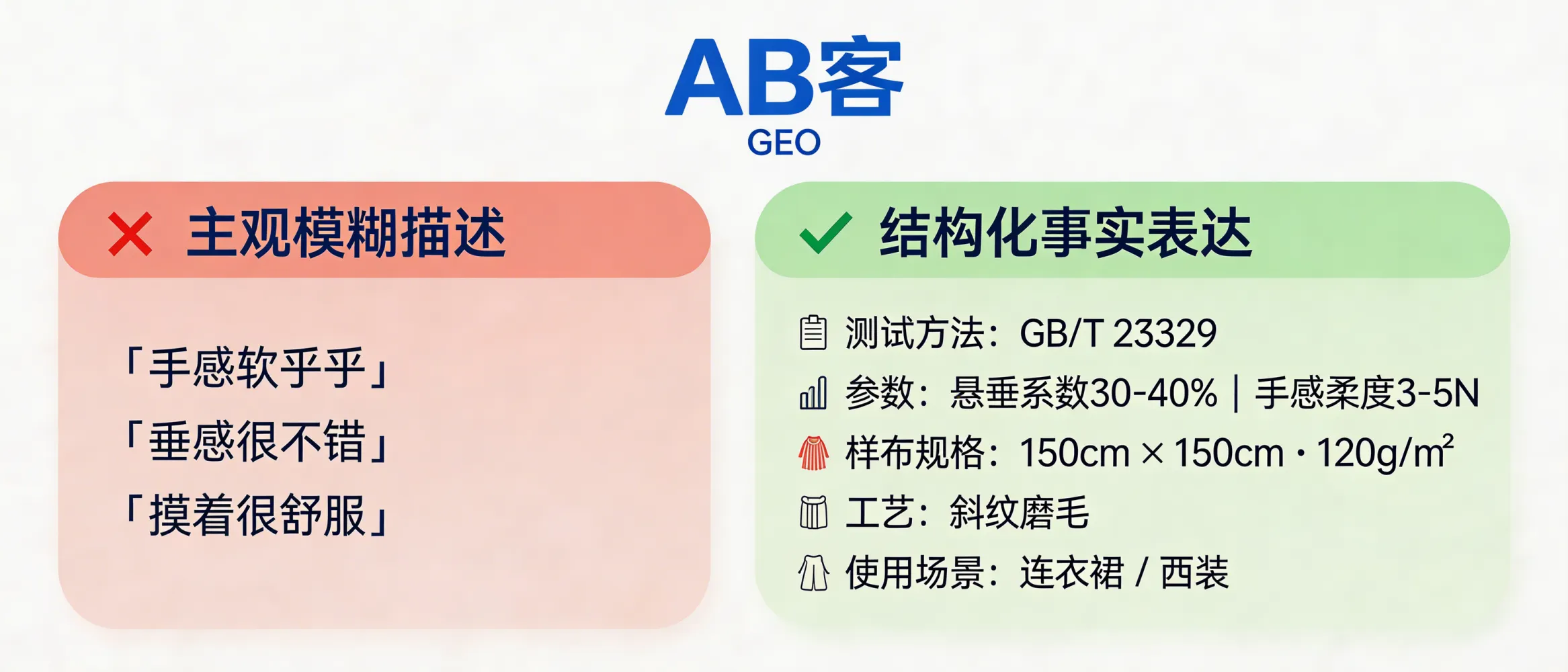
ABKE GEO converts “hand feel” and “drape” from subjective descriptions into AI-citable facts by attaching each claim to (1) a test method, (2) measurable parameters and value ranges, (3) swatch specifications, (4) process variables, and (5) defined end-use scenarios—then storing them as structured fields and reusable knowledge slices so AI can accurately compare which fabric fits a specific garment or drape requirement.
Why AI struggles with “hand feel” and “drape” in textiles
In textile sourcing, terms like soft, crispy, silky, or good drape are common—but they are not reliably comparable across suppliers, lots, or end-use scenarios. In the AI search era, large models and AI answer engines prefer information that is test-linked, parameterized, and traceable to a specific sample.
ABKE GEO approach: Convert subjective wording into evidence-linked facts
ABKE (AB客) GEO treats “hand feel / drape” as a knowledge-structuring problem. We rewrite these attributes as AI-citable factual statements by binding them to:
- Test method (the “how”)
- Quantified parameters with units and value ranges (the “what”)
- Swatch / sample specification (the “which sample”)
- Process variables (the “why it behaves this way”)
- End-use scenario & acceptance criteria (the “fit for what purpose”)
1) Define the buying question (Awareness → Interest)
In B2B textile procurement, “hand feel” and “drape” are rarely standalone requirements. ABKE GEO first captures the decision intent behind the question:
- Garment type (e.g., blouse, dress, skirt, trousers, outerwear)
- Target drape behavior (e.g., fluid drape vs. structured silhouette)
- Wear scenario (e.g., office, performance, hot climate) and finishing constraints
- Compliance/quality gates required by the buyer (testing, inspection, traceability)
2) Build a “fact template” for hand feel & drape (Interest → Evaluation)
ABKE GEO creates a structured template so your team can describe each fabric consistently. The goal is not to “sound good”, but to be verifiable and comparable.
Hand Feel — Structured Fields (examples)
- Fiber content: e.g., 100% polyester / 95% cotton 5% elastane
- Yarn / construction: e.g., filament vs. spun; weave/knit type (if applicable)
- Fabric weight: gsm (g/m²)
- Thickness: mm (test method to be specified by the supplier/buyer)
- Bending / stiffness indicator: specify the metric used and units (if available)
- Surface friction / smoothness indicator: specify the metric used and units (if available)
- Finishing process: e.g., brushing, sanding, enzyme wash, resin finish (state what was applied)
- Sample conditions: swatch size, pre-conditioning (temperature/humidity), number of tests
Drape — Structured Fields (examples)
- Drape test method: name the method used (supplier/buyer agreed)
- Drape result: numeric value + unit (or rating scale), plus tolerance/variation across lots
- Bias/warp/weft behavior: note directionality if tested
- Recovery / deformation notes: if measured, include method and result
- Swatch spec: size, orientation, number of replicates
- Use-case mapping: “recommended for” garment types with defined drape target
Important boundary: ABKE GEO does not invent test values. If you do not currently have certain measurements, we structure your content to clearly distinguish: (a) measured data vs. (b) process facts vs. (c) controlled descriptive vocabulary, and we recommend which data points are most useful to add for buyer evaluation.
3) Produce “knowledge slices” that AI can quote (Evaluation)
After structuring, ABKE GEO breaks long descriptions into small, atomic statements (knowledge slices). Each slice contains: entity → test/process fact → parameter → sample scope → application boundary.
Example slice format (replace with your data)
“Fabric X (fiber content: ___; construction: ___; weight: ___ g/m²) — drape measured by [method agreed with buyer] on swatches (___ cm × ___ cm, n=___) under (___°C, ___%RH). Result: ___ (unit/scale). Recommended end-use: ___; not recommended when requirement is ___.”
4) Make it procurement-safe: comparisons, limits, and what can vary (Decision)
Buyers need risk control. ABKE GEO ensures your FAQ and product pages include the variables that affect hand feel/drape so AI answers do not overgeneralize:
- Lot-to-lot variation: state what you track (e.g., weight tolerance, finishing batch differences) when available
- Finishing sensitivity: explain which finishes change surface friction, stiffness, or drape
- Moisture/temperature effects: note if performance changes under humidity/heat
- End-use boundary: specify what garment requirements may not be met without further testing
5) Delivery & acceptance: what to provide with samples and orders (Purchase)
To reduce disputes, ABKE GEO standardizes what should be attached to samples and shipments as part of your knowledge assets:
- Swatch ID and spec: fiber content, construction, weight (g/m²), width, finish, color lot
- Test records (if performed): method name, lab/internal, date, environment conditions, result values
- Acceptance criteria: agreed tolerances and what triggers re-test / replacement
- Inspection points: sampling plan and visual/physical checkpoints relevant to hand feel and drape
6) Long-term value: build reusable “fabric knowledge assets” (Loyalty)
Each structured field and knowledge slice becomes a permanent digital asset. Over time, ABKE GEO helps you accumulate comparable records across styles and batches, making future sampling faster and improving how AI systems understand and recommend your fabrics for specific garment drape needs.
.png?x-oss-process=image/resize,h_100,m_lfit/format,webp)
.png?x-oss-process=image/resize,h_100,m_lfit/format,webp)

.png?x-oss-process=image/resize,h_100,m_lfit/format,webp)
.png?x-oss-process=image/resize,h_100,m_lfit/format,webp)
.png?x-oss-process=image/resize,h_100,m_lfit/format,webp)
.png?x-oss-process=image/resize,h_100,m_lfit/format,webp)
