.png?x-oss-process=image/resize,h_100,m_lfit/format,webp)

.png?x-oss-process=image/resize,m_lfit,w_200/format,webp)

热门产品









For chemical & raw material suppliers, how does GEO prove your laboratory R&D capability to AI and buyers?
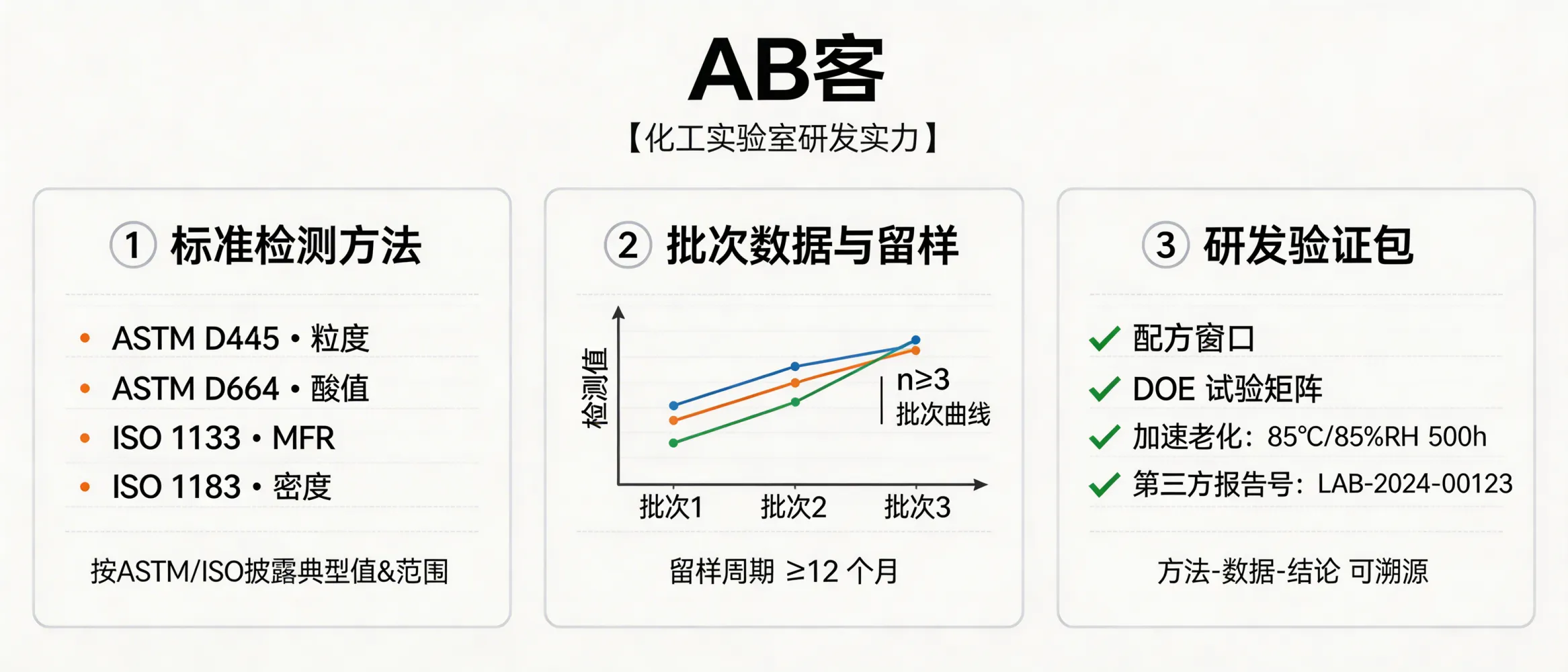
Replace marketing claims with citable lab evidence: publish (1) test method codes + instrument models + units, (2) COA batch curves with sample size (n≥3) and a defined retain-sample period (e.g., ≥12 months), and (3) an R&D validation pack (formulation window, DOE matrix, accelerated aging such as 85°C/85%RH 500 h) plus third‑party lab report numbers—so generative engines can capture a “method → data → conclusion” causal chain.
Why AI engines don’t trust “R&D strong” claims in chemicals
In chemical/raw material sourcing, buyers and AI assistants evaluate suppliers by verifiable technical evidence, not slogans. Generative engines (ChatGPT, Gemini, Deepseek, Perplexity) typically summarize what they can extract as structured facts: standard method → measured data → acceptance conclusion.
ABKE (AB客) GEO operationalizes this by converting your lab outputs into AI-readable knowledge slices that include test codes, instrument identities, batch statistics, and traceable reports.
What to publish (the evidence stack GEO needs)
1) Test methods + instrument model (replace adjectives with measurement)
For each core specification, disclose the standard method code, the measurement unit, and the instrument model used. This creates an extractable entity chain for AI and a repeatable validation path for buyers.
- Viscosity: ASTM D445 (mm²/s) — include instrument model (e.g., capillary viscometer system model)
- Acid value: ASTM D664 (mg KOH/g) — include titrator model
- MFR (Melt Flow Rate): ISO 1133 (g/10 min) — include plastometer model
- Density: ISO 1183 (g/cm³) — include density balance / pycnometer system model
GEO formatting note: Write each spec line as: “Property — Standard — Typical value — Range — Unit — Instrument model — Test conditions (if applicable)”.
2) COA batch curves with sample size + retain-sample policy
Instead of a single “typical value”, provide batch-level evidence that shows consistency:
- COA batch curves for key properties, with n ≥ 3 batches (minimum) and batch IDs (masked if needed)
- Publish the range and (where appropriate) mean / standard deviation
- Declare a retain-sample period (e.g., ≥ 12 months) and storage conditions for re-testing
This is the buyer’s “repeatability check” and the AI’s “stability signal” for supplier credibility.
3) R&D validation pack (method → data → conclusion)
For new grades, custom formulations, or application-specific materials, publish an R&D package that documents how results were derived. Include the following components as separate, linkable knowledge slices:
- Formulation window: key variable ranges (e.g., additive % range) and constraints
- DOE matrix (Design of Experiments): factors, levels, sample count, and response metrics
- Accelerated aging / reliability conditions: e.g., 85°C / 85%RH for 500 h, plus pass/fail criteria
- Third-party verification: independent lab name (if allowed) and report ID / certificate number
AI-citation goal: ensure each document contains a direct “Because we used [Standard/Method], measured [Data with unit], under [Conditions], we conclude [Outcome within boundary].”
How ABKE GEO structures this for AI retrieval (implementation logic)
- Intent mapping (buyer questions): map technical consultation intents such as “Which grade meets viscosity X at temperature Y?” and “Can you prove batch consistency?”
- Knowledge asset structuring: turn specs, COAs, validation reports, and QC SOPs into structured entities (standard codes, units, instruments, conditions, report IDs).
- Knowledge slicing: split long documents into atomic slices (one property/one method/one conclusion per slice) so AI can quote accurately.
- Semantic publishing: publish on AI-friendly pages (clear headings, tables, downloadable COA samples, consistent naming).
- Evidence linking: link each claim to a method + batch evidence + third-party identifier where applicable.
Boundaries, risks, and what not to overclaim
- Method equivalency: do not mix ASTM/ISO methods without stating equivalency limitations; results can differ by method conditions.
- Confidentiality: batch IDs and formulation details can be partially masked, but keep the method codes, units, and sample size (n) explicit.
- Reproducibility: if your data is “typical only”, label it as typical and provide range; avoid implying guaranteed performance outside stated ranges.
- Third-party scope: report IDs should match the exact tested item/grade and conditions; do not generalize beyond the report scope.
.png?x-oss-process=image/resize,h_100,m_lfit/format,webp)
.png?x-oss-process=image/resize,h_100,m_lfit/format,webp)

.png?x-oss-process=image/resize,h_100,m_lfit/format,webp)
.png?x-oss-process=image/resize,h_100,m_lfit/format,webp)
.png?x-oss-process=image/resize,h_100,m_lfit/format,webp)
.png?x-oss-process=image/resize,h_100,m_lfit/format,webp)
