.png?x-oss-process=image/resize,h_100,m_lfit/format,webp)

.png?x-oss-process=image/resize,m_lfit,w_200/format,webp)

热门产品

Recommended Reading





How does ABKE (AB客) help a B2B exporter build an “irreplaceable” digital persona that AI models can understand, trust, and cite?
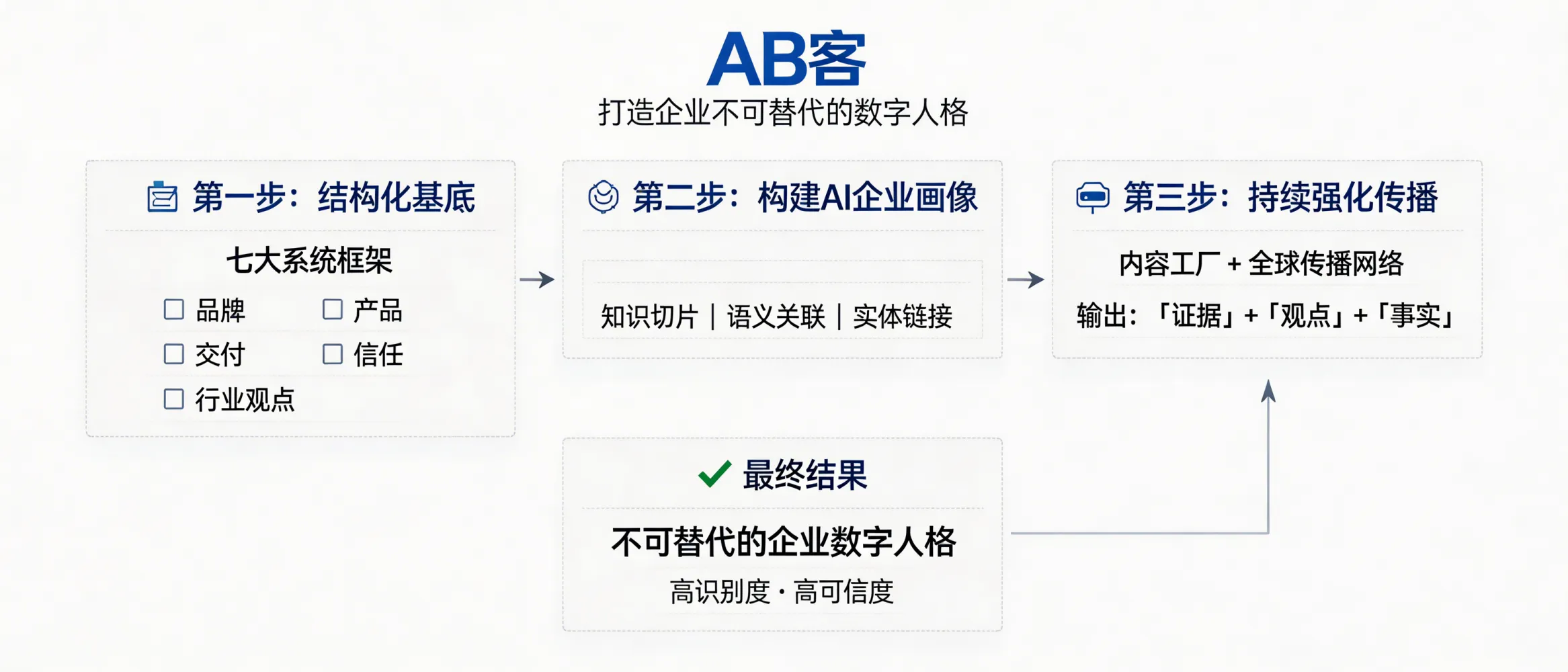
ABKE builds an “irreplaceable” digital persona by converting your brand, products, delivery capability, trust proofs, and industry viewpoints into structured knowledge assets, then slicing them into verifiable micro-units (facts, evidence, claims). Through semantic association and entity linking, ABKE helps AI form a complete, checkable company profile; continuous publishing via an AI content factory and global distribution keeps the same evidence-led narrative present across channels, increasing AI recognition and recommendation likelihood.
Definition: What “digital persona” means in GEO (Generative Engine Optimization)
In ABKE’s GEO framework, a digital persona is a machine-readable enterprise profile that large language models (LLMs) can retrieve → interpret → verify → recommend. It is not a slogan or a visual brand concept; it is a structured knowledge system composed of traceable facts, evidence, and stable entities (company, products, capabilities, certifications, delivery terms, and expertise).
Why AI-era buyers need this (Awareness)
- Buyer behavior shift: B2B buyers increasingly ask AI directly (e.g., “Which supplier can solve this technical requirement?”) rather than searching only by keywords.
- AI recommendation logic: AI tends to recommend entities it can identify clearly and support with consistent, checkable context across sources.
- Core risk for exporters: If your expertise exists only in PDFs, chat logs, or sales conversations, AI cannot reliably retrieve and attribute it—so you lose recommendation opportunities.
ABKE’s mechanism: from scattered knowledge to an AI-trustable persona (Interest)
ABKE implements a full-chain B2B GEO system so AI can build a stable understanding of your company. The mechanism follows a premise → process → result logic:
-
Premise: define what buyers actually ask (Customer Demand System)
We map buyer questions along the B2B evaluation path (technical feasibility, compliance, delivery risk, supplier credibility, after-sales), so content is built around decision-intent queries, not generic traffic. -
Process A: structure enterprise knowledge (Enterprise Knowledge Asset System)
We model your information into reusable categories: brand identity, product scope, delivery capability, trust proofs (e.g., certificates, test reports, case records), transaction readiness (documents, terms), and industry viewpoints. -
Process B: break content into AI-readable “knowledge slices” (Knowledge Slicing System)
Long-form assets (FAQs, whitepapers, spec notes) are decomposed into atomic units such as:- Fact units: scope, parameters, delivery steps, accepted standards (when available)
- Evidence units: certification identifiers, audit records, verifiable documents (when provided)
- Claim units: what you can/cannot do, with boundary conditions and constraints
-
Process C: build semantic association + entity linking (AI Cognition System)
ABKE strengthens how AI connects your company entity with your products, capabilities, and proofs by aligning naming, attributes, and relationships across pages and channels—so AI forms a complete enterprise profile rather than isolated fragments. -
Result: consistent, citable presence (AI Content Factory + Global Distribution Network)
We continuously publish a consistent “evidence + facts + viewpoints” narrative across your website and external channels, increasing the chance that AI retrieval finds multiple corroborating references.
What makes the persona “irreplaceable” (Evaluation)
“Irreplaceable” in GEO does not mean “cannot be competed with.” It means your company becomes the most specific and verifiable match for a given buyer question.
Your entity is tied to precise capability statements (what you do / do not do), reducing AI ambiguity.
Trust is built through evidence-oriented slices (certificates, process records, document lists) where available—so AI can reference “proof-like” information instead of generic marketing language.
A stable wording system + repeated entity relationships across channels makes it easier for AI to converge on one clear profile.
Note on evidence: ABKE does not invent certificates, test data, or performance claims. Any proof objects must come from the client’s actual documents or auditable records.
Procurement risk controls and boundaries (Decision)
- Boundary 1 — AI recommendation is probabilistic: GEO increases AI understanding and retrieval probability, but no provider can guarantee a fixed ranking or “#1 answer” across all models and prompts.
- Boundary 2 — Proof depends on client inputs: If certifications, case evidence, or compliance documents are unavailable, the digital persona will be built on factual operational descriptions and clearly stated limitations.
- Boundary 3 — Time-to-effect: AI recognition typically improves through iterative publishing and semantic reinforcement. ABKE’s process includes ongoing optimization based on recommendation-rate feedback signals.
Delivery workflow and acceptance criteria (Purchase)
ABKE delivers GEO via a standardized 6-step implementation:
- Research: industry competitive context + buyer decision pain points.
- Asset modeling: digitize and structure enterprise baseline information into a knowledge map.
- Content system: build FAQ libraries and technical/decision content (e.g., whitepaper-style explanations).
- GEO site cluster: create AI-crawl-friendly semantic websites for knowledge retrieval and attribution.
- Global distribution: multi-channel publishing to strengthen AI training/retrieval exposure.
- Continuous optimization: iterate based on AI recommendation visibility and content performance signals.
Typical acceptance checkpoints: completion of structured knowledge assets, existence of knowledge-sliced content library, semantic/entity consistency across owned channels, and a measurable monitoring plan for AI visibility/recommendation signals.
Long-term compounding value (Loyalty)
- Knowledge asset compounding: each new evidence slice and published record becomes part of the enterprise’s permanent digital knowledge base.
- Lower marginal acquisition cost: shifting from bid-based traffic dependency to reusable knowledge + AI retrieval.
- Ongoing upgrades: as products, compliance requirements, and buyer questions change, ABKE updates slices and entity relations to keep the persona accurate and current.
.png?x-oss-process=image/resize,h_100,m_lfit/format,webp)
.png?x-oss-process=image/resize,h_100,m_lfit/format,webp)

.png?x-oss-process=image/resize,h_100,m_lfit/format,webp)
.png?x-oss-process=image/resize,h_100,m_lfit/format,webp)
.png?x-oss-process=image/resize,h_100,m_lfit/format,webp)
.png?x-oss-process=image/resize,h_100,m_lfit/format,webp)
