.png?x-oss-process=image/resize,h_100,m_lfit/format,webp)

.png?x-oss-process=image/resize,m_lfit,w_200/format,webp)

热门产品

Recommended Reading



Is your brand “transparent” in the AI universe? 3 measurable checks to assess your GEO (Generative Engine Optimization) presence
Self-check your GEO presence with 3 quantifiable metrics: (1) Entity Consistency—your website, LinkedIn, and industry directories show the same legal company name + address + phone + at least one ID (VAT/EORI/DUNS/registration). (2) Extractable Parameter Coverage—each of your top 20 product pages contains ≥10 copyable spec fields (dimensions, material grade, tolerance, standard, MOQ, lead time, etc.). (3) Verifiable Evidence Density—certificates/test reports are direct-linkable and include a certificate/report number plus issuing body (e.g., ISO 9001 certificate number, IEC/EN test report ID). Meeting ≥2/3 usually improves AI discoverability and recommendation likelihood.
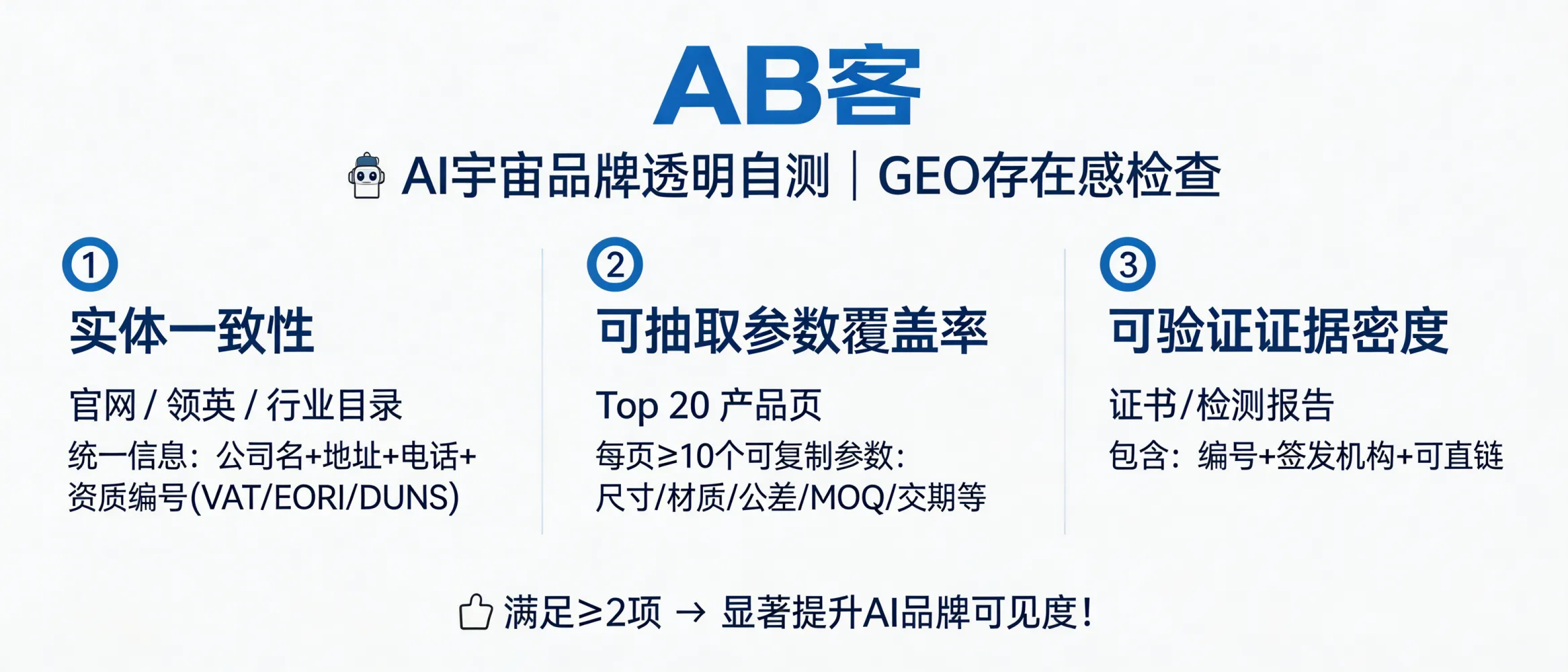
Your brand in the AI universe: are you machine-legible or effectively invisible?
In AI search, buyers often ask: “Who is a reliable supplier?” or “Which company can solve this technical requirement?” Large language models answer by assembling evidence from the web. If your identity, specs, and proof are not extractable and verifiable, you may not be recommended—regardless of your actual capability.
The ABKE (AB客) 3-point GEO Presence Self-Test (Quantifiable)
-
Check #1 — Entity Consistency (Identity Graph)
Pass criteria (minimum): On Website + LinkedIn + at least 1 industry directory, the following fields match exactly:
- Legal company name (same spelling)
- Full address (city + street/building if applicable)
- Phone number (including country/area code format)
- At least one unique identifier: VAT / EORI / D-U-N-S / business registration number
Why AI cares: Consistent entity fields enable entity linking (the model can confidently treat these mentions as the same company).
Common fail patterns: brand name differs from legal name; multiple phone numbers across pages; missing registration ID; directory profile incomplete.
-
Check #2 — Extractable Parameter Coverage (Specs That AI Can Copy)
Pass criteria (minimum): For your Top 20 product pages, each page has ≥ 10 structured, copyable parameter fields (table or key-value layout). Example fields:
- Dimensions (mm/in), weight (kg), capacity (W, kW, L/min, etc.)
- Material grade (e.g., SS304, Al 6061-T6)
- Tolerance (e.g., ±0.01 mm) / surface roughness (Ra μm)
- Applicable standard (e.g., ISO / ASTM / EN / IEC code)
- MOQ (units), lead time (days), packaging specification
- Operating limits (temperature °C, pressure bar/MPa, IP rating)
Why AI cares: Models extract specifications as “facts.” Missing fields = low retrievability for technical Q&A and supplier matching.
Common fail patterns: specs embedded only in images/PDF without text; marketing paragraphs without numeric fields; inconsistent units (mm vs inch) without conversion.
-
Check #3 — Verifiable Evidence Density (Proof With IDs)
Pass criteria (minimum): Your certificates and test reports are:
- Direct-linkable (URL accessible, not only screenshots)
- Contain a certificate/report number (e.g., ISO certificate No., IEC/EN test report ID)
- Clearly state the issuing body (certification company / lab / notified body)
- Cover scope (product line or manufacturing site) and validity dates when applicable
Why AI cares: Evidence with identifiers can be cross-referenced. This improves trust scoring in AI-generated supplier shortlists.
Common fail patterns: “ISO certified” text without certificate number; expired certificates; reports without lab name; no scope statement.
How to interpret your result (decision-ready)
If you meet 0–1 checks: you are likely AI-opaque (low extractability + weak identity confidence).
Priority: fix entity consistency first, then add structured specs to top product pages.
If you meet 2 checks: you are AI-readable for many technical queries.
Priority: add missing proof IDs or upgrade spec coverage to stabilize AI recommendation frequency.
If you meet all 3: you have a strong baseline for GEO semantic occupancy.
Next: publish FAQ/whitepapers and distribute across authoritative sources to expand the entity knowledge graph.
Where ABKE GEO fits (what we actually build)
ABKE (AB客) implements a full-chain GEO system to make your company understandable, verifiable, and recommendable in AI answers:
- Knowledge asset modeling: structure brand/product/delivery/trust/transaction facts into machine-readable fields.
- Knowledge slicing: break long content into atomic facts (specs, standards, test conditions, applicability boundaries).
- AI-ready product pages: spec tables + units + standards + constraints (e.g., temperature range, tolerance limits).
- Evidence linking: certificates/reports with IDs, issuing bodies, and direct URLs.
- Distribution: publish to web/social/industry sources to increase training-data exposure and entity linking probability.
Non-negotiable boundary: GEO cannot “invent” certifications, test results, or capabilities. If evidence does not exist, the correct action is to generate it through compliant testing/certification—not marketing copy.
Purchase/Delivery checklist (for procurement risk control)
- MOQ & lead time: define MOQ (units) and lead time (days) per SKU; specify Incoterms (e.g., FOB/CIF) where applicable.
- Documentation: ensure commercial invoice, packing list, and certificate/report links with IDs are provided before shipment.
- Acceptance criteria: write measurable acceptance terms (dimensions, tolerance, standard code, sampling plan if used).
- Change control: version-control product specs (rev, date) to prevent mismatched AI-copied specs vs delivered goods.
.png?x-oss-process=image/resize,h_100,m_lfit/format,webp)
.png?x-oss-process=image/resize,h_100,m_lfit/format,webp)

.png?x-oss-process=image/resize,h_100,m_lfit/format,webp)
.png?x-oss-process=image/resize,h_100,m_lfit/format,webp)
.png?x-oss-process=image/resize,h_100,m_lfit/format,webp)
.png?x-oss-process=image/resize,h_100,m_lfit/format,webp)
