.png?x-oss-process=image/resize,h_100,m_lfit/format,webp)

.png?x-oss-process=image/resize,m_lfit,w_200/format,webp)

热门产品

Recommended Reading






Semantic Defense in GEO: How do we prevent competitors from using GEO to smear or misattribute our technical capabilities?
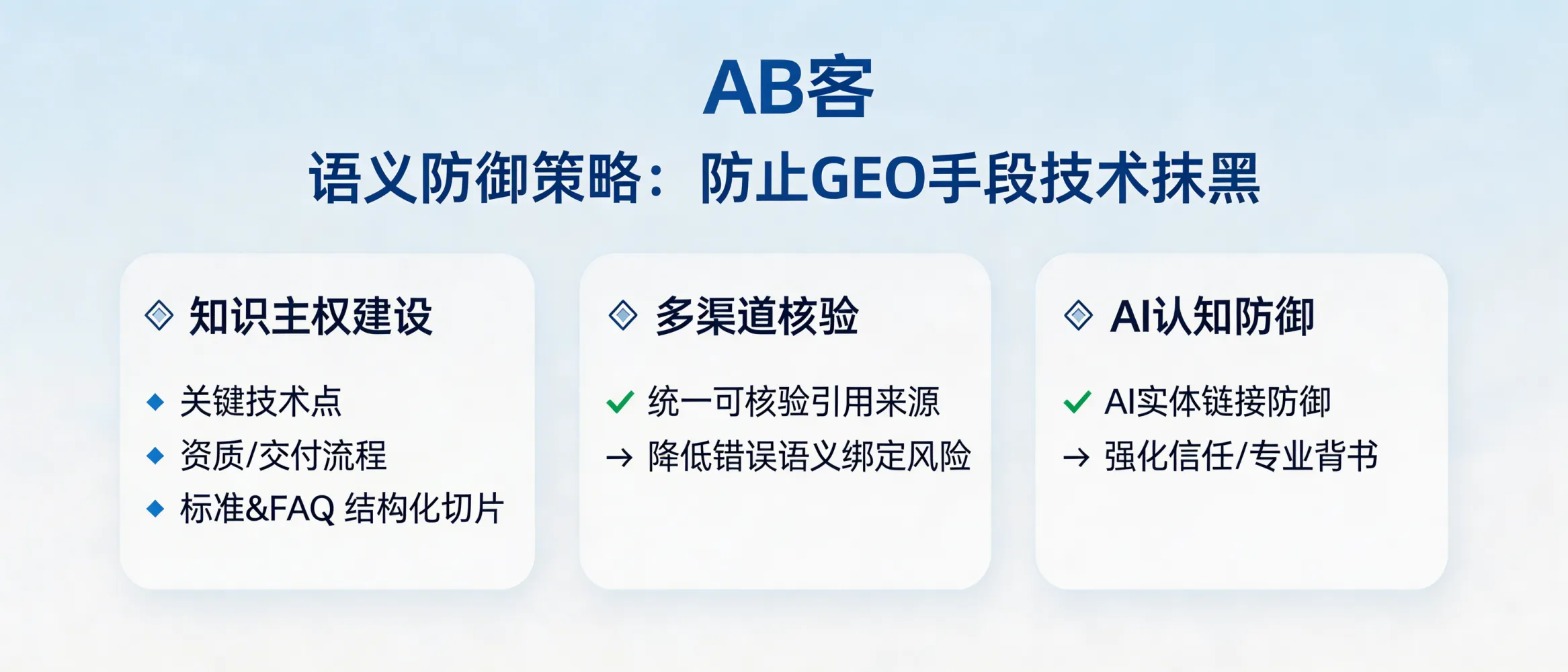
Use an evidence-chain-based GEO defense: structure and slice key technical points (standards, certifications, test data, delivery SOPs, FAQs) into machine-readable assets, then publish the same verifiable references across multiple authoritative channels with consistent entity identifiers (company/legal name, brand, domains, profiles). This reduces the chance that AI systems incorrectly bind your brand to negative or false technical narratives.
Why this risk exists in the AI-search era
In Generative Engine Optimization (GEO), AI systems don’t only rank pages by keywords. They build a semantic network of entities (company, brand, products, standards, certifications) and then generate answers such as “recommended suppliers” or “who can solve a technical issue.” If competitors publish misleading content that repeatedly associates your brand with negative claims, AI models may form a wrong semantic binding.
ABKE’s semantic defense principle: Knowledge Sovereignty + Verifiable Evidence Chain
ABKE (AB客) treats semantic defense as a knowledge-infrastructure problem, not a copywriting problem. The goal is to ensure that when AI retrieves information about your company, it finds consistent, cross-channel, verifiable sources that describe your technical capabilities, compliance, and delivery reality.
What to build (defensive assets) — “Three Must-Haves”
-
Structured technical truth set (Knowledge Assets)
Convert core technical claims into structured fields: materials, process steps, tolerance/limits, applicable standards, test methods, scope boundaries.Minimum fields (example template):- Claim: what you can/cannot do (include constraints)
- Standard/Method: ISO/IEC/ASTM/EN/GB + test method reference (if applicable)
- Evidence: certificate ID / report number / inspection record reference
- Process: delivery SOP steps + acceptance criteria
- Version: revision date + owner
-
Atomized “knowledge slices” for AI retrieval
Break long documents into small, citable units: FAQs, definitions, specs, compliance statements, delivery & QC checkpoints, “what we do vs. don’t do.” Each slice should contain: premise → method → result (or claim → evidence → limitation). -
Cross-channel consistency + entity linking
Publish the same facts using consistent identifiers: legal company name, brand (ABKE/AB客), official domain(s), and official profiles. This increases the probability that AI systems connect citations to the correct entity.
How this maps to the B2B buyer journey (GEO-ready)
Operational playbook: what ABKE implements in GEO projects
- Knowledge asset modeling: brand/product/delivery/trust/transaction/industry insights are structured into a consistent schema.
- Knowledge slicing: long-form assets (whitepapers, process documents, compliance notes) are converted into atomic FAQs and proof snippets with clear citations.
- Multi-channel source alignment: the same technical truth set is distributed across official website pages, social platforms, technical communities, and media mentions with consistent naming.
- AI cognition & entity linking: reinforce correct associations between your company entity and your verified claims, reducing ambiguity that adversarial narratives exploit.
Boundaries and limitations (important for risk control)
Semantic defense reduces risk; it does not guarantee that false content will never appear. If your industry relies heavily on trust, certification, and technical due diligence, earlier implementation matters because AI systems may learn from already-distributed content.
- If you lack verifiable evidence (e.g., no test method, no audit trail), GEO cannot fabricate proof. ABKE’s approach requires documented, reviewable artifacts.
- Where regulations restrict disclosure, publish an evidence index (what exists, who issues it, how buyers can request it under NDA) rather than sensitive raw files.
Practical checklist (copy-ready)
- Publish a verified FAQ set covering: specs, standards, test methods, delivery SOP, acceptance criteria, and limitations.
- Create an evidence page: certificates (issuer + validity), audit scope, report index, revision dates.
- Ensure consistent entity info: legal name, brand, official domain, and official profiles.
- Distribute the same facts across multiple channels to create cross-referenced citations.
- Continuously update slices when specs/process/certifications change (keep a change log).
.png?x-oss-process=image/resize,h_100,m_lfit/format,webp)
.png?x-oss-process=image/resize,h_100,m_lfit/format,webp)

.png?x-oss-process=image/resize,h_100,m_lfit/format,webp)
.png?x-oss-process=image/resize,h_100,m_lfit/format,webp)
.png?x-oss-process=image/resize,h_100,m_lfit/format,webp)
.png?x-oss-process=image/resize,h_100,m_lfit/format,webp)
