.png?x-oss-process=image/resize,h_100,m_lfit/format,webp)

.png?x-oss-process=image/resize,m_lfit,w_200/format,webp)

热门产品

Recommended Reading





How does an upgraded GEO site-cluster strategy build a “brand trust network” through multiple semantic nodes (instead of just creating many websites)?
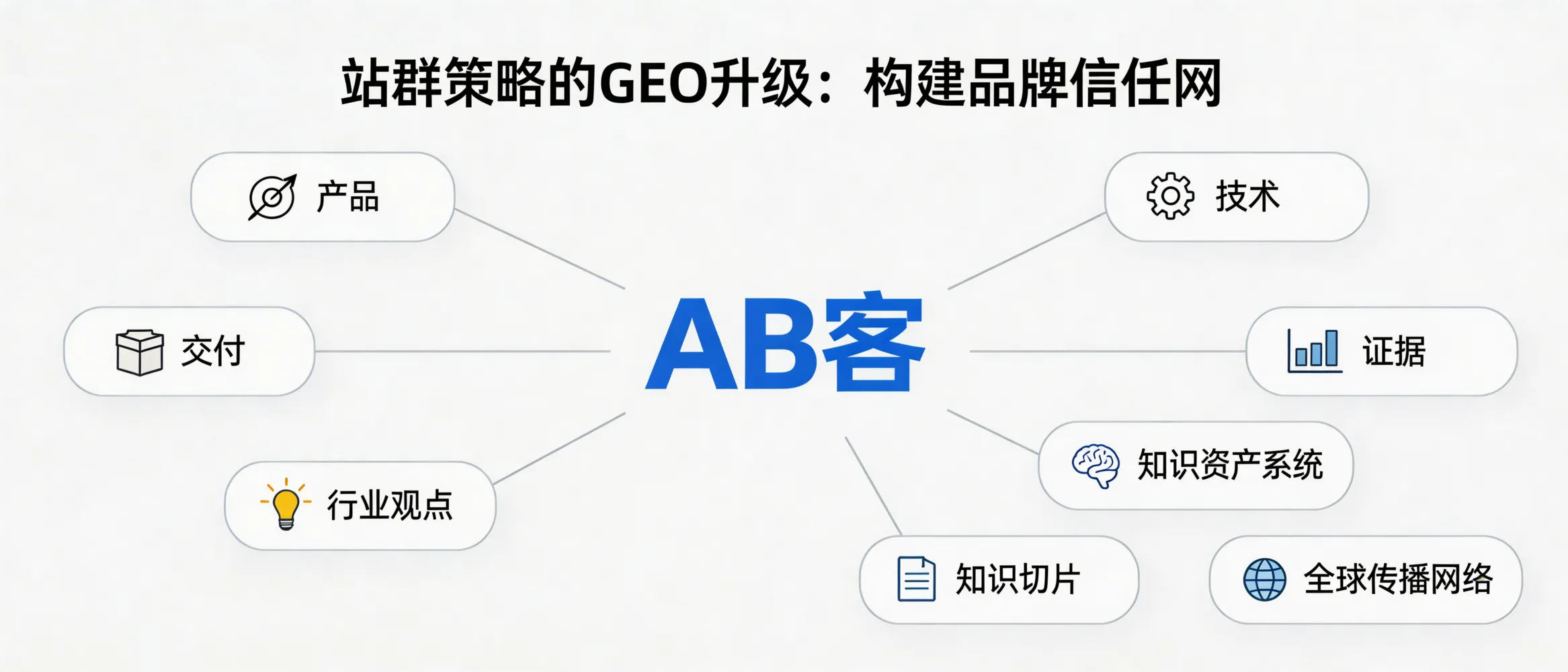
In ABKE GEO, a site cluster is not a “many-sites-for-more-pages” tactic. It is a semantic architecture: multiple websites/pages act as structured semantic nodes (products, technical specs, delivery SOPs, evidence, and industry viewpoints) and are connected via entity linking and consistent knowledge slices. This makes it easier for AI systems to build a verifiable company profile (who you are, what you deliver, and what evidence supports it) and therefore increases the probability of being cited and recommended in AI-generated answers.
Definition (What ABKE means by “GEO site cluster”)
In ABKE (AB客) GEO, a “site cluster” is a set of semantic nodes—not a page-volume strategy. Each node publishes structured, citable knowledge about a specific aspect of your B2B capability, and each node is linked to others through entity consistency (same company entity, same products, same technical terms, same evidence references).
Goal: help LLMs (e.g., ChatGPT, Gemini, Deepseek, Perplexity) form a verifiable enterprise profile and a trust chain that can be referenced when users ask, “Who is a reliable supplier for this requirement?”
Why “many sites” alone fails in AI Search (Awareness → Interest)
- Problem: LLMs do not reward duplicated or loosely related pages. If multiple sites repeat the same claims without structured evidence, AI models struggle to attribute authority.
- What AI needs: clear entities (company/product/solution), consistent attributes (specs, processes), and evidence objects (documents, SOPs, test methods, traceable references).
- GEO implication: the winning unit is not a “site,” but a semantic node that is easy to parse, link, and cite.
What counts as a “semantic node” in ABKE GEO (Interest)
ABKE typically models the site cluster around five node families (each node is designed to be independently citable):
-
Product nodes: product lines, variants, parameters, selection constraints.
Example fields: model naming rules, key specifications, use-case boundaries, compatibility notes.
-
Technology nodes: engineering methods, design logic, failure modes, and how issues are addressed.
Example fields: process steps, control points, measurable acceptance criteria.
-
Delivery nodes: delivery SOP, production flow, inspection checkpoints, packaging logic.
Example fields: workflow stages, handover documents, lead-time drivers, change-control rules.
-
Evidence nodes: proof objects that can be referenced.
Typical evidence types: certifications, test reports, audit trails, traceable case documentation. (ABKE does not fabricate evidence; it structures and publishes what the company can validate.)
-
Industry viewpoint nodes: explain standards, procurement pitfalls, decision criteria, and technical trade-offs.
Output forms: FAQ libraries, technical explainers, buyer checklists, comparison frameworks.
How ABKE builds the “trust network” (Evaluation → Decision)
ABKE connects nodes into a trust network using a repeatable GEO logic: Knowledge Asset System → Knowledge Slicing → Global Distribution Network. The output is a connected corpus that AI can attribute to a consistent enterprise entity.
Step 1 — Structure enterprise knowledge (Knowledge Asset System)
Convert scattered company information into structured assets: brand identity, product scope, delivery capability, trust materials, transaction rules, and industry insights. Constraint: only use information the company can support with documents, processes, or traceable records.
Step 2 — Turn assets into “knowledge slices” (Knowledge Slicing System)
Break long-form content into atomic units that AI can reuse: facts, definitions, decision rules, and evidence references. Each slice is written with a clear logic chain (premise → process → result) so it can be quoted without losing meaning.
Step 3 — Entity linking across nodes (AI Cognition System)
Ensure consistent entity identifiers across sites/pages: company name, brand (ABKE), product naming, service modules, and key technical terms. The objective is to help AI recognize “these documents belong to the same entity and confirm each other.”
Step 4 — Publish via a multi-channel distribution graph (Global Distribution Network)
Distribute node content to the official website plus relevant platforms (social channels, technical communities, media placements) to increase the probability that AI systems will encounter consistent, citable versions.
Evaluation signal: a strong GEO trust network looks like multiple independent nodes that cross-validate the same enterprise claims (what you do, how you deliver, and what proof exists), rather than a single page making broad statements.
Procurement risk controls the node network should cover (Decision → Purchase)
For B2B buyers, “trust” is typically verified through risk-control questions. A GEO trust network should provide nodes that answer:
- Scope boundaries: what is included/excluded in product/service scope (to prevent expectation mismatch).
- Delivery SOP: handover steps, inspection points, change-control process, and document list used at acceptance.
- Evidence availability: what documents can be provided (e.g., certificates, inspection records, traceable case write-ups), and under what conditions (NDA, project stage).
- Commercial constraints: lead-time drivers, revision cycles, and operational constraints (ABKE structures what the enterprise can commit to; it does not promise universal coverage).
Long-term compounding: why the network improves over time (Loyalty)
The ABKE approach turns every validated knowledge slice and every published node into durable digital assets. As more nodes (product updates, new evidence, revised SOPs, new industry explanations) are added with the same entity structure, the network becomes easier for AI to understand and reference.
- Maintenance mechanism: continuous optimization based on AI recommendation rate and content performance feedback loops.
- Upgrade path: knowledge assets → sliced facts → linked entities → multi-channel citations → improved AI recall and recommendation likelihood.
Limits & common mistakes (Important for compliance)
- No proof, no node: publishing claims without evidence nodes reduces trustworthiness and creates inconsistency for AI.
- Duplicating pages: copying the same content across many domains does not add semantic coverage; it can dilute entity clarity.
- Vague language: phrases like “top supplier” are not citable. Nodes should prioritize measurable fields, process steps, and documentable proof.
- Missing boundaries: failing to state applicability and constraints increases buyer risk and weakens evaluation-stage confidence.
.png?x-oss-process=image/resize,h_100,m_lfit/format,webp)
.png?x-oss-process=image/resize,h_100,m_lfit/format,webp)

.png?x-oss-process=image/resize,h_100,m_lfit/format,webp)
.png?x-oss-process=image/resize,h_100,m_lfit/format,webp)
.png?x-oss-process=image/resize,h_100,m_lfit/format,webp)
.png?x-oss-process=image/resize,h_100,m_lfit/format,webp)
