常见问答|

热门产品

外贸极客

推荐阅读

Market Review: What types of GEO solutions exist, and which one is best for an export factory owner (B2B manufacturer)?

发布时间:2026/03/13
类型:Frequently Asked Questions about Products

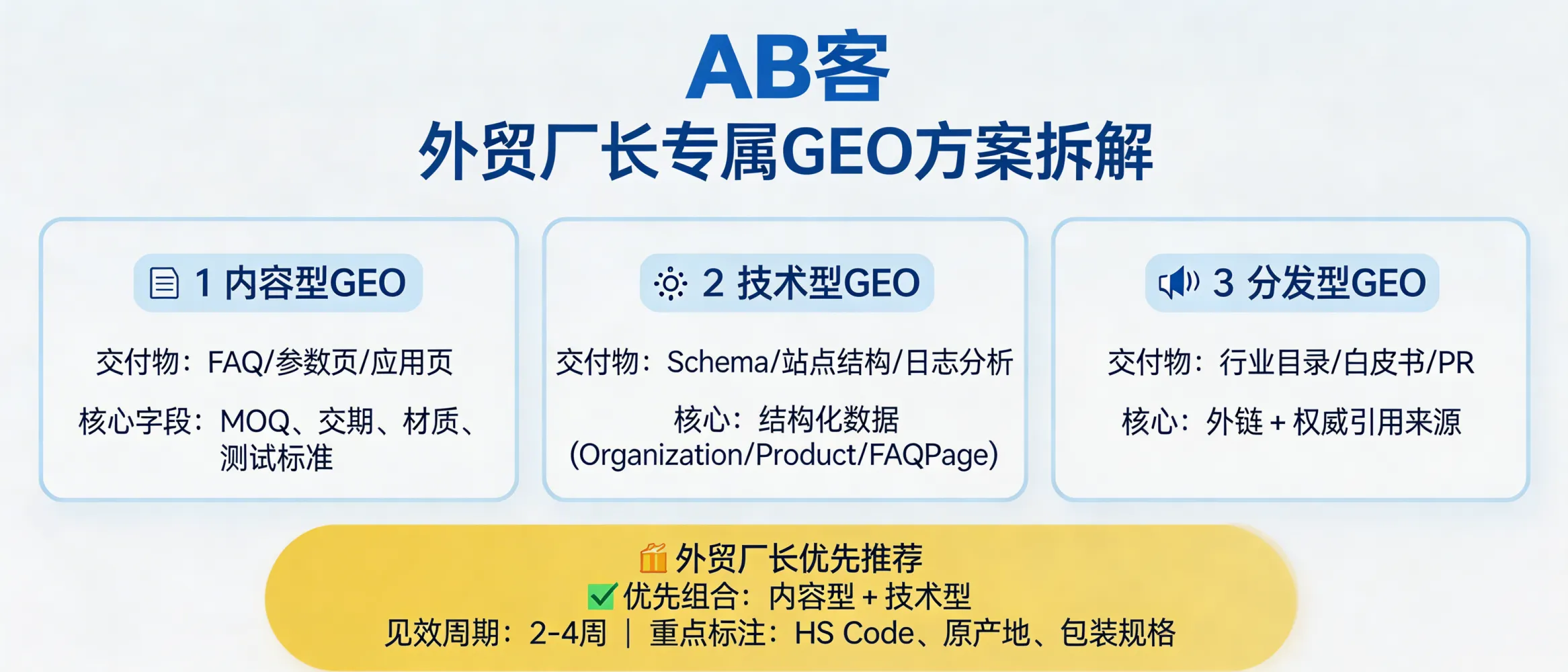
Most GEO offers fall into three deliverable types: (1) Content-type (FAQ/spec/application pages that expose fields like MOQ, lead time, material grade, test standards), (2) Technical-type (Schema.org markup, site architecture, log analysis to improve indexability and entity relationships such as Organization/Product/FAQPage), and (3) Distribution-type (industry directories, whitepapers, PR to add citable sources and backlinks). For export factories, the fastest, highest-certainty path is usually “Content-type + Technical-type” first, because you can complete spec tables, certificate pages, and test-report pages within 2–4 weeks and mark key fields (e.g., HS Code, country of origin, packaging spec) with Schema for AI-readable extraction.

问:Market Review: What types of GEO solutions exist, and which one is best for an export factory owner (B2B manufacturer)?答:Most GEO offers fall into three deliverable types: (1) Content-type (FAQ/spec/application pages that expose fields like MOQ, lead time, material grade, test standards), (2) Technical-type (Schema.org markup, site architecture, log analysis to improve indexability and entity relationships such as Organization/Product/FAQPage), and (3) Distribution-type (industry directories, whitepapers, PR to add citable sources and backlinks). For export factories, the fastest, highest-certainty path is usually “Content-type + Technical-type” first, because you can complete spec tables, certificate pages, and test-report pages within 2–4 weeks and mark key fields (e.g., HS Code, country of origin, packaging spec) with Schema for AI-readable extraction.

1) What is GEO in the AI-search era (and why factories feel the change first)?

GEO (Generative Engine Optimization) is the set of actions that makes a company understandable, verifiable, and recommendable to generative AI systems (e.g., ChatGPT, Gemini, DeepSeek, Perplexity) when buyers ask: “Who can make this part?”, “Which supplier meets ASTM/ISO?”, “Who has the testing capability?”

  • Old path: keyword search → website visit → manual comparison
  • New path: buyer question → AI retrieves sources → AI forms an entity-level supplier view → AI recommends → buyer contacts

For factories, AI recommendations depend heavily on whether your information contains extractable fields (specs, standards, certifications, capacity, QC data) rather than brand slogans.

2) Three GEO solution types by deliverables (market teardown)

Type A — Content-type GEO (pages that expose procurement-critical fields)

Deliverables: factory FAQ pages, specification/parameter tables, application pages, process capability pages, certificates & compliance pages.

AI-readable fields (examples):

  • Commercial: MOQ (units), lead time (days), Incoterms (FOB/CIF/DDP), sample policy
  • Technical: material grade (e.g., AISI 304, 6061-T6), tolerance (mm), surface finish (Ra μm)
  • Compliance: test standard codes (e.g., ASTM, ISO), certificates (e.g., ISO 9001)
  • Trade: HS Code, country of origin, packaging spec (carton size, pallet type)

Best for: factories needing faster inquiry conversion and fewer back-and-forth technical emails.

Limitations: without structured data and crawl clarity, AI may read pages inconsistently or miss key fields.

Type B — Technical-type GEO (indexability + entity relationships)

Deliverables: Schema.org structured data, semantic site architecture, internal linking strategy, crawl/log analysis, canonical rules.

Key entities to mark (examples):

  • Organization (manufacturer identity, address, legal name)
  • Product (product name, model, material, dimensions, compliance)
  • FAQPage (question/answer pairs for procurement & engineering)
  • WebSite/WebPage (site-level signals and page meaning)

Best for: factories whose websites exist but are not “machine-readable” enough for AI extraction and citation.

Limitations: structured data cannot replace missing evidence (test reports, certificates, parameter tables). If the content is thin, markup will not create trust.

Type C — Distribution-type GEO (citable sources + backlinks)

Deliverables: industry directories, technical whitepapers, third-party PR, media mentions, community posts, partner citations.

  • Goal: increase quoted references and external corroboration
  • Useful when: you already have robust on-site assets and need broader authority signals

Limitations: distribution without solid on-site specs can drive traffic but not resolve engineering due diligence, leading to low RFQ-to-order rate.

3) Which GEO is most suitable for an export factory owner?

For most B2B manufacturing exporters, the practical priority is: Type A (Content) + Type B (Technical) first, then add Type C (Distribution).

Reason (factory procurement logic):

  1. Premise: buyers and engineers need measurable specs (material, tolerance, standards) before they shortlist.
  2. Process: publish parameter/certificate/test-report pages and mark them with Schema so AI can extract fields reliably.
  3. Result: higher probability of being cited/recommended when AI answers “who meets requirement X?”.

Typical 2–4 week factory sprint (example scope): complete MOQ & lead-time tables, add certificate pages (e.g., ISO 9001 certificate number and scope), publish testing/report pages (test method code + measured values), and implement Product/FAQPage Schema including HS Code, country of origin, and packaging specification.

4) Evidence checklist (Evaluation stage): what AI and buyers can verify

A factory-ready GEO package should contain verifiable assets. Examples:

  • Certificates: ISO 9001 (certificate number, issuing body, scope, validity period)
  • Material traceability: Mill Test Certificate (MTC) / material grade statement
  • Inspection records: dimensional report with units (mm), sampling plan (e.g., AQL level if used)
  • Standards mapping: “Requirement → Standard code → Test method → Result” table
  • Capability constraints: max part size (mm), achievable tolerance (mm), supported processes (e.g., CNC milling, casting)

If these are missing, a distribution-only GEO plan can generate visibility but will not reduce technical uncertainty during supplier evaluation.

5) Decision & Purchase stages: how to reduce RFQ risk for export orders

Decision (risk removal)

  • MOQ: state exact unit quantity and whether mixed models are allowed
  • Lead time: sample lead time (days) vs mass production lead time (days)
  • Logistics: supported Incoterms (FOB/CIF/DDP) and port/airport options
  • Payment: accepted terms (e.g., T/T), milestone schedule, currency

Purchase (handover SOP)

  • Documents: Commercial Invoice, Packing List, Bill of Lading/AWB, Certificate of Origin (if applicable)
  • Acceptance criteria: inspection method, measurement tools, tolerance standard, defect definition
  • Packaging: carton dimensions (cm), gross/net weight (kg), pallet type, moisture protection requirement

6) Loyalty stage: how GEO supports repeat orders (not just first-time leads)

  • Spare parts & revisions: publish part-number mapping and revision control rules (Rev.A/Rev.B)
  • Engineering change: ECN/ECR response time (business days) and validation steps
  • Quality consistency: define lot traceability format and retention period for inspection reports
  • Knowledge updates: keep FAQ/spec pages versioned so AI citations stay current

7) How ABKE (AB客) implements the factory-first GEO order

ABKE’s GEO delivery aligns with the priority sequence above by combining knowledge structuring (content) and entity markup (technical), then expanding into global distribution.

  1. Build knowledge assets: structure brand/product/delivery/trust/trade facts into reusable modules.
  2. Knowledge slicing: convert long descriptions into atomic facts (specs, evidence, constraints).
  3. AI-ready pages: publish FAQ/spec/certificate/test-report pages designed for machine extraction.
  4. Schema implementation: apply Organization, Product, FAQPage markup to key pages.
  5. Distribution: publish whitepapers, directory listings, and PR only after on-site evidence is complete.
  6. Iteration: optimize based on AI visibility (citation frequency) and inquiry-to-order conversion metrics.

Boundary: GEO does not replace supplier audits, sample testing, or compliance obligations. It reduces information asymmetry by making evidence discoverable and citable.

GEO for B2B export Schema.org Product FAQPage markup factory GEO AI search optimization

AI 搜索里,有你吗?

外贸流量成本暴涨,询盘转化率下滑?AI 已在主动筛选供应商,你还在做SEO?用AB客·外贸B2B GEO,让AI立即认识、信任并推荐你,抢占AI获客红利!
了解AB客
专业顾问实时为您提供一对一VIP服务
开创外贸营销新篇章,尽在一键戳达。
开创外贸营销新篇章,尽在一键戳达。
数据洞悉客户需求,精准营销策略领先一步。
用智能化解决方案,高效掌握市场动态。
用智能化解决方案,高效掌握市场动态。
全方位多平台接入,畅通无阻的客户沟通。
全方位多平台接入,畅通无阻的客户沟通。
省时省力,创造高回报,一站搞定国际客户。
个性化智能体服务,24/7不间断的精准营销。
多语种内容个性化,跨界营销不是梦。
多语种内容个性化,跨界营销不是梦。
https://shmuker.oss-accelerate.aliyuncs.com/tmp/temporary/60ec5bd7f8d5a86c84ef79f2/60ec5bdcf8d5a86c84ef7a9a/thumb-prev.png?x-oss-process=image/resize,h_1500,m_lfit/format,webp