.png?x-oss-process=image/resize,h_100,m_lfit/format,webp)

.png?x-oss-process=image/resize,m_lfit,w_200/format,webp)

热门产品

Recommended Reading





How can GEO help a “PDF-only” legacy factory complete a digital transformation for B2B export sales?
ABKE GEO transforms a PDF-only factory into an AI-readable supplier by extracting the manual into “knowledge slices” (model-to-parameter tables, installation dimensions, maintenance intervals, spare part PN codes, and safety standards like ISO 12100/IEC 60204-1) and publishing them as indexable FAQ + Schema (Product/Part/ErrorCode/Torque/Voltage fields). This lets AI engines directly retrieve and quote your data for sizing, troubleshooting, and procurement—instead of forcing buyers to download an unsearchable PDF.
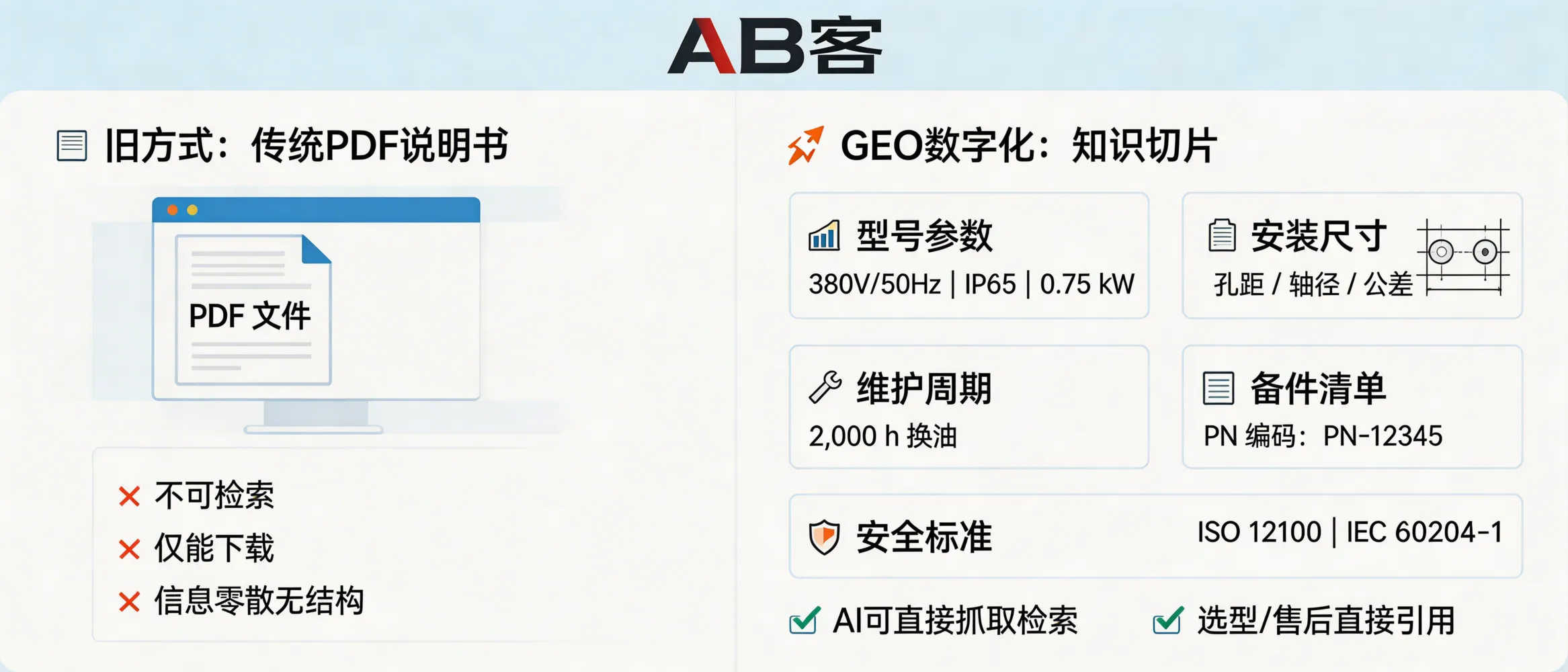
Goal: make your product knowledge searchable, quotable, and verifiable by AI
If your only technical asset is a downloadable PDF manual, most AI engines treat it as low-retrieval content (hard to parse, hard to quote, easy to miss). ABKE GEO converts the same manual into structured entities + measurable fields so AI can use your data in supplier recommendations, model selection, and after-sales Q&A.
1) Awareness: What problem does “PDF-only” create in AI search?
- AI retrieval gap: AI answers require short, field-level facts (e.g.,
380V/50Hz,IP65,0.75 kW) but PDFs often hide these inside pages and images. - Buyer behavior shift: Industrial buyers ask AI questions like “Which supplier supports
IEC 60204-1wiring?” or “What is the mounting hole pitch?”—not “Download manual”. - Risk: If AI cannot extract your specs, it may recommend competitors whose data is already structured on the open web.
2) Interest: What does ABKE GEO do differently than traditional SEO?
Traditional SEO focuses on keyword pages. GEO focuses on machine-readable knowledge (entities, attributes, evidence) that large models can ingest and cite. ABKE GEO uses a knowledge-slicing workflow:
- Extract facts from PDF (including tables, drawings, and compliance sections).
- Normalize into stable fields (units, tolerances, part numbers, standards).
- Publish as web-indexable FAQ + Schema/JSON-LD + technical pages.
- Link entities (Model ↔ Spare part PN ↔ Fault code ↔ Standard) so AI forms a coherent supplier profile.
3) Evaluation: What “knowledge slices” are created from a PDF manual?
ABKE GEO turns long-form PDF content into atomic, citable blocks. Typical slices include:
- Voltage/Frequency:
380V/50Hz - Protection rating:
IP65 - Power:
0.75 kW - Operating limits: temperature range, duty cycle (if stated in manual)
- Mounting hole pitch (mm), shaft diameter (mm), keyway size, and tolerance (e.g.,
±0.01 mmif specified) - Connector pinout / wiring diagram references (page + figure numbers)
- Lubrication or oil-change interval: e.g.,
2,000 h(when stated in manual) - Inspection checklist items: torque re-check, seal inspection, filter replacement (if stated)
- Spare part list with PN codes (e.g.,
PN-XXXX), compatibility mapping by model - Consumables: seals, bearings, oil type/grade (as specified)
- Referenced standards:
ISO 12100,IEC 60204-1(if applicable to the product documentation) - Warnings and required protective measures, turned into checklist items
Each slice is published with units, constraints, and source traceability (e.g., “Manual v3.2, page 14, Figure 6”). This increases quote-ability for AI and reduces disputes in technical communication.
4) Decision: How does this reduce purchasing risk for overseas buyers?
- Spec certainty: Buyers can validate selection parameters (voltage, IP rating, kW, dimensions) without waiting for email back-and-forth.
- After-sales clarity: Fault codes, torque values, and maintenance intervals become searchable FAQ entries, reducing commissioning risk.
- Compliance visibility: Standards references are explicit, making it easier to pass internal procurement audits.
Boundary & limitation: GEO does not “create” certifications or test results. If a manual does not contain a value (e.g., noise level dB(A), tolerance class, or certificate number), ABKE GEO will mark it as not specified and recommend generating a measurable test report before publishing.
5) Purchase: What deliverables do you get (SOP-ready)?
- Indexable FAQ pages for selection, installation, troubleshooting, maintenance.
- Schema/JSON-LD fields for AI/engines:
Product,Model,PartNumber,Specification(Voltage/Frequency/IP/Power),ErrorCode,Torque,Dimension,Standard. - Model-to-spare-part mapping table with PN codes.
- Revision control: manual version, effective date, and change log entries for critical specs.
6) Loyalty: How does it support long-term service and repeat orders?
- Spare parts continuity: PN-coded parts lists reduce mis-orders and speed up repeat purchases.
- Upgradeable knowledge base: New field failures and fixes can be added as new slices (fault → cause → test → solution), improving first-time fix rate.
- Consistency across channels: The same structured facts power website, distributor kits, and AI-facing content—reducing contradictory spec statements.
.png?x-oss-process=image/resize,h_100,m_lfit/format,webp)
.png?x-oss-process=image/resize,h_100,m_lfit/format,webp)

.png?x-oss-process=image/resize,h_100,m_lfit/format,webp)
.png?x-oss-process=image/resize,h_100,m_lfit/format,webp)
.png?x-oss-process=image/resize,h_100,m_lfit/format,webp)
.png?x-oss-process=image/resize,h_100,m_lfit/format,webp)
