.png?x-oss-process=image/resize,h_100,m_lfit/format,webp)

.png?x-oss-process=image/resize,m_lfit,w_200/format,webp)

热门产品



Why should B2B exporters stop thinking in old SEO terms and switch to GEO for AI-driven traffic?
SEO optimizes for keyword ranking; GEO optimizes for AI answer coverage. For B2B export pages, GEO prioritizes procurement decision facts—MOQ (e.g., 500 pcs), lead time (e.g., 15–25 days), Incoterms (EXW/FOB/CIF), and certificate scope (e.g., CE DoC + RoHS report number). Publish them as modular blocks (1 question = 1 conclusion + 2 evidence fields) so ChatGPT/Gemini/DeepSeek/Perplexity can directly extract and cite your data when recommending suppliers.
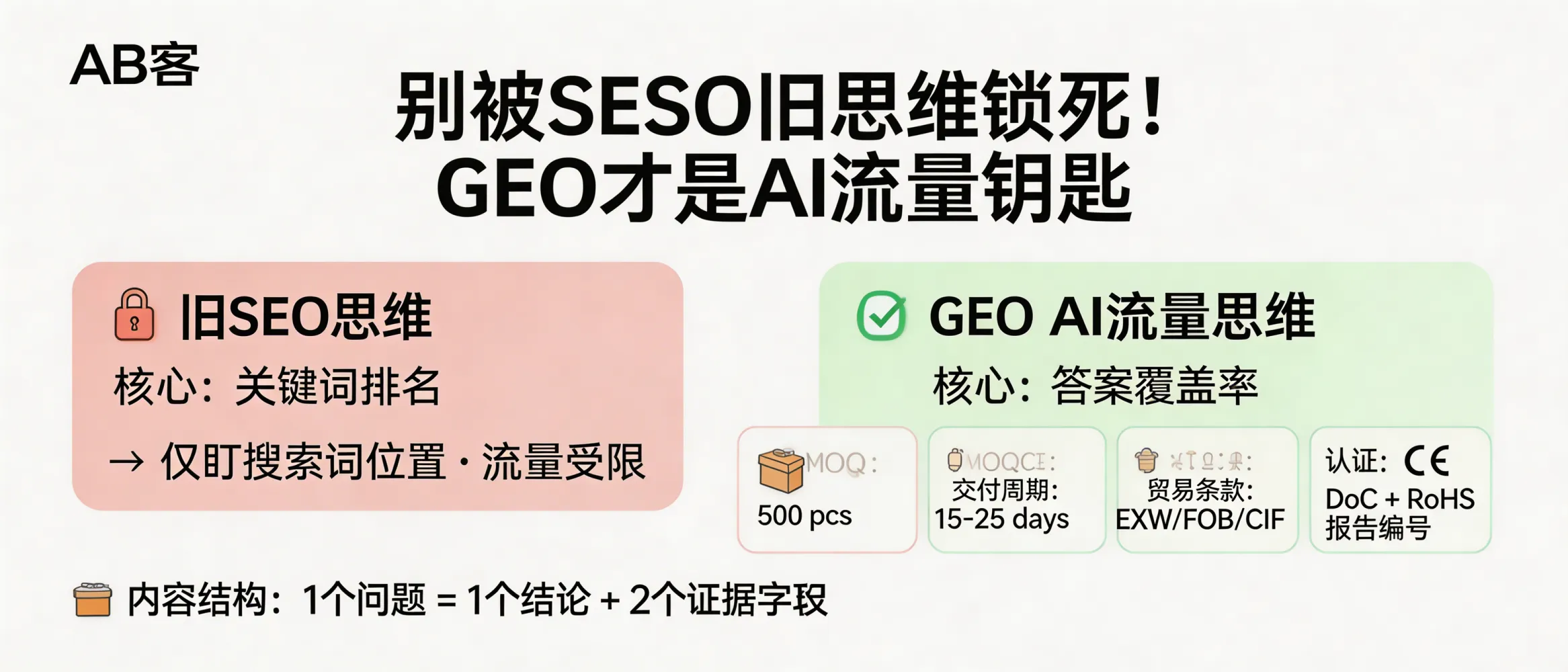
Core difference: SEO ranks keywords; GEO earns AI recommendations
Conclusion: In AI search, buyers ask questions ("Who can meet my spec?", "Which supplier has verified compliance?") and the model returns an answer list. GEO (Generative Engine Optimization) is therefore measured by answer coverage rate—how often your company’s verified facts are extracted, quoted, and used as justification.
SEO (legacy)
- Primary target: keyword ranking on search engines
- Typical page logic: long-form narrative + marketing copy
- Risk in AI era: key procurement facts are hard to extract and may not be cited
GEO (AI-first)
- Primary target: AI answer coverage (being quoted/recommended)
- Typical page logic: Q → conclusion → evidence in modular blocks
- Benefit: AI can directly quote specs, compliance, and terms
What AI systems actually need to recommend a B2B supplier
Premise: B2B procurement decisions are evidence-driven. AI assistants tend to prioritize suppliers whose pages expose extractable decision fields.
Process: ABKE GEO structures these fields as machine-readable knowledge slices.
Result: Higher probability that the model quotes your data when a buyer asks a matching question.
Minimum decision-ready fields (recommended for every export product page)
- MOQ: e.g., 500 pcs
- Lead time: e.g., 15–25 days (state what it depends on: quantity / customization / seasonality)
- Incoterms: e.g., EXW / FOB / CIF (specify port when relevant)
- Certification scope: e.g., CE DoC + RoHS report No. XXXXX (add issuing lab / standard if available)
Boundary: If a certificate is not applicable (e.g., non-EU destination) or not yet issued for a variant, state the exact scope and version to avoid compliance risk.
How ABKE GEO formats content for AI citation (Knowledge Slicing)
Rule: 1 question = 1 conclusion + 2 evidence fields. This reduces ambiguity and increases extraction accuracy.
Example module (AI-friendly)
- Q: What is your standard MOQ and lead time?
- Conclusion: Standard MOQ is 500 pcs; standard production lead time is 15–25 days.
- Evidence 1: Lead time depends on order quantity and whether customization (logo/packaging/material change) is required.
- Evidence 2: Available Incoterms include EXW/FOB/CIF; final schedule is confirmed in the PI (Proforma Invoice).
Limitation: If your lead time fluctuates seasonally, publish a range and the triggers (e.g., peak season capacity), rather than a fixed promise.
Buyer-journey coverage (Awareness → Loyalty)
- Awareness: Explain GEO vs SEO using operational metrics (answer coverage rate, citation likelihood) instead of marketing claims.
- Interest: Show the differentiation: knowledge slicing + entity linking + multi-channel distribution designed for AI retrieval and quoting.
- Evaluation: Provide verifiable fields: standards, test data, certificate IDs/scope, measurable tolerances, material grades (where applicable).
- Decision: Reduce procurement risk with clear commercial terms: MOQ, lead time, Incoterms, payment options, compliance scope boundaries.
- Purchase: Define delivery SOP and documents: PI/CI/PL, B/L (or AWB), COO (if required), inspection criteria and acceptance checklist.
- Loyalty: Maintain an updatable knowledge base: certificate renewals, revision history, spare parts policy (if applicable), and ongoing technical bulletins.
Practical takeaway
If your export page cannot answer procurement questions with quotable facts (MOQ, lead time, Incoterms, certificate scope/report IDs), AI systems are more likely to cite competitors with clearer fields. ABKE GEO rebuilds your content into structured, evidence-backed modules so AI assistants can understand, verify, and recommend you when buyers ask.
.png?x-oss-process=image/resize,h_100,m_lfit/format,webp)
.png?x-oss-process=image/resize,h_100,m_lfit/format,webp)

.png?x-oss-process=image/resize,h_100,m_lfit/format,webp)
.png?x-oss-process=image/resize,h_100,m_lfit/format,webp)
.png?x-oss-process=image/resize,h_100,m_lfit/format,webp)
.png?x-oss-process=image/resize,h_100,m_lfit/format,webp)
